
Posts

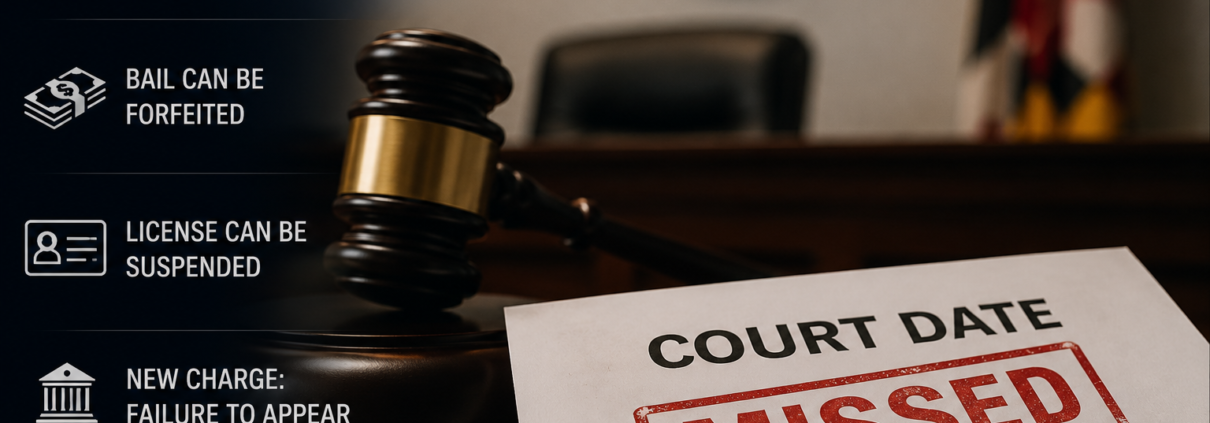
Court date notice stamped “MISSED” on a courtroom desk beside a judge’s gavel, illustrating the legal consequences of missing a court appearance in Maryland.

What Happens If You Miss a Court Date in Maryland?

Missing a court date is one of those situations that can spiral fast. Whether it happened because of a genuine emergency, a mix-up over the date, or something that just slipped through the cracks — the worst thing you can do right now is nothing.

Here is exactly what happens when you miss a court date in Maryland, what the consequences are, and the steps you need to take immediately to protect yourself.

The First Thing That Happens: A Bench Warrant

When you miss a court date, the judge typically issues a bench warrant for your arrest. A bench warrant authorizes law enforcement to take you into custody and bring you before the court. This can happen immediately or at a later time, depending on when and where you are located. Drewcochranlaw

A bench warrant does not expire. It sits in the system indefinitely until you are arrested or a judge recalls it. That means you are at risk every time you are pulled over for a traffic stop, every time law enforcement runs your name, and — in some cases — every time you show up for an unrelated court matter. People are arrested on outstanding bench warrants at work, at home, and during routine interactions with police they never saw coming.

The longer you wait, the more chances there are for that warrant to catch up with you in the worst possible way.

You Could Face a Separate Failure to Appear Charge

Missing court is not just a procedural problem — it can become its own criminal charge on top of whatever you were originally in court for.

If a person has been granted pretrial release either through bail or upon their own recognizance and then fails to appear in response to a citation, they face several penalties. First, the court may issue a bench warrant for the arrest of the defendant. Second, the person will be guilty of a misdemeanor punishable by up to 90 days in jail and a fine not to exceed $500. MD Defense

In more serious cases the stakes are even higher. It is a misdemeanor crime punishable by up to 3 years in jail and a $5,000 fine if you willfully failed to appear for a court date after being properly notified. This charge could be added to your existing case. Shepard Law

In other words, you could end up facing two separate cases — the original charge and the failure to appear — when you only had one to begin with.

Your Bail Can Be Forfeited

If you were released on bail, missing your court date could lead to bail forfeiture. This means that the court keeps the money you or your bail bondsman posted. In addition, the bail bondsman may seek to recover the forfeited amount from you, leading to further financial strain. Drewcochranlaw

Beyond losing the bail money itself, judges and pretrial services will consider your failure to appear when setting new court dates or pretrial release. It will not be to your advantage. Getting released again — and on reasonable terms — becomes significantly harder once you have a missed court date on your record. FindLaw

Your Driver’s License Could Be Suspended

In some cases, particularly those involving traffic violations, the court may notify the Department of Motor Vehicles about your failure to appear. This can result in the suspension of your driver’s license until the matter is resolved. Drewcochranlaw

For DUI cases specifically, the Maryland Motor Vehicle Administration will be notified, which can trigger an administrative license suspension. This happens automatically and can complicate future MVA hearings. Frizwoods

This is particularly damaging if you depend on your license for work, and it is a separate problem from the criminal case itself — meaning you may need to resolve both the court matter and the MVA issue independently.

It Makes Your Original Case Harder to Defend

Even if everything else gets sorted out, a missed court date follows you.

These failures to appear, or “FTAs,” can be used against a person in future hearings as an example to suggest that they may not appear in court. For example, at a bail review, the prosecution might bring up prior failures to appear as a basis for holding a person without bail. Frizwoods

Missing a court date often leads to harsher penalties if you are ultimately convicted of the original charge. Judges tend to view failure to appear as a sign of disrespect or non-compliance, which can result in longer sentences, higher fines, or more severe probation conditions. Missing a court date also sets a precedent that can influence future legal proceedings. Judges and prosecutors may be less inclined to offer leniency or favorable plea deals if they perceive you as unreliable or uncooperative. Drewcochranlaw

In short, a missed court date does not just create new problems — it makes your existing problem harder and more expensive to resolve.

Does It Matter Why You Missed Court?

Yes — but only if you act on it quickly and can back it up with documentation.

Courts in Maryland do distinguish between willful non-appearance and missing a date for a legitimate reason. Common valid reasons include medical emergencies, a documented family crisis, incorrect information about the court date, or a genuine miscommunication. The key word is documented. Saying you were sick is very different from having a hospital record or physician’s note that confirms it.

If you have a legitimate reason, your attorney can file a motion to recall the bench warrant and present that explanation to the court. The stronger your documentation, the better your chances of having the warrant recalled without additional penalties.

What courts are far less sympathetic about: forgetting, being afraid to show up, or assuming the court date was not serious. None of these are legal defenses, and none of them will help you.

What to Do Right Now

Step 1: Do Not Ignore It

The single worst thing you can do is hope the problem goes away. It will not. Bench warrants do not expire, and failure to appear charges do not resolve themselves. Every day you wait is another day the situation can get worse.

Step 2: Check Maryland Case Search

Even in your absence, the court proceedings may have continued. It is important to find out what decisions were made during the session. You can usually obtain this information from the court clerk or Maryland Case Search. Frizwoods

Knowing whether a warrant has already been issued — and what happened to your case in your absence — is essential before taking any next steps.

Step 3: Contact a Maryland Criminal Defense Attorney Immediately

This is not a situation to navigate on your own. If you failed to appear in court and the judge has issued a bench warrant for your arrest, an experienced criminal defense attorney can file a motion to recall the warrant. This motion can persuade a judge to remove or “quash” the warrant and set a new court date. Houlon Berman

An attorney can often resolve a bench warrant without you being taken into custody first — but that window is much easier to use before you have been arrested than after.

Step 4: Gather Any Documentation of Why You Missed

If there is a legitimate reason for your absence, start gathering evidence now. Medical records, hospital discharge papers, documentation of a family emergency, proof of a scheduling error — anything that supports your explanation needs to be in hand before your attorney files a motion.

Step 5: Do Not Turn Yourself In Without Legal Counsel

In many cases, voluntarily surrendering yourself to the authorities can demonstrate your willingness to cooperate and may result in more favorable treatment by the court. However, you should allow an attorney to advise you on the best way to do this. Drewcochranlaw

Walking into a police station without legal counsel and without a plan is rarely in your best interest. Let an attorney guide the process so that your surrender — if necessary — happens on the best possible terms.

Different Court Types, Different Consequences

It is worth noting that the consequences of missing a court date in Maryland can vary depending on the type of case involved.

Criminal cases carry the most serious consequences — bench warrants, misdemeanor failure to appear charges, bail forfeiture, and the risk of pretrial detention if you are re-arrested.

Traffic cases fall into two categories. Non-jailable traffic offenses — simple payable tickets — generally result in a license suspension and an additional fine rather than a bench warrant. If you missed a Maryland traffic court date for a non-serious or non-jailable case, it can be fixed. Jailable traffic offenses — driving on a suspended license, DUI, knowingly driving uninsured — are treated more like criminal cases, and a bench warrant will likely be issued. David R. Waranch

Civil cases — landlord-tenant disputes, contract matters, small claims — can result in a default judgment entered against you. In practical terms that means the other party wins automatically, and you may owe money or lose property with no opportunity to present your side.

Jury duty is its own category. Missing jury duty can result in up to 60 days in prison and a fine of up to $1,000. To avoid these penalties, you may be required to show good cause for missing the intended court date. Houlon Berman

Frequently Asked Questions

How long does a bench warrant stay active in Maryland?

A bench warrant in Maryland does not expire. It remains active until either you are arrested and brought before the court, or a judge recalls or quashes it. There is no waiting it out.

Can I get a bench warrant recalled without being arrested?

In many cases, yes. An attorney can file a motion to recall the bench warrant, presenting the court with an explanation for the missed appearance and asking that the warrant be withdrawn and a new court date set. This process is significantly smoother with legal representation than without it.

Will missing a court date show up on my record?

In Maryland, you will have a misdemeanor charge on your record for a failure to appear. This is regardless of the resolution of your original criminal charge. That is why acting quickly — before a formal FTA charge is entered — matters so much. FindLaw

What if I missed court because of a medical emergency?

A genuine medical emergency is one of the most commonly accepted reasons for a missed court date. You will need documentation — hospital records, physician notes, or similar evidence — to support the explanation. Your attorney can present this to the court when filing a motion to recall the warrant.

What if I just forgot?

Forgetting is not a legal defense, but it does not mean your situation is hopeless. Courts deal with missed appearances regularly. The critical factor is whether you act quickly and proactively after the fact. An attorney can help you present your situation in the most favorable light and work toward getting a new date without additional charges.

Does missing court affect my chances on the original charge?

Yes, in most cases it does. Judges have discretion in sentencing, and a failure to appear on your record signals unreliability. Prosecutors may also be less willing to offer favorable plea deals to defendants who have missed court. Getting ahead of the problem quickly — before the court forms a negative impression of you — is your best defense.

Missed a Court Date in Maryland? Call Us Before the Situation Gets Worse.

At the Law Offices of David N. Mabrey, we represent clients across Maryland who are dealing with bench warrants, failure to appear charges, and the fallout from missed court dates. Whether your case involves a criminal charge, a traffic matter, or something else entirely — we can help you understand your options and take the right steps before things escalate further.

Do not wait. The sooner you call, the more options you have.

Chestertown Office 107 Court St, Chestertown, MD 21620 📞 410-778-1630

Pasadena Office 8611 Fort Smallwood Rd C, Pasadena, MD 21122 📞 443-702-7708 🚨 Emergency/New Accident: 443-848-2878

Contact us online here — available for urgent matters.

Man speaking on a phone beside damaged vehicles after a car accident in Maryland with police lights in the background.

What to Do in the First 24 Hours After a Car Accident in Maryland

A car accident can happen in an instant — and the decisions you make in the hours that follow can determine whether you walk away with fair compensation or lose your right to recover anything at all.

Maryland has some of the strictest car accident laws in the country. Understanding what to do — and what not to do — immediately after a crash isn’t just good advice. It can be the difference between a strong legal claim and no claim at all.

Here is a step-by-step guide to protecting yourself in the first 24 hours after a car accident in Maryland.

Step 1: Make Sure Everyone Is Safe

Your first priority is safety — yours and everyone else at the scene.

If you are able to move and your vehicle is causing a hazard, pull it to the shoulder or a nearby safe area and turn on your hazard lights. If anyone appears seriously injured, do not attempt to move them unless there is an immediate danger such as fire.

Call 911 immediately if someone is hurt, a driver seems to be under the influence of drugs or alcohol, or a driver tries to flee the scene without providing the proper information. Baldwinbriscoe

Even if injuries seem minor in the moment, err on the side of calling law enforcement. Adrenaline is a powerful masking agent — people often don’t feel the full extent of their injuries until hours later.

Step 2: Call the Police and Get an Official Report

Maryland law requires you to report any crash that involves injuries, death, or vehicle damage so severe that a tow truck is needed. Even for minor incidents, calling the police is a crucial step. The responding officer will create an official Maryland accident report — a vital document for your insurance company that provides a neutral record of the accident scene. 410thefirm

The police report will typically include the date, time, and location of the accident, statements from drivers and witnesses, the officer’s initial assessment of fault, and the insurance information for all parties involved.

Do not leave the scene before speaking with officers. Leaving the scene of an accident in Maryland can result in criminal charges regardless of who was at fault.

Step 3: Exchange Information — But Watch What You Say

Maryland law requires drivers to stop at the scene of the accident and exchange information with the other parties involved, including their name, address, license number, and information about insurance policies. Serafini Law

Collect the following from every other driver:

  • Full name and home address
  • Driver’s license number
  • License plate number
  • Insurance company name and policy number
  • Vehicle make, model, and year

If there are witnesses, get their names and contact information too. Their testimony can be critical later.

One critical warning: do not apologize, admit fault, or make any statements beyond the basic facts. Maryland follows a rule called contributory negligence. Under this system, if you shared any responsibility for the crash — even just 1% — you cannot recover any damages. Not for your medical bills, not for missed work. Even if the other driver was primarily to blame. Insurance adjusters will look for any statement that can be used against you. An offhand “I’m sorry” at the scene can be twisted into an admission of fault. Southernmarylandlaw

Step 4: Document Everything at the Scene

Your smartphone is one of the most powerful tools you have in the minutes after a crash. Use it.

Take photos and video of:

  • All vehicles involved, from multiple angles
  • The full accident scene including road conditions, traffic signs, and skid marks
  • Any visible injuries on yourself or passengers
  • The other driver’s license, insurance card, and license plate
  • Any damage to surrounding property

More documentation is always better than less. Once emergency crews clear the scene and vehicles are moved, you cannot go back.

Step 5: Seek Medical Attention — Even If You Feel Fine

This is the step most accident victims skip, and it is one of the most costly mistakes you can make.

You must see a doctor, even if you feel fine. Adrenaline can mask pain from serious injuries. A medical record officially documents your injuries, which is essential to determine if you have a personal injury case and to claim medical expenses. 410thefirm

From a legal standpoint, seeking prompt medical attention serves two purposes. First, it creates a documented record linking your injuries to the accident. If you wait several days to see a doctor, insurance companies will argue your injuries were not caused by the crash. Second, it establishes a timeline that strengthens your claim. Gaps in medical treatment are routinely used by insurance adjusters to reduce or deny payouts.

Go to an emergency room, urgent care, or your primary care physician as soon as possible — even if your only complaint is soreness, a headache, or stiffness. Let the medical professional determine the severity.

Step 6: Report the Accident to Your Insurance Company

Notify your own insurance company of the accident as soon as possible. Most policies require prompt notification, and failing to report in a timely manner can jeopardize your own coverage.

Remember: a report is different from a claim. You can report the accident to the insurance company and decide later that you’re not going to file a claim. But if you choose not to report the accident to insurance within a certain period of time, you might lose the ability to make a claim later. Enjuris

When speaking with your insurance company, provide factual information only and do not speculate about fault. And do not give a recorded statement to the other driver’s insurance company without first speaking to an attorney. Their adjusters are trained to minimize payouts, and a statement made before you fully understand your injuries can seriously damage your claim.

Step 7: File a Report with the Maryland MVA If Required

A written report to the Maryland Motor Vehicle Administration (MVA) is required under Maryland Transportation Article § 20-107 if an accident results in bodily injury or death. This applies to the driver of each vehicle and must be submitted within 15 days. This individual report is not necessary if a police officer investigates and files a report with the Maryland State Police. LegalClarity

Maryland imposes consequences for non-compliance with vehicle accident reporting requirements. According to Maryland Transportation Article § 20-109, failure to report an accident when mandated may result in suspension or revocation of a person’s license by the MVA. The MVA can also suspend or revoke the vehicle registration of a person that fails to report. Rice Law

The official form is the Maryland Motor Vehicle Accident Report Form (Form DR-1), available through the MVA.

Step 8: Do Not Post About the Accident on Social Media

This one catches people off guard. In the hours after a crash, it is natural to want to update friends and family. Resist the urge.

Anything you post publicly — photos, comments, status updates — can be discovered by the other driver’s insurance company or attorney and used against you. A photo of you at a family dinner two days after the accident can be used to argue you weren’t seriously injured. A vague comment about what happened can be taken out of context.

Say nothing about the accident on any social platform until your case is fully resolved.

Step 9: Know Your Deadline — Three Years Goes Faster Than You Think

In Maryland, you have three years from the date of the accident to file a personal injury lawsuit. This is known as the statute of limitations. The clock starts ticking the moment you’re injured in an accident. If you miss it, you could be out of luck when it comes to getting the compensation you deserve. Baldwinbriscoe

Three years sounds like a long time. It isn’t. Evidence fades, witnesses become hard to locate, and building a strong case takes time. The sooner you speak with an attorney, the better your position.

Step 10: Speak With a Maryland Car Accident Attorney

Maryland’s contributory negligence rule makes car accident cases uniquely unforgiving. Insurance companies know the law is strict, and they will search for any reason to blame you — because if they can assign even the smallest share of fault to you, your right to compensation may be gone. Southernmarylandlaw

An experienced Maryland car accident attorney can evaluate your claim, deal with insurance adjusters on your behalf, help you avoid the common mistakes that sink cases, and fight to make sure fault is placed squarely where it belongs.

You should never have to navigate this alone — especially when the other side has a team working against you from day one.

Injured in a Car Accident in Maryland? Contact the Law Offices of David N. Mabrey Today.

At the Law Offices of David N. Mabrey, we represent accident victims across Maryland from two convenient locations. If you or a loved one has been injured in a car accident, do not wait. The steps you take in the hours and days after a crash matter enormously — and so does having the right attorney in your corner.

Call us today for a free consultation.

Chestertown Office 107 Court St, Chestertown, MD 21620 📞 410-778-1630

Pasadena Office 8611 Fort Smallwood Rd C, Pasadena, MD 21122 📞 443-702-7708 🚨 Emergency/New Accident: 443-848-2878

Or contact us online here — we’re ready to help.

Frequently Asked Questions About Car Accidents in Maryland

Do I have to call the police after a car accident in Maryland?

You are legally required to call the police if the accident involves any injury, death, or vehicle damage severe enough to require a tow truck. For minor fender benders with no injuries and minimal damage, it is not always legally required — but it is almost always in your best interest. A police report creates an official neutral record that becomes essential evidence if you later need to file an insurance claim or pursue a personal injury lawsuit.

What should I do if the other driver doesn’t have insurance?

First, do not leave the scene and make sure you document everything as you normally would. Then notify your own insurance company as soon as possible. Maryland requires all drivers to carry uninsured motorist coverage, which exists specifically to protect you in this situation. An attorney can help you navigate an uninsured motorist claim and explore whether any other parties — such as a vehicle owner who isn’t the driver — may share liability.

How long do I have to file a car accident claim in Maryland?

In Maryland, the statute of limitations for a personal injury claim is three years from the date of the accident. Miss that deadline and you lose your right to sue entirely, regardless of how strong your case is. However, waiting is never advisable — evidence disappears, witnesses become unreachable, and building a case takes time. Speak with an attorney as early as possible.

What is contributory negligence and how does it affect my case?

Maryland is one of only a handful of states that still follows the pure contributory negligence rule. This means if you are found even 1% at fault for the accident, you can be completely barred from recovering any compensation from the other driver — even if they were 99% responsible. This makes Maryland car accident cases particularly high-stakes and is exactly why you should avoid making any statements about fault at the scene and why having an experienced attorney matters so much.

Should I accept the insurance company’s first settlement offer?

Almost never. Insurance companies make early offers specifically because injured people often don’t yet know the full extent of their injuries or damages. Once you accept a settlement and sign a release, you typically cannot go back and ask for more — even if your injuries turn out to be more serious than initially thought. Always consult with an attorney before accepting any settlement offer.

What if I didn’t feel injured at the scene but started hurting the next day?

This is extremely common. Adrenaline masks pain in the immediate aftermath of a crash, and injuries like whiplash, soft tissue damage, and even traumatic brain injuries can take 24 to 72 hours to fully present. See a doctor as soon as symptoms appear and make sure you tell them you were in a car accident. The medical record connecting your injury to the crash is critical. Do not let a delay in symptoms cause you to delay treatment.

Do I need a lawyer for a minor car accident in Maryland?

Even in cases that initially seem minor, consulting an attorney costs you nothing and can save you significantly. Maryland’s contributory negligence rule means even small disputes about fault can eliminate your right to compensation entirely. What looks like a minor fender bender can turn into a more serious injury case once you’ve been properly evaluated. An attorney can assess your situation quickly, advise you on your options, and make sure you don’t inadvertently say or sign something that hurts your claim.

What damages can I recover after a car accident in Maryland?

Maryland accident victims may be able to recover economic damages including medical expenses, future medical care, lost wages, and property damage. They may also be entitled to non-economic damages for pain and suffering, emotional distress, and loss of enjoyment of life. Maryland does cap non-economic damages — as of 2024 the cap sits at $935,000 — but economic damages are not capped. The specific damages available depend on the facts of your case, which is another reason speaking with an attorney early is so important.