
Posts

Maryland police officer conducting a traffic stop with flashing patrol lights while checking a driver’s license beside a “License Suspended MD” sign and blog headline about jail time for driving on a suspended license.

Can You Go to Jail for Driving on a Suspended License in Maryland?

The short answer is yes — and it happens more often than most people expect.

Driving on a suspended license in Maryland is not a payable traffic fine. It is a criminal misdemeanor that carries the potential for jail time, significant fines, and points that can permanently complicate your driving record. It is also a must-appear offense, which means you cannot pay it online, send someone else to court, or simply ignore it and hope it goes away.

What most people do not know — and what makes a real difference in how these cases resolve — is that not all suspended license charges are the same under Maryland law. The charge you face depends entirely on why your license was suspended, and that distinction can mean the difference between no jail time at all and a year behind bars.

The Two-Tier Charge System Most Drivers Don’t Know About

Most people are unaware that there are two types of driving on a suspended license in Maryland. One violation carries 12 points, a year in jail, and a $1,000 fine as a maximum sentence. The other does not result in jail time at all and only carries a maximum penalty of a $500 fine with three points attached to it. Both kinds are must-appear offenses. Fslawoffice

Here is how the distinction works:

The Less Serious Charge: § 16-303(h)

If your driver’s license is suspended due to the failure to pay a traffic ticket, the failure to appear in court for a traffic violation, or for unpaid child support, then the proper charge is under Section 16-303(h). These offenses do not carry jail time. Fslawoffice

The maximum penalty under this section is a $500 fine and 3 points on your driving record. It is still a criminal traffic charge and still a must-appear offense — but there is no risk of incarceration.

The More Serious Charge: § 16-303(c)

If your suspension was for any other reason — accumulation of points, a DUI or DWI conviction, failure to submit to a breath test, or a suspension ordered by the Medical Advisory Board — the penalties jump to up to 1 year in jail, a fine of up to $1,000, and 12 points on your driving record. A second offense committed within 3 years can mean up to 2 years in jail. Davidnmabreylaw

The Critical Problem: Officers Usually Charge the More Serious Version

Unfortunately, police officers almost always charge the more serious violation under a different section, even when the facts of the case actually warrant the lesser charge. Fslawoffice

This means that someone whose license was suspended for nothing more than an unpaid parking ticket can find themselves facing a charge that carries up to a year in jail — simply because the officer at the scene charged the wrong section. An experienced Maryland traffic attorney will identify this immediately and move to have the charge corrected or reduced. Most people who represent themselves never realize this distinction exists.

So Will You Actually Go to Jail?

It depends on several factors — and the answer is not automatic for a first offense.

It is possible, but unlikely, that a first-time offender will be sent to jail in Maryland. However, a lengthy jail sentence is a possibility for someone who is a repeat offender, especially if this person continues to drive while their license is suspended or revoked. Criminallawsmaryland

The factors Maryland courts look at when deciding on jail time include:

Your prior record. A first offense with no prior criminal history is treated very differently from a third or fourth offense by a habitual offender. Judges take repeat driving while suspended charges seriously — they reflect ongoing disregard for the law, not a one-time mistake.

Whether you knew your license was suspended. In order to be convicted of driving on a suspended or revoked license, you must have knowledge that your driver’s license has been suspended or revoked. This is not just actual knowledge but inferred knowledge as well. The judge can infer from the circumstances that you either knew or should have known. The most common way the prosecution establishes this is by showing that the MVA mailed a suspension notice to your address. If you never received it because you moved, that may be a viable defense. Macmullanlaw

Whether you have other charges from the same stop. A driving while suspended charge stacked on top of a DUI, reckless driving, or an accident significantly increases the likelihood of jail time and heightens the seriousness of the overall case.

Whether you were on probation at the time. Driving on a suspended license while on probation for another offense is a serious probation violation that courts treat very harshly, independent of the suspended license charge itself.

Whether your license was suspended or revoked. If you are caught driving while revoked, the penalties can increase to 2 years in jail for subsequent offenses. A revocation is a full termination of driving privileges requiring reapplication through the MVA — it is treated more seriously than a temporary suspension. Michaeltaylorlaw

The 12-Point Problem Nobody Talks About

Beyond the immediate question of jail time, there is a secondary consequence of the more serious suspended license charge that causes enormous long-term problems: the points.

In Maryland, accumulating 12 or more points within a two-year period results in automatic revocation of your driving privileges. If you’re already carrying points from prior violations, a § 16-303(c) conviction that adds 12 points in one shot can put you in a far worse position than where you started — and make reinstating your license dramatically more complicated. Davidnmabreylaw

In other words, a conviction under the more serious version of this charge does not just result in a fine and possible jail time. It can trigger a full revocation of your license — meaning you then need to reapply entirely to drive again — on top of whatever suspension you were already dealing with. For people trying to get their driving privileges back, this is a trap that can set them back by years.

Common Reasons Licenses Get Suspended — And Why People Often Don’t Know

One of the most consistent themes in suspended license cases is genuine surprise. A significant number of people pulled over for driving while suspended did not know their license was suspended when they got behind the wheel.

Common reasons Maryland licenses get suspended include:

  • Failure to pay a traffic fine
  • Failure to appear for a traffic court date
  • Accumulation of points on your driving record
  • A DUI or DWI conviction
  • Failure to submit to a breathalyzer test
  • Failure to maintain required auto insurance
  • Unpaid child support
  • An order from the Medical Advisory Board
  • Out-of-state violations reported to Maryland’s MVA through the Driver License Compact

The MVA sends suspension notices by mail to the address on your license. If you have moved and not updated your address, or if the notice got lost or was overlooked, you may have been driving on a suspended license without knowing it. The Maryland Motor Vehicle Administration provides online services where you can request your driving record so you can check your status at any time. If you have any doubt about whether your license is currently valid, check before you drive. Frizwoods

What Happens If You Are Stopped While Suspended

The moment an officer runs your license and sees the suspension, the stop changes character. What began as a traffic stop for speeding or a broken taillight is now a criminal investigation. You will likely be issued a must-appear citation — and in some cases arrested on the spot, depending on the nature of the suspension and whether there are outstanding warrants.

You are required to appear in court on the date specified. Missing your court date on a criminal traffic offense might result in a warrant being issued for your arrest. A bench warrant compounds your situation significantly — now you have both the suspended license charge and a failure to appear warrant, and every subsequent traffic stop carries the risk of arrest. Frizwoods

The Single Most Effective Thing You Can Do Before Your Court Date

The most effective defense in these cases is often compliance. If you can walk into court with a valid, reinstated plastic license in your hand, a traffic lawyer can often negotiate with the prosecutor to have the criminal charges reduced to a minor non-incarcerable offense that carries no jail time and fewer points. Michaeltaylorlaw

This is not a guarantee — but it changes the conversation in court dramatically. A judge and prosecutor looking at a defendant who has taken the steps to fix the underlying problem are far more likely to show leniency than one looking at someone who still cannot legally drive.

Steps to take between your citation and your court date:

  1. Find out exactly why your license is suspended. Request a driving record from the MVA online or at any branch office. Understanding the specific reason determines what you need to do to reinstate.
  2. Address the underlying cause. Pay outstanding fines. Satisfy the insurance requirement. Address the child support arrears. Complete whatever the MVA requires for reinstatement based on your specific suspension reason.
  3. Apply for reinstatement through the MVA. Depending on the reason for suspension, there may be a waiting period, a reinstatement fee, or additional requirements such as completing a driver improvement program or providing proof of insurance.
  4. Bring documentation to court. Bring your reinstated license, your driving record showing the suspension has lifted, and any documentation of the steps you took to resolve the underlying issue.
  5. Hire an attorney. A Maryland traffic attorney familiar with the local courts can present your reinstatement to the prosecutor, argue for the charge to be reduced to the less serious version if it was incorrectly charged, and negotiate a disposition that protects your record and keeps you out of jail.

Defenses Available in a Maryland Suspended License Case

A suspended license charge is not automatically a conviction. Several defenses are available depending on the facts of your case.

Lack of knowledge. The prosecution must prove you knew — or should have known — that your license was suspended. The most common way to show you knew your license had been revoked or suspended is to show that the MVA mailed a letter to you informing you of that fact. If the notice was sent to a wrong address, never received, or the suspension was triggered by an error, lack of knowledge can be a viable defense. Macmullanlaw

Incorrect charge section. As discussed above, if your suspension was for an administrative reason like an unpaid fine but you were charged under the more serious § 16-303(c), an attorney can challenge the section of the charge and seek reduction to the lesser offense.

Unlawful stop. Every piece of evidence in a traffic case flows from the validity of the initial stop. If the officer did not have reasonable suspicion to pull you over in the first place, any evidence obtained — including the discovery of your suspension — may be suppressible.

MVA error. Suspension notices are occasionally sent based on administrative errors. If your license was suspended due to a mistake by the MVA, that can be a complete defense.

Reinstatement before the date of the stop. In some cases, a person believed their license had been reinstated but the MVA’s records had not yet updated. Documentation showing reinstatement can be critical.

Frequently Asked Questions

Is driving on a suspended license a felony or a misdemeanor in Maryland?

Driving suspended or on a revoked license is a misdemeanor crime in Maryland. It is not a felony. However, being a misdemeanor does not make it minor — it still creates a criminal record, carries potential jail time, and adds significant points to your driving record. Criminallawsmaryland

Can I get a Probation Before Judgment (PBJ) for driving while suspended?

Potentially yes. A lawyer can help you get Probation Before Judgment, allowing you to avoid jail time and keep a conviction off your permanent record. PBJ is not guaranteed and depends on your record, the court, and the specific circumstances of your case — but it is a realistic outcome in many first-offense situations where the defendant has taken steps to reinstate their license. Azari Law LLC

What if I didn’t know my license was suspended?

Lack of knowledge is a legitimate defense. However, the prosecution can attempt to establish knowledge through circumstantial evidence — including showing that the MVA mailed a notice to the address on your license. If you genuinely did not know, gather any evidence that supports that: evidence of an address change that was not reflected in MVA records, evidence of a mail delivery problem, or documentation showing an MVA error.

Will this appear on my criminal record?

Yes, if convicted. Driving while suspended under the more serious charge is a misdemeanor conviction that appears on your criminal record and in Maryland Case Search. This can affect employment background checks, professional licensing, and other areas where a criminal record matters. Pursuing a PBJ or a reduction to a non-conviction disposition specifically avoids this.

What if I have been charged multiple times for driving while suspended?

Repeat offenses are where the potential consequences become most serious. A pattern of driving on a suspended license signals to judges that ordinary penalties are not deterring the behavior, and sentencing tends to escalate accordingly. If you have multiple prior charges, legal representation is not optional — it is essential.

Can I get a hardship or restricted license while suspended?

In some cases yes. In some cases, the MVA may grant a restricted or provisional license that allows for limited driving, such as commuting to work or school, during a suspension period. However, this is not guaranteed and often requires a persuasive argument at a hearing after a timely request. An attorney can advise you on whether you are eligible and help prepare the strongest possible case for a restricted license. Frizwoods

Charged With Driving on a Suspended License in Maryland? Talk to Us First.

At the Law Offices of David N. Mabrey, we handle driving while suspended cases across Maryland — including in Queen Anne’s County, Kent County, Anne Arundel County, and throughout the Eastern Shore. Whether this is your first offense or you have prior charges on your record, we can review the specific reason for your suspension, identify whether the charge was correctly filed, help you pursue reinstatement before your court date, and fight for the best possible outcome.

Do not walk into a Maryland courtroom on a criminal traffic charge without representation.

Chestertown Office 107 Court St, Chestertown, MD 21620 📞 410-778-1630

Pasadena Office 8611 Fort Smallwood Rd C, Pasadena, MD 21122 📞 443-702-7708 🚨 Emergency/New Accident: 443-848-2878

Contact us online here — we are ready to help.

Tenant and landlord reviewing eviction and security deposit documents during a housing dispute consultation in Maryland.

Maryland Landlord-Tenant Disputes: When Do You Actually Need a Lawyer?

Most landlord-tenant disputes in Maryland start the same way — a security deposit that never gets returned, a repair that never gets made, an eviction notice that shows up without warning. The question most people ask at that point is whether they need a lawyer, or whether they can handle it themselves.

The honest answer is: it depends on what kind of dispute you’re dealing with and how much is at stake. This guide breaks down the most common landlord-tenant situations in Maryland, what your rights actually are under Maryland law, and the scenarios where getting an attorney involved can make a real difference in the outcome.

What Maryland Law Says About the Landlord-Tenant Relationship

Maryland has a detailed body of law governing rental housing — and it was updated significantly in 2024. As of October 1, 2024, landlords are required to provide a copy of the Maryland Tenants’ Bill of Rights as an addendum to every residential lease. This document outlines the core legal protections available to Maryland renters. Keyrenter Metro

At its core, Maryland law establishes clear obligations on both sides. Landlords are required to provide properties that meet minimum standards of habitability and safety, including maintaining vital systems like electricity, heat, plumbing, and structurally sound premises free of hazards like lead paint. Tenants have the right to withhold rent and pay it into an escrow account if serious repair issues are not addressed. Hemlane

Leases cannot contain provisions that deny tenants’ rights under Maryland law, cannot authorize confessed judgments, cannot impose late fees exceeding 5% of rent owed, and cannot allow a landlord to evict or take possessions without a court judgment. Maryland

Understanding this baseline matters — because both landlords and tenants frequently operate without knowing what the law actually requires of them.

The Most Common Landlord-Tenant Disputes in Maryland

1. Security Deposit Disputes

Security deposit disagreements are the most frequent landlord-tenant conflict in Maryland, and the law is highly specific about what landlords can and cannot do.

The maximum security deposit for leases signed on or after October 1, 2024 is one month’s rent. For leases signed before October 1, 2024, it was two months’ rent. If the landlord charges more than this, the tenant may get back up to three times the extra amount charged, plus reasonable attorney’s fees. Maryland People’s Law Library

After the tenancy ends, timing matters enormously. If the landlord fails to return the deposit within 45 days after the end of the lease, the landlord loses the right to keep any part of the security deposit for damages. Maryland People’s Law Library

If a landlord keeps any portion of the security deposit beyond 45 days without a reasonable basis, they can be liable to the tenant for three times the improperly withheld amount, plus attorney’s fees. Super Lawyers

When do you need a lawyer for a security deposit dispute?

If the amount in dispute is small, small claims court in Maryland District Court is an accessible option for most tenants. Tenants may file a claim in Maryland District Court to recover improperly withheld security deposits. Claims up to $10,000 may be handled in small claims court. Keyrenter Metro

However, if your landlord is disputing the claim, has documentation you need to counter, or if the stakes are higher, an attorney can help you build the strongest possible case — and the potential for attorney’s fees recovery under Maryland law means a lawyer may cost you nothing if you win.

2. Failure to Make Repairs and Habitability Issues

Landlords in Maryland have a legal duty to keep rental properties safe and habitable. When they don’t, tenants have real remedies — but those remedies come with procedural requirements that many tenants get wrong.

Maryland law requires landlords to provide properties that meet minimum standards of habitability and safety. Tenants have the right to withhold rent and pay it into an escrow account if serious repair issues are not addressed. For any rent increase, landlords in Maryland must provide tenants with adequate written notice as specified in the lease or local laws. Hemlane

Rent escrow is one of the most powerful tools available to Maryland tenants dealing with habitability problems. Maryland law is very specific about the conditions under which rent may be placed in escrow. You must give the landlord proper notice and adequate time to make the repairs before you have the right to place rent in escrow. The escrow account can only be set up by the court. Maryland

This is a situation where DIY gets risky fast. If you withhold rent without properly establishing escrow, you are exposed to eviction for non-payment — even if your landlord is clearly in the wrong. An attorney can make sure you follow the correct procedure so that your remedy does not become your problem.

When do you need a lawyer for a habitability dispute?

If the issue involves serious conditions — no heat in winter, mold, structural hazards, broken plumbing — and your landlord is unresponsive after written notice, legal intervention is worth considering. An attorney can help you pursue rent escrow correctly, document the landlord’s failure, and seek compensation for damages.

3. Eviction — Whether You Are the Landlord or the Tenant

Eviction is the highest-stakes landlord-tenant situation in Maryland, and it matters enormously which side of it you are on.

For tenants facing eviction:

If a tenant fails to pay the rent on time, the landlord may not evict the tenant without asking the court to approve the tenant’s eviction. That means that a landlord cannot lock a tenant out or force a tenant out by turning off the heat, water, or electricity without a court order. Maryland People’s Law Library

Before filing for eviction, the landlord must provide the tenant with written notice of the landlord’s intent to file a complaint for failure to pay rent. The notice must tell the tenant how much rent is due and give the tenant 10 days to pay the amount due. Maryland People’s Law Library

Tenants have meaningful defenses available in eviction court. The tenant can raise legal defenses like breach of the warranty of habitability, landlord retaliation, discrimination, or landlord failure to make repairs. The tenant can explain special situations leading to nonpayment like job loss, illness, or family emergency. The tenant should gather evidence like receipts, lease agreements, inspection reports, letters, or photographs. Hemlane

Retaliatory eviction is illegal. A landlord cannot use eviction to retaliate against the tenant for making a complaint or filing a lawsuit. If proven — and if the tenant is current on the rent due — a tenant may receive damages up to three months’ rent, reasonable attorney fees, and court costs. Maryland People’s Law Library

For landlords pursuing eviction:

The eviction process in Maryland follows a strict legal procedure, and cutting corners creates serious liability. Landlords must follow the legal eviction process. Attempting self-help evictions — such as changing locks, shutting off utilities, or removing tenant belongings — is illegal. Salisburypropertymanagement

The entire eviction process, from notice to removal, typically takes 4 to 6 weeks in Maryland. That timeline assumes the process is handled correctly from the start. Errors in notice, filing, or procedure can reset the clock entirely and expose the landlord to liability. Hemlane

When do you need a lawyer for an eviction?

For tenants: if you have any defense to raise — including habitability issues, a claim of retaliation, or evidence that the rent was actually paid — legal representation can mean the difference between staying in your home and losing it. Do not go to eviction court without at least consulting an attorney first.

For landlords: if your tenant has a history of filing complaints, if there are habitability issues on the property that could be raised as a defense, or if the tenant has legal representation, you need counsel to protect your interests.

4. Illegal Lockouts and Utility Shutoffs

This one is straightforward: a landlord who locks you out or cuts off your utilities to force you to leave is breaking the law — period.

Illegal lockouts and utility cutoffs — exercising self-help remedies such as changing locks or discontinuing utilities without a court’s directive — is not only an illegal eviction action but also a potential ground for criminal charges and civil liability against the landlord. Steadily

If this is happening to you, you do not need to wait for a court date. If a landlord takes one of these actions without a court order, a tenant can call the police and an attorney or a legal services organization. Maryland People’s Law Library

When do you need a lawyer for an illegal lockout?

Immediately. An attorney can seek emergency relief from the court to restore your access to the property and pursue damages against the landlord. This is exactly the kind of urgent situation where having an attorney’s number already in hand matters.

5. Lease Disputes and Early Termination

Lease disputes cover a wide range — disagreements about what the lease actually allows, disputes over unauthorized occupants or pets, questions about early termination, and conflicts over lease renewal terms.

Leases must provide at least 30 days’ notice to terminate. Any changes to lease terms should be dated and initialed by both parties. Maryland

When a landlord wishes to end a fixed-term lease but doesn’t have cause to evict the tenant, the landlord has to wait until the lease has expired before expecting the tenant to move. Nolo

Early lease termination is a particularly common source of disputes. If a tenant breaks a lease, if the landlord is able to re-rent the place, the landlord may only recoup the amount of rent actually unpaid during the unleased period, not for the remainder of a breaching tenant’s lease. Many landlords attempt to claim far more than they are legally entitled to, and many tenants pay it without realizing they did not have to. Super Lawyers

When do you need a lawyer for a lease dispute?

If the dispute involves a significant financial claim — several months of rent, a large security deposit, or a lease with complex terms — it is worth consulting an attorney before you sign anything or make any payments. What looks like a clear landlord win is sometimes legally much weaker than it appears.

New in 2024: What Changed Under the Renters’ Rights and Stabilization Act

Maryland significantly updated its landlord-tenant law in 2024, and both landlords and tenants need to be aware of the changes.

House Bill 693 made several substantial changes to existing Maryland landlord-tenant law, with the majority of changes going into effect on October 1, 2024, impacting all Maryland landlords and property owners. Marylandbusinesslitigationlawyerblog

Key changes include:

  • The maximum security deposit dropped from two months’ rent to one month’s rent for new leases signed on or after October 1, 2024
  • The security deposit may not be forfeited to the landlord for breach of a lease, except in the amount the landlord is actually damaged by a breach, or the amount of a surcharge authorized by law Marylandbusinesslitigationlawyerblog
  • Landlords are now required to attach the Maryland Tenants’ Bill of Rights to every new residential lease
  • Certain failure to pay rent case records must now be shielded from public view if they did not result in a judgment of possession

If you signed a lease recently or are entering into a new lease, make sure you understand how these changes affect your rights and obligations.

Situations Where You Should Almost Always Consult an Attorney

Not every landlord-tenant dispute requires full legal representation. But there are specific situations where going it alone carries real risk:

You are facing eviction and have a defense. Once a judgment of possession is entered against you, your options narrow significantly. Get legal advice before the court date, not after.

Your landlord is retaliating against you. Retaliation claims carry potential damages of up to three months’ rent plus attorney’s fees — but only if properly pursued and documented.

You are a landlord dealing with a tenant who has legal representation. If your tenant shows up to court with an attorney and you do not, you are at a significant disadvantage.

There is significant money at stake. Security deposit disputes under $10,000 can go to small claims court, but anything more complex or higher value warrants professional guidance.

Your landlord has performed an illegal lockout or utility shutoff. This requires immediate legal action, not a letter.

You are being discriminated against. Housing discrimination claims under the Fair Housing Act and Maryland law are legally complex and should never be pursued without counsel.

Frequently Asked Questions

Can a landlord in Maryland refuse to make repairs?

No. Landlords must repair and eliminate conditions that pose a fire hazard or a serious and substantial threat to the life, health, or safety of occupants, including lack of heat, light, electricity, or hot or cold running water. When there is a habitability problem, you must give the landlord written notice and a reasonable amount of time to fix it. If they do not act, you have legal remedies including rent escrow. Nolo

Can a landlord raise my rent whenever they want?

For any rent increase, landlords in Maryland must provide tenants with adequate written notice as specified in the lease or local laws. Retaliatory rent hikes are prohibited if the tenant recently filed a complaint or exercised their rights. Some Maryland jurisdictions have additional local rules governing rent increases, so check your county’s specific requirements. Hemlane

What if my landlord keeps my security deposit but won’t tell me why?

If the landlord fails to present an itemized list of damages within 45 days after the termination of the tenancy, the landlord loses the right to withhold any part of the security deposit for damages. File a claim in Maryland District Court. The potential recovery is up to three times the withheld amount plus attorney’s fees. Maryland People’s Law Library

Can my landlord evict me for complaining about repairs?

No. Maryland law prohibits landlords from evicting, increasing rent, decreasing services, or otherwise retaliating against tenants within 6 months of the tenant filing an official complaint about housing code violations. If a landlord tries to evict you shortly after you raised a repair complaint, that is a red flag for retaliation — and a strong legal defense. Hemlane

What is the difference between eviction for non-payment and eviction for lease violation?

Non-payment evictions require a 10-day written notice giving the tenant time to pay before the landlord can file in court. Lease violation evictions typically require a 30-day notice to vacate. The procedures differ and the defenses available differ. An attorney can help you understand exactly what type of eviction you are facing and what your options are.

Do I need a lawyer for small claims court?

Not legally — but it helps. Small claims court handles cases up to $5,000 in Maryland District Court. For straightforward security deposit disputes where the facts are clear and well-documented, many tenants handle these themselves successfully. Where it gets complicated — disputed facts, counterclaims, or landlords with legal representation — having an attorney levels the playing field considerably.

Dealing With a Landlord-Tenant Dispute in Maryland? We Can Help.

At the Law Offices of David N. Mabrey, we assist both landlords and tenants across Maryland with disputes involving security deposits, evictions, lease violations, habitability issues, and more. Whether you are a renter trying to protect your home or a property owner trying to protect your investment, we provide the straightforward legal guidance you need.

We serve clients from two convenient locations in Anne Arundel County and Kent County.

Chestertown Office 107 Court St, Chestertown, MD 21620 📞 410-778-1630

Pasadena Office 8611 Fort Smallwood Rd C, Pasadena, MD 21122 📞 443-702-7708 🚨 Emergency/New Accident: 443-848-2878

Contact us online here to schedule a consultation.

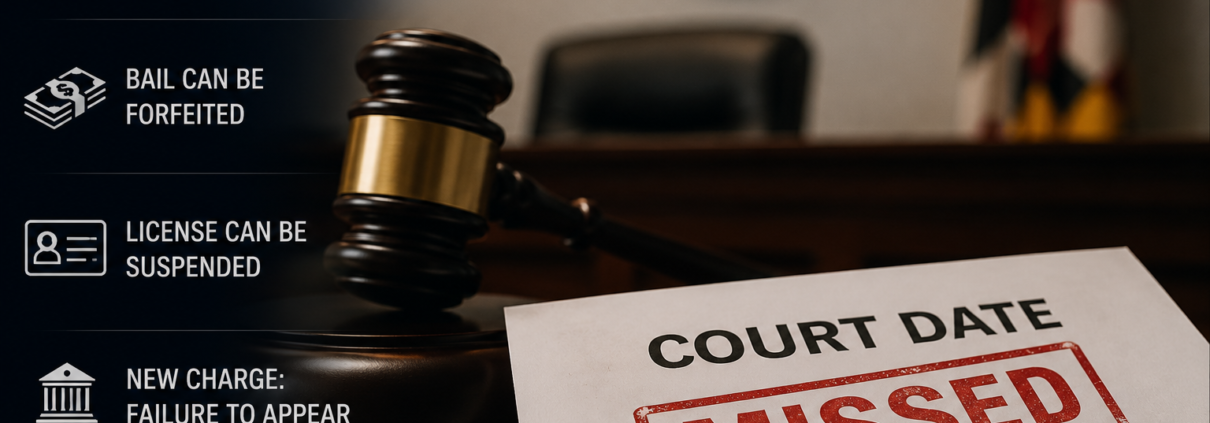
Court date notice stamped “MISSED” on a courtroom desk beside a judge’s gavel, illustrating the legal consequences of missing a court appearance in Maryland.

What Happens If You Miss a Court Date in Maryland?

Missing a court date is one of those situations that can spiral fast. Whether it happened because of a genuine emergency, a mix-up over the date, or something that just slipped through the cracks — the worst thing you can do right now is nothing.

Here is exactly what happens when you miss a court date in Maryland, what the consequences are, and the steps you need to take immediately to protect yourself.

The First Thing That Happens: A Bench Warrant

When you miss a court date, the judge typically issues a bench warrant for your arrest. A bench warrant authorizes law enforcement to take you into custody and bring you before the court. This can happen immediately or at a later time, depending on when and where you are located. Drewcochranlaw

A bench warrant does not expire. It sits in the system indefinitely until you are arrested or a judge recalls it. That means you are at risk every time you are pulled over for a traffic stop, every time law enforcement runs your name, and — in some cases — every time you show up for an unrelated court matter. People are arrested on outstanding bench warrants at work, at home, and during routine interactions with police they never saw coming.

The longer you wait, the more chances there are for that warrant to catch up with you in the worst possible way.

You Could Face a Separate Failure to Appear Charge

Missing court is not just a procedural problem — it can become its own criminal charge on top of whatever you were originally in court for.

If a person has been granted pretrial release either through bail or upon their own recognizance and then fails to appear in response to a citation, they face several penalties. First, the court may issue a bench warrant for the arrest of the defendant. Second, the person will be guilty of a misdemeanor punishable by up to 90 days in jail and a fine not to exceed $500. MD Defense

In more serious cases the stakes are even higher. It is a misdemeanor crime punishable by up to 3 years in jail and a $5,000 fine if you willfully failed to appear for a court date after being properly notified. This charge could be added to your existing case. Shepard Law

In other words, you could end up facing two separate cases — the original charge and the failure to appear — when you only had one to begin with.

Your Bail Can Be Forfeited

If you were released on bail, missing your court date could lead to bail forfeiture. This means that the court keeps the money you or your bail bondsman posted. In addition, the bail bondsman may seek to recover the forfeited amount from you, leading to further financial strain. Drewcochranlaw

Beyond losing the bail money itself, judges and pretrial services will consider your failure to appear when setting new court dates or pretrial release. It will not be to your advantage. Getting released again — and on reasonable terms — becomes significantly harder once you have a missed court date on your record. FindLaw

Your Driver’s License Could Be Suspended

In some cases, particularly those involving traffic violations, the court may notify the Department of Motor Vehicles about your failure to appear. This can result in the suspension of your driver’s license until the matter is resolved. Drewcochranlaw

For DUI cases specifically, the Maryland Motor Vehicle Administration will be notified, which can trigger an administrative license suspension. This happens automatically and can complicate future MVA hearings. Frizwoods

This is particularly damaging if you depend on your license for work, and it is a separate problem from the criminal case itself — meaning you may need to resolve both the court matter and the MVA issue independently.

It Makes Your Original Case Harder to Defend

Even if everything else gets sorted out, a missed court date follows you.

These failures to appear, or “FTAs,” can be used against a person in future hearings as an example to suggest that they may not appear in court. For example, at a bail review, the prosecution might bring up prior failures to appear as a basis for holding a person without bail. Frizwoods

Missing a court date often leads to harsher penalties if you are ultimately convicted of the original charge. Judges tend to view failure to appear as a sign of disrespect or non-compliance, which can result in longer sentences, higher fines, or more severe probation conditions. Missing a court date also sets a precedent that can influence future legal proceedings. Judges and prosecutors may be less inclined to offer leniency or favorable plea deals if they perceive you as unreliable or uncooperative. Drewcochranlaw

In short, a missed court date does not just create new problems — it makes your existing problem harder and more expensive to resolve.

Does It Matter Why You Missed Court?

Yes — but only if you act on it quickly and can back it up with documentation.

Courts in Maryland do distinguish between willful non-appearance and missing a date for a legitimate reason. Common valid reasons include medical emergencies, a documented family crisis, incorrect information about the court date, or a genuine miscommunication. The key word is documented. Saying you were sick is very different from having a hospital record or physician’s note that confirms it.

If you have a legitimate reason, your attorney can file a motion to recall the bench warrant and present that explanation to the court. The stronger your documentation, the better your chances of having the warrant recalled without additional penalties.

What courts are far less sympathetic about: forgetting, being afraid to show up, or assuming the court date was not serious. None of these are legal defenses, and none of them will help you.

What to Do Right Now

Step 1: Do Not Ignore It

The single worst thing you can do is hope the problem goes away. It will not. Bench warrants do not expire, and failure to appear charges do not resolve themselves. Every day you wait is another day the situation can get worse.

Step 2: Check Maryland Case Search

Even in your absence, the court proceedings may have continued. It is important to find out what decisions were made during the session. You can usually obtain this information from the court clerk or Maryland Case Search. Frizwoods

Knowing whether a warrant has already been issued — and what happened to your case in your absence — is essential before taking any next steps.

Step 3: Contact a Maryland Criminal Defense Attorney Immediately

This is not a situation to navigate on your own. If you failed to appear in court and the judge has issued a bench warrant for your arrest, an experienced criminal defense attorney can file a motion to recall the warrant. This motion can persuade a judge to remove or “quash” the warrant and set a new court date. Houlon Berman

An attorney can often resolve a bench warrant without you being taken into custody first — but that window is much easier to use before you have been arrested than after.

Step 4: Gather Any Documentation of Why You Missed

If there is a legitimate reason for your absence, start gathering evidence now. Medical records, hospital discharge papers, documentation of a family emergency, proof of a scheduling error — anything that supports your explanation needs to be in hand before your attorney files a motion.

Step 5: Do Not Turn Yourself In Without Legal Counsel

In many cases, voluntarily surrendering yourself to the authorities can demonstrate your willingness to cooperate and may result in more favorable treatment by the court. However, you should allow an attorney to advise you on the best way to do this. Drewcochranlaw

Walking into a police station without legal counsel and without a plan is rarely in your best interest. Let an attorney guide the process so that your surrender — if necessary — happens on the best possible terms.

Different Court Types, Different Consequences

It is worth noting that the consequences of missing a court date in Maryland can vary depending on the type of case involved.

Criminal cases carry the most serious consequences — bench warrants, misdemeanor failure to appear charges, bail forfeiture, and the risk of pretrial detention if you are re-arrested.

Traffic cases fall into two categories. Non-jailable traffic offenses — simple payable tickets — generally result in a license suspension and an additional fine rather than a bench warrant. If you missed a Maryland traffic court date for a non-serious or non-jailable case, it can be fixed. Jailable traffic offenses — driving on a suspended license, DUI, knowingly driving uninsured — are treated more like criminal cases, and a bench warrant will likely be issued. David R. Waranch

Civil cases — landlord-tenant disputes, contract matters, small claims — can result in a default judgment entered against you. In practical terms that means the other party wins automatically, and you may owe money or lose property with no opportunity to present your side.

Jury duty is its own category. Missing jury duty can result in up to 60 days in prison and a fine of up to $1,000. To avoid these penalties, you may be required to show good cause for missing the intended court date. Houlon Berman

Frequently Asked Questions

How long does a bench warrant stay active in Maryland?

A bench warrant in Maryland does not expire. It remains active until either you are arrested and brought before the court, or a judge recalls or quashes it. There is no waiting it out.

Can I get a bench warrant recalled without being arrested?

In many cases, yes. An attorney can file a motion to recall the bench warrant, presenting the court with an explanation for the missed appearance and asking that the warrant be withdrawn and a new court date set. This process is significantly smoother with legal representation than without it.

Will missing a court date show up on my record?

In Maryland, you will have a misdemeanor charge on your record for a failure to appear. This is regardless of the resolution of your original criminal charge. That is why acting quickly — before a formal FTA charge is entered — matters so much. FindLaw

What if I missed court because of a medical emergency?

A genuine medical emergency is one of the most commonly accepted reasons for a missed court date. You will need documentation — hospital records, physician notes, or similar evidence — to support the explanation. Your attorney can present this to the court when filing a motion to recall the warrant.

What if I just forgot?

Forgetting is not a legal defense, but it does not mean your situation is hopeless. Courts deal with missed appearances regularly. The critical factor is whether you act quickly and proactively after the fact. An attorney can help you present your situation in the most favorable light and work toward getting a new date without additional charges.

Does missing court affect my chances on the original charge?

Yes, in most cases it does. Judges have discretion in sentencing, and a failure to appear on your record signals unreliability. Prosecutors may also be less willing to offer favorable plea deals to defendants who have missed court. Getting ahead of the problem quickly — before the court forms a negative impression of you — is your best defense.

Missed a Court Date in Maryland? Call Us Before the Situation Gets Worse.

At the Law Offices of David N. Mabrey, we represent clients across Maryland who are dealing with bench warrants, failure to appear charges, and the fallout from missed court dates. Whether your case involves a criminal charge, a traffic matter, or something else entirely — we can help you understand your options and take the right steps before things escalate further.

Do not wait. The sooner you call, the more options you have.

Chestertown Office 107 Court St, Chestertown, MD 21620 📞 410-778-1630

Pasadena Office 8611 Fort Smallwood Rd C, Pasadena, MD 21122 📞 443-702-7708 🚨 Emergency/New Accident: 443-848-2878

Contact us online here — available for urgent matters.

How to Choose an Executor for Your Maryland Estate (And Why It Matters)

When most people sit down to write a will, they spend the most time thinking about who gets what. The house, the savings account, the family heirlooms. What they spend far less time on — and often get wrong — is who will be in charge of making all of it actually happen.

That person is your executor. In Maryland, they are officially called your Personal Representative, and choosing the right one may be the single most consequential decision in your entire estate plan.

What Does an Executor Actually Do?

Before you can choose the right person, it helps to understand exactly what you are asking them to take on.

The Personal Representative is the person that settles up your affairs after death and handles the administration of your will. Importantly, the Personal Representative is NOT the person receiving property and assets of the estate. The Personal Representative is legally put in place — with fiduciary obligations — to manage a decedent’s assets on behalf of the estate, the heirs, and the beneficiaries. Tstahllaw

In practical terms, that means your executor will be responsible for:

  • Filing your will with the Register of Wills in the county where you lived
  • Petitioning the court to open your estate and obtain Letters of Administration
  • Taking possession of and securing all estate assets
  • Notifying creditors and beneficiaries
  • Paying outstanding debts, taxes, and expenses from estate funds
  • Filing your final income tax returns and any estate tax returns
  • Inventorying and appraising all estate property
  • Distributing remaining assets to your beneficiaries
  • Filing a final accounting with the court

The personal representative must file an Inventory and Information Report within three months after opening the estate. The personal representative must secure the decedent’s assets, appraise or value each asset, and prepare a detailed inventory to file with the Register of Wills. Depending on the nature of the assets, the personal representative may need to retain a professional appraiser to value specific assets. Thienel Law

Within 20 days of appointment, the personal representative is required to file with the court a list of names and addresses of the beneficiaries named in the will and the decedent’s next-of-kin who would inherit in the absence of a will. Nashlegal

This is not a passive role. Depending on the size and complexity of your estate, serving as Personal Representative can take anywhere from several months to well over a year. It involves real deadlines, legal filings, financial decisions, and direct interaction with courts, creditors, and beneficiaries — often while grieving.

Who Can Legally Serve as an Executor in Maryland?

Maryland law sets specific eligibility requirements that your chosen executor must meet before the Register of Wills will appoint them.

In Maryland, the executor must be at least 18 years old and of sound mind. They cannot have been convicted of a serious crime. Maryland law also requires that the executor be a U.S. citizen or a permanent resident. Hartman

In Maryland, you can’t name an executor who has been convicted of a “serious crime” unless this person demonstrates a good reason to serve as executor. For example, someone who has been convicted of fraud, extortion, embezzlement, forgery, perjury, or theft would in most cases be ineligible to serve. Nolo

Maryland also has a slayer statute — a person who feloniously and intentionally kills someone is prohibited from being appointed executor of that person’s estate. Nolo

What if your executor lives out of state? This is a common situation — a trusted sibling or adult child who has moved away. It is not disqualifying, but it does create an additional requirement. In Maryland, a nonresident executor must appoint someone who lives in the state to act as a resident agent. Your executor’s in-state agent will accept legal papers on behalf of your estate. Nolo

For practical reasons, choosing someone local is still preferable whenever possible. Your Personal Representative may need to appear in person at the Register of Wills, manage physical property, and deal with local institutions — all of which become significantly more burdensome from out of state.

The Qualities That Actually Matter

Meeting the legal requirements is just the baseline. The qualities that make someone a truly effective Personal Representative go well beyond eligibility.

Trustworthiness

Your executor will have complete access to your financial accounts, personal records, and estate assets. They will be making decisions that directly affect your beneficiaries’ inheritance. Whether you’re considering a family member, close friend, or professional institution, the person or entity you select should be utterly trustworthy and uphold the highest standards of integrity. They’ll be handling your assets and possibly making significant financial decisions. Chesapeakewillsandtrusts

Organizational Ability

The Maryland probate process involves multiple deadlines, forms, and filings — all of which must be completed accurately and on time. Personal representatives should calendar all notice, inventory, accounting, and tax deadlines the day they are appointed. They must document decisions and keep receipts, statements, and beneficiary communications. A disorganized executor can cause delays, missed filings, and real financial harm to your estate. Hatcher Legal, PLLC

Emotional Stability and Impartiality

Serving as an executor often means managing family members who are grieving, disagreeing, and under financial stress — sometimes all at once. Your executor may be asked to make decisions that disappoint or upset people they love. They need to be able to hold the line on what your will actually says, even under pressure.

Financial Literacy

Your executor does not need to be an accountant, but they should be comfortable handling financial documents, reading bank statements, and understanding basic tax concepts. They will need to manage an estate account, pay bills on time, and ensure the correct taxes are filed.

Availability

This is underestimated more than almost any other factor. Administering an estate is not a weekend project. It requires sustained attention over months, sometimes longer. Before naming someone, honestly assess whether they have the time and bandwidth to take this on — especially if they work full time, have young children, or have their own health concerns.

Common Mistakes People Make When Choosing an Executor

Choosing the oldest child out of tradition

Naming a firstborn child is a deeply ingrained cultural habit. But birth order has nothing to do with organizational ability, financial literacy, or temperament. The best executor for your estate is the most capable and available person — not necessarily the eldest.

Choosing someone who is also a major beneficiary without thinking through the conflict

There is nothing legally wrong with naming a beneficiary as your executor — it is actually quite common. But if your estate has the potential for disputes among heirs, putting a major beneficiary in charge of administration can create real or perceived conflicts of interest that poison family relationships and invite legal challenges.

Not naming an alternate

Life changes. The person you name today may predecease you, become incapacitated, or simply be unwilling to serve when the time comes. Always name a backup. In the will, you will name your chosen executor and, if desired, an alternate executor who can step in if the primary executor is unable or unwilling to serve. Hartman

Naming someone without asking them first

It is a good practice to discuss your choice with the person you wish to appoint to ensure they are willing to take on the responsibility. This conversation can help clarify any questions they might have about their role and provide them with an understanding of your wishes. Discovering you have been named executor for the first time after someone has already died is a jarring experience — and some people will decline. Have the conversation now. Hartman

Never updating your choice

The person who was perfect for the role ten years ago may no longer be. Circumstances change — health, geography, relationships, financial stability. Review your executor designation every few years and after any major life event.

Can You Name Co-Executors?

Yes. Maryland law permits the appointment of co-executors, which can be beneficial if you have multiple individuals you trust and who can share the responsibilities. However, co-executors must work together and agree on all decisions, which can sometimes lead to complications if there are disagreements. Hartman

Co-executors work well when the two people are closely aligned, communicate well, and have complementary skills — for example, one who is financially savvy and one who is closer to the family. They work poorly when there is already tension between them or when they live in different states and will struggle to coordinate.

If you are considering co-executors specifically to avoid hurting anyone’s feelings, think carefully. A fractious co-administration can cause far more damage to family relationships than simply choosing one person and explaining your reasoning.

Should You Name a Professional as Your Executor?

For most estates, a trusted family member or close friend is the right choice. But there are circumstances where naming a professional — an attorney, a CPA, or a bank trust department — makes genuine sense.

Consider a professional executor if:

  • Your estate is large or complex, with business interests, investment portfolios, or property in multiple states
  • There is significant conflict among your beneficiaries and you want a neutral administrator
  • You do not have a family member or close friend who is capable, available, or willing to serve
  • You are concerned that a family member executor will be subjected to undue pressure

Maryland statutes permit you to name a corporation, such as a savings bank or trust company, as your executor. But think carefully before appointing a corporation. It’s almost always best to name an individual — consider an institution only if you don’t know anyone you trust enough to serve, or your estate is very large and complex. Nolo

Professional executors charge fees, typically a percentage of the estate’s value. That cost must be weighed against the peace of mind and expertise they bring, particularly for estates where a family member would likely need to hire an attorney anyway.

What Happens If You Die Without Naming an Executor?

If you die without a valid will — or if your named executor cannot or will not serve and you have no alternate — Maryland law determines who steps in.

Without a will, the law sets a specific pecking order starting with the surviving spouse. Either way, the person must file a formal petition, meet eligibility requirements, and receive court-issued letters before they have any legal authority over the estate. LegalClarity

The priority order under Maryland law generally runs: surviving spouse, children, other relatives, creditors, and finally any other person the court deems appropriate. The court does not know your family dynamics, your relationships, or your wishes. The person who ends up in charge may not be the person you would have chosen — and they will be distributing your assets according to Maryland’s intestacy laws, not according to any plan you had.

This is exactly why naming your own executor in a properly drafted will matters so much.

Frequently Asked Questions

What is the difference between an executor and a Personal Representative in Maryland?

They are the same role. Most states use the term executor. Maryland uses the term Personal Representative. If you encounter either term in an estate planning context, they refer to the same function — the person appointed to administer your estate after your death.

Does a Maryland executor get paid?

Yes, Personal Representatives in Maryland are entitled to reasonable compensation for their work. Executors may receive reasonable compensation or be reimbursed for out-of-pocket expenses, depending on the size of the estate and state law. In Maryland, compensation often requires court approval or alignment with the will’s terms. Many family members who serve as executor choose to waive compensation, but it is always available. Bridgelegal

Can an executor also be a beneficiary?

Yes. It is extremely common for the same person to serve both roles — a surviving spouse, for example, is often both the primary beneficiary and the Personal Representative. There is no legal prohibition, though it is worth considering whether this arrangement could create tension with other beneficiaries.

What happens if the executor makes a mistake?

Personal Representatives have fiduciary duties to the estate and its beneficiaries. A poor fit can bring delays, confusion, and hard feelings within the family. Assets can be put at risk if bills are ignored or paperwork sits in a drawer. When deadlines slip, tax penalties and interest often follow. Problems can include financial mistakes, unpaid creditors, missed court filings, and lawsuits between heirs. In serious cases of mismanagement, an executor can face personal liability. This is one of the strongest arguments for choosing carefully — and for having an experienced estate attorney guide the process. Powers & Worshtil

Can an executor be removed?

Yes. Maryland courts can remove a Personal Representative who is not fulfilling their duties, who has a disqualifying conflict of interest, or who is mismanaging estate assets. Beneficiaries can petition the Orphans’ Court to seek removal. This process is disruptive and expensive, which is again why the initial choice matters so much.

Does my executor need to hire a lawyer?

They are not legally required to, but for most estates it is strongly advisable. Maryland’s probate process involves specific forms, deadlines, and court filings that are easy to get wrong. The cost of an estate attorney is typically paid from the estate itself, not out of pocket by the executor.

Ready to Choose the Right Executor for Your Maryland Estate?

Choosing your Personal Representative is not a formality. It is one of the most important decisions in your entire estate plan — and one that deserves a real conversation with an experienced Maryland estate planning attorney.

At the Law Offices of David N. Mabrey, we help families across Maryland put the right plans in place, including making sure the right person is named to carry those plans out. We work with clients at two convenient locations.

Chestertown Office 107 Court St, Chestertown, MD 21620 📞 410-778-1630

Pasadena Office 8611 Fort Smallwood Rd C, Pasadena, MD 21122 📞 443-702-7708 🚨 Emergency/New Accident: 443-848-2878

Contact us online here to schedule a consultation. We are ready to help you protect your family and your legacy.

Man speaking on a phone beside damaged vehicles after a car accident in Maryland with police lights in the background.

What to Do in the First 24 Hours After a Car Accident in Maryland

A car accident can happen in an instant — and the decisions you make in the hours that follow can determine whether you walk away with fair compensation or lose your right to recover anything at all.

Maryland has some of the strictest car accident laws in the country. Understanding what to do — and what not to do — immediately after a crash isn’t just good advice. It can be the difference between a strong legal claim and no claim at all.

Here is a step-by-step guide to protecting yourself in the first 24 hours after a car accident in Maryland.

Step 1: Make Sure Everyone Is Safe

Your first priority is safety — yours and everyone else at the scene.

If you are able to move and your vehicle is causing a hazard, pull it to the shoulder or a nearby safe area and turn on your hazard lights. If anyone appears seriously injured, do not attempt to move them unless there is an immediate danger such as fire.

Call 911 immediately if someone is hurt, a driver seems to be under the influence of drugs or alcohol, or a driver tries to flee the scene without providing the proper information. Baldwinbriscoe

Even if injuries seem minor in the moment, err on the side of calling law enforcement. Adrenaline is a powerful masking agent — people often don’t feel the full extent of their injuries until hours later.

Step 2: Call the Police and Get an Official Report

Maryland law requires you to report any crash that involves injuries, death, or vehicle damage so severe that a tow truck is needed. Even for minor incidents, calling the police is a crucial step. The responding officer will create an official Maryland accident report — a vital document for your insurance company that provides a neutral record of the accident scene. 410thefirm

The police report will typically include the date, time, and location of the accident, statements from drivers and witnesses, the officer’s initial assessment of fault, and the insurance information for all parties involved.

Do not leave the scene before speaking with officers. Leaving the scene of an accident in Maryland can result in criminal charges regardless of who was at fault.

Step 3: Exchange Information — But Watch What You Say

Maryland law requires drivers to stop at the scene of the accident and exchange information with the other parties involved, including their name, address, license number, and information about insurance policies. Serafini Law

Collect the following from every other driver:

  • Full name and home address
  • Driver’s license number
  • License plate number
  • Insurance company name and policy number
  • Vehicle make, model, and year

If there are witnesses, get their names and contact information too. Their testimony can be critical later.

One critical warning: do not apologize, admit fault, or make any statements beyond the basic facts. Maryland follows a rule called contributory negligence. Under this system, if you shared any responsibility for the crash — even just 1% — you cannot recover any damages. Not for your medical bills, not for missed work. Even if the other driver was primarily to blame. Insurance adjusters will look for any statement that can be used against you. An offhand “I’m sorry” at the scene can be twisted into an admission of fault. Southernmarylandlaw

Step 4: Document Everything at the Scene

Your smartphone is one of the most powerful tools you have in the minutes after a crash. Use it.

Take photos and video of:

  • All vehicles involved, from multiple angles
  • The full accident scene including road conditions, traffic signs, and skid marks
  • Any visible injuries on yourself or passengers
  • The other driver’s license, insurance card, and license plate
  • Any damage to surrounding property

More documentation is always better than less. Once emergency crews clear the scene and vehicles are moved, you cannot go back.

Step 5: Seek Medical Attention — Even If You Feel Fine

This is the step most accident victims skip, and it is one of the most costly mistakes you can make.

You must see a doctor, even if you feel fine. Adrenaline can mask pain from serious injuries. A medical record officially documents your injuries, which is essential to determine if you have a personal injury case and to claim medical expenses. 410thefirm

From a legal standpoint, seeking prompt medical attention serves two purposes. First, it creates a documented record linking your injuries to the accident. If you wait several days to see a doctor, insurance companies will argue your injuries were not caused by the crash. Second, it establishes a timeline that strengthens your claim. Gaps in medical treatment are routinely used by insurance adjusters to reduce or deny payouts.

Go to an emergency room, urgent care, or your primary care physician as soon as possible — even if your only complaint is soreness, a headache, or stiffness. Let the medical professional determine the severity.

Step 6: Report the Accident to Your Insurance Company

Notify your own insurance company of the accident as soon as possible. Most policies require prompt notification, and failing to report in a timely manner can jeopardize your own coverage.

Remember: a report is different from a claim. You can report the accident to the insurance company and decide later that you’re not going to file a claim. But if you choose not to report the accident to insurance within a certain period of time, you might lose the ability to make a claim later. Enjuris

When speaking with your insurance company, provide factual information only and do not speculate about fault. And do not give a recorded statement to the other driver’s insurance company without first speaking to an attorney. Their adjusters are trained to minimize payouts, and a statement made before you fully understand your injuries can seriously damage your claim.

Step 7: File a Report with the Maryland MVA If Required

A written report to the Maryland Motor Vehicle Administration (MVA) is required under Maryland Transportation Article § 20-107 if an accident results in bodily injury or death. This applies to the driver of each vehicle and must be submitted within 15 days. This individual report is not necessary if a police officer investigates and files a report with the Maryland State Police. LegalClarity

Maryland imposes consequences for non-compliance with vehicle accident reporting requirements. According to Maryland Transportation Article § 20-109, failure to report an accident when mandated may result in suspension or revocation of a person’s license by the MVA. The MVA can also suspend or revoke the vehicle registration of a person that fails to report. Rice Law

The official form is the Maryland Motor Vehicle Accident Report Form (Form DR-1), available through the MVA.

Step 8: Do Not Post About the Accident on Social Media

This one catches people off guard. In the hours after a crash, it is natural to want to update friends and family. Resist the urge.

Anything you post publicly — photos, comments, status updates — can be discovered by the other driver’s insurance company or attorney and used against you. A photo of you at a family dinner two days after the accident can be used to argue you weren’t seriously injured. A vague comment about what happened can be taken out of context.

Say nothing about the accident on any social platform until your case is fully resolved.

Step 9: Know Your Deadline — Three Years Goes Faster Than You Think

In Maryland, you have three years from the date of the accident to file a personal injury lawsuit. This is known as the statute of limitations. The clock starts ticking the moment you’re injured in an accident. If you miss it, you could be out of luck when it comes to getting the compensation you deserve. Baldwinbriscoe

Three years sounds like a long time. It isn’t. Evidence fades, witnesses become hard to locate, and building a strong case takes time. The sooner you speak with an attorney, the better your position.

Step 10: Speak With a Maryland Car Accident Attorney

Maryland’s contributory negligence rule makes car accident cases uniquely unforgiving. Insurance companies know the law is strict, and they will search for any reason to blame you — because if they can assign even the smallest share of fault to you, your right to compensation may be gone. Southernmarylandlaw

An experienced Maryland car accident attorney can evaluate your claim, deal with insurance adjusters on your behalf, help you avoid the common mistakes that sink cases, and fight to make sure fault is placed squarely where it belongs.

You should never have to navigate this alone — especially when the other side has a team working against you from day one.

Injured in a Car Accident in Maryland? Contact the Law Offices of David N. Mabrey Today.

At the Law Offices of David N. Mabrey, we represent accident victims across Maryland from two convenient locations. If you or a loved one has been injured in a car accident, do not wait. The steps you take in the hours and days after a crash matter enormously — and so does having the right attorney in your corner.

Call us today for a free consultation.

Chestertown Office 107 Court St, Chestertown, MD 21620 📞 410-778-1630

Pasadena Office 8611 Fort Smallwood Rd C, Pasadena, MD 21122 📞 443-702-7708 🚨 Emergency/New Accident: 443-848-2878

Or contact us online here — we’re ready to help.

Frequently Asked Questions About Car Accidents in Maryland

Do I have to call the police after a car accident in Maryland?

You are legally required to call the police if the accident involves any injury, death, or vehicle damage severe enough to require a tow truck. For minor fender benders with no injuries and minimal damage, it is not always legally required — but it is almost always in your best interest. A police report creates an official neutral record that becomes essential evidence if you later need to file an insurance claim or pursue a personal injury lawsuit.

What should I do if the other driver doesn’t have insurance?

First, do not leave the scene and make sure you document everything as you normally would. Then notify your own insurance company as soon as possible. Maryland requires all drivers to carry uninsured motorist coverage, which exists specifically to protect you in this situation. An attorney can help you navigate an uninsured motorist claim and explore whether any other parties — such as a vehicle owner who isn’t the driver — may share liability.

How long do I have to file a car accident claim in Maryland?

In Maryland, the statute of limitations for a personal injury claim is three years from the date of the accident. Miss that deadline and you lose your right to sue entirely, regardless of how strong your case is. However, waiting is never advisable — evidence disappears, witnesses become unreachable, and building a case takes time. Speak with an attorney as early as possible.

What is contributory negligence and how does it affect my case?

Maryland is one of only a handful of states that still follows the pure contributory negligence rule. This means if you are found even 1% at fault for the accident, you can be completely barred from recovering any compensation from the other driver — even if they were 99% responsible. This makes Maryland car accident cases particularly high-stakes and is exactly why you should avoid making any statements about fault at the scene and why having an experienced attorney matters so much.

Should I accept the insurance company’s first settlement offer?

Almost never. Insurance companies make early offers specifically because injured people often don’t yet know the full extent of their injuries or damages. Once you accept a settlement and sign a release, you typically cannot go back and ask for more — even if your injuries turn out to be more serious than initially thought. Always consult with an attorney before accepting any settlement offer.

What if I didn’t feel injured at the scene but started hurting the next day?

This is extremely common. Adrenaline masks pain in the immediate aftermath of a crash, and injuries like whiplash, soft tissue damage, and even traumatic brain injuries can take 24 to 72 hours to fully present. See a doctor as soon as symptoms appear and make sure you tell them you were in a car accident. The medical record connecting your injury to the crash is critical. Do not let a delay in symptoms cause you to delay treatment.

Do I need a lawyer for a minor car accident in Maryland?

Even in cases that initially seem minor, consulting an attorney costs you nothing and can save you significantly. Maryland’s contributory negligence rule means even small disputes about fault can eliminate your right to compensation entirely. What looks like a minor fender bender can turn into a more serious injury case once you’ve been properly evaluated. An attorney can assess your situation quickly, advise you on your options, and make sure you don’t inadvertently say or sign something that hurts your claim.

What damages can I recover after a car accident in Maryland?

Maryland accident victims may be able to recover economic damages including medical expenses, future medical care, lost wages, and property damage. They may also be entitled to non-economic damages for pain and suffering, emotional distress, and loss of enjoyment of life. Maryland does cap non-economic damages — as of 2024 the cap sits at $935,000 — but economic damages are not capped. The specific damages available depend on the facts of your case, which is another reason speaking with an attorney early is so important.

No Win no fee contingency lawyer example

Contingency Fee Lawyer in Maryland – You Don’t Pay Unless You Win

Lawyer fees are one of the biggest concerns for most people looking to find a lawyer. For many, there is the concern that the costs of an attorney could outweigh the benefits of having one or that they simply can’t afford a good lawyer. Hiring a contingency lawyer, however, provides a way to hire a lawyer for your case without having to worry about upfront costs.

If you need a lawyer but are concerned with upfront costs or hourly legal fees then consider hiring a contingency lawyer near you.

Here at the Law Offices of David N. Mabrey, we are a Maryland law firm that works your Personal Injury case on a contingency fee basis. Below, you will find more information about hiring a contingency fee-based lawyer. If you already know it’s what you are looking for, then give us a call.

Read more
Lawyer helping to file peace order

What to Know About Maryland Peace Orders

Are you being harassed or worried for your safety? Has someone been stalking you, threatening you, or making you feel increasingly uncomfortable?  If you are in a situation where you feel the best way to keep yourself or your family safe is by legally having someone stay away, refrain from contacting you, or stop their behavior towards you, then you may need to consider filing a peace order. 

What is a peace order?

A peace order is a court-ordered form of legal protection for someone experiencing problems with another individual. Its function is to protect an individual by requiring the other party to refrain from coming near them or continuing behavior that’s intended to harm the other party.

A peace order is enacted when the petitioner (the person filing the peace order) is worried harm or harassment will come to them or a family member by the respondent (the individual accused of the wrongdoing). 

A peace order can include any action which may put the petitioner in potential harm’s way including:

  • Harming, hurting, or touching
  • Threatening the victim
  • Stalking
  • Coming within a certain distance
  • Visiting the home or workplace of the petitioner
  • Speaking with or attempting to contact the individual (physically or through other means of communication i.e. text, letter, a third party, etc.)

Traditionally a peace order would only be filed on behalf of the individual for themselves or someone in their care such as their child. 

Effective 10/1/2021, HB 289 Chapter 341 authorizes an employer to file a peace order for their employee for certain acts that happen at the workplace.

Difference between a peace order and protective order in Maryland

You may have heard the terms protective order and peace order used interchangeably. In some regards, they are very similar. Both peace orders and protective orders serve the purpose of protecting victims by refraining another party from interacting or getting close to them. While these two court orders are very similar they are in fact different. 

The differences mainly stem from the nature of the relationship the victim/petitioner has with the culprit/respondent. 

A protective order is filed when the two parties are in a domestic relationship. Parent and child, spouses, cohabitors, those in or who previously were in a sexual relationship within 1 year of the petition being filed, etc. When it comes to protective orders, the petitioner can be the individual looking to protect themselves (or family members) but it can also be the State’s Attorney or the department of social services on behalf of a child or vulnerable person. 

A peace order is filed when the two parties are not in a domestic relationship. The accused person could be someone the victim knows such as a neighbor, acquaintance, co-worker, past boyfriend/girlfriend or they could be a stranger. 

Depending on the situation, a victim will qualify for either a peace order or a protection order. If you’re unsure, an attorney can help you decide what is best and how to file.

How to file a peace order in Maryland

Filing a peace order in Maryland does not take many steps but the process of obtaining a peace order can be a long and stressful one especially if you’re in a situation where you’re scared or you feel that time is of the essence. 

Here is the process of filing and obtaining a peace order: 

  • Start by filling out a series of forms
  • Next, file the paperwork with the clerk in a District Court
  • If courts are closed you can submit the paperwork to the District Court Commissioner’s office. (only choose this option if the District Court is closed)
  • Depending on where you filed your forms, you will have a hearing immediately.
    • If filed with the Commissioner, you will have an interim hearing right away. 
      • If the commissioner believes you qualify then they will provide an interim peace order and schedule a date for a temporary hearing at the District Court.
    • If filed with the District Court you will skip the interim hearing and peace order and will have a temporary hearing right away to see if you qualify for a peace order.
  • If the judge believes that you qualify for a peace order they will provide a temporary peace order, which lasts seven days.
  • At this point, you will work with the courts to schedule your final hearing
  • During this time, law enforcement will attempt to serve copies of your petition to the other party.
  • Finally, you will have a final hearing to provide evidence. The respondent may likely be at this hearing to provide evidence as well.  

Once you’ve obtained a peace order, it will remain in effect for up to six months. This can be extended by the courts if necessary. 

Unfortunately for some, a peace order is not guaranteed. It’s important that this process is done correctly and that evidence is properly presented or else the courts may find that you do not qualify for one. 

A lawyer who specializes in peace orders can help you through each step in this process to help you ensure the best outcome. 

How a peace order lawyer can help

When it comes to peace order protections, one does not require a lawyer. However, it can be advantageous for an individual to seek legal counsel especially if the abuser has a lawyer. If one is worried for their safety, or their family’s safety, they shouldn’t risk the peace order being denied. 

Having a lawyer can help the petitioner in many ways:

  • Helping them to understand the process
  • Giving guidance on filing the petition and other necessary documents
  • Providing steps and insights along the way 
    • I.e. how to keep a petitioner’s address and contact information private on court documents that are given to the respondent.
  • Knowing what to keep and provide as evidence
  • Understanding timeframes and deadlines

At the end of the day, a lawyer is there to help a victim ensure that their peace order goes off without a hitch. If you’re worried about your safety or your family, the last thing you want is for your peace order to be denied. 

At the Law Offices of David Mabrey, we provide personal attention to every client that walks through our doors. We believe that this is crucial especially when it comes to the time-sensitive nature of something like a peace order. If you’re in Maryland and looking for a peace order lawyer, then consider giving us a call. We provide the experience and the care to help you protect yourself and/or your family.