
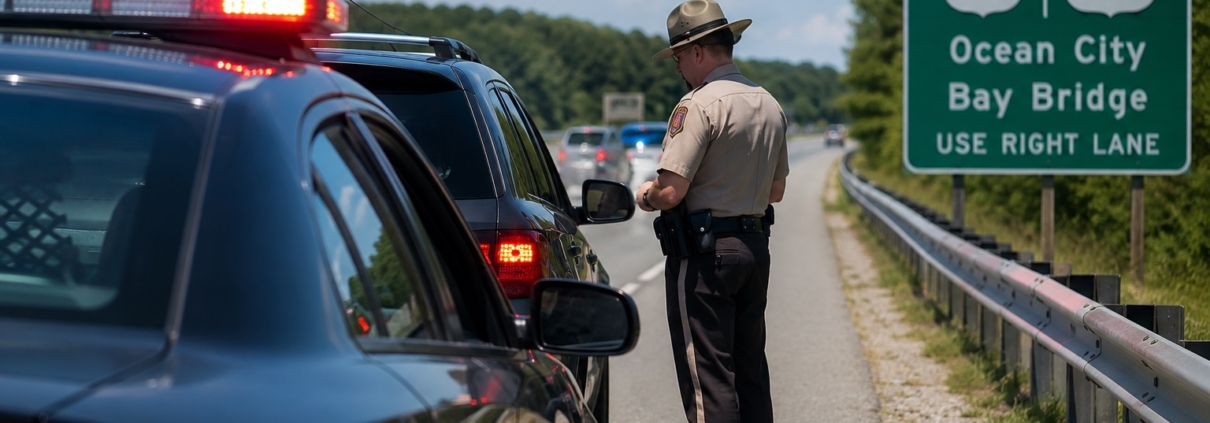
Summer Traffic Stops on Route 50 and Route 301: When a Simple Citation Turns Into a Criminal Charge
Every summer, millions of drivers pour onto Route 50 and Route 301 heading to the Eastern Shore — DC and Baltimore commuters escaping to the beach, families heading to Ocean City, boaters making for Kent Island and the Chesapeake Bay. And every summer, Maryland law enforcement floods those same corridors with heightened enforcement operations that catch far more than just speeders.
What most drivers do not realize is how quickly a routine traffic stop on the Eastern Shore can escalate into something much more serious than a citation. A speeding ticket becomes a suspended license charge. An open container becomes a DUI investigation. A warrant from another county turns a minor infraction into an arrest on the side of Route 50.
Here is what is actually happening on these roads in summer — and what to do if a traffic stop takes a turn you did not expect.
Why Route 50 and Route 301 Are Active Enforcement Corridors Every Summer
This is not coincidence or random patrol activity. Maryland law enforcement specifically targets these routes during summer travel season as part of coordinated high-visibility enforcement operations.
Maryland Transportation Authority Police Officers conducted high visibility traffic enforcement along US-50 near the Bay Bridge ahead of Memorial Day weekend and the busy summer travel season, joined by troopers from the Maryland State Police, officers from the Anne Arundel County Police Department, and deputies from the Queen Anne’s County Office of the Sheriff. Officers conducted 189 traffic stops and issued 277 citations, warnings, and repair orders during a single initiative. One driver was charged with driving under the influence, and two drivers were charged with drug offenses. maryland
Maryland State Police increase enforcement efforts on impaired, aggressive, and distracted driving through every major holiday weekend, with troopers from all barracks conducting high-visibility enforcement along Route 50 and state roads throughout their respective counties. Maryland State Police
The result is a corridor where enforcement density during summer weekends is among the highest in the state — and where a stop for a minor violation is far more likely to lead to additional scrutiny than it would be on a typical weekday in a less-trafficked area.
How a Simple Traffic Stop Escalates: The Most Common Scenarios
Speeding + Suspended License = Criminal Charge
This combination happens constantly on Route 50 and 301. A driver gets pulled over for speeding — a routine stop. The officer runs the license. It comes back suspended. What was a payable traffic citation is now a criminal charge.
Driving on a suspended license in Maryland is not a traffic infraction. It is a criminal offense that can result in arrest, jail time, additional fines, and a charge that goes on your criminal record. Many people driving with suspended licenses do not know their license is suspended — they missed a court date, failed to pay a fine, or were never properly notified. The suspension happened anyway.
The summer traffic volume on Route 50 means that officers are running license checks at high frequency. If your license has any issue — a suspension, a revocation, an outstanding failure to comply — the odds of it being discovered are significantly higher than they would be during a slow Tuesday in February.
Speeding + New Maryland Aggressive Driving Law
Maryland significantly expanded its aggressive driving statute effective October 1, 2025. Aggressive driving will now be triggered by committing two or more listed traffic violations in a single driving period, reduced from three. A conviction carries a fine of up to $1,000. Additionally, driving 30 mph or more over the posted limit will now be classified as reckless driving, carrying a fine of up to $1,000 or jail time, with six points added to the driver’s record. CBS News
On a highway like Route 50, the combination of speeding and an unsafe lane change — something that happens routinely in heavy beach traffic — can now satisfy the threshold for an aggressive driving charge. That is no longer just a point offense. It is a criminal misdemeanor.
For drivers approaching the Eastern Shore from the Bay Bridge, where traffic moves fast and lane discipline deteriorates during congestion, this is a genuine trap that many summer drivers are unaware of.
Open Container in the Car
An open container violation in Maryland might seem minor, but it can quickly lead to more serious legal trouble. When police find alcohol near the driver or in the passenger area, it often triggers more questions and a closer look at the driver’s behavior and level of impairment. What might have started as a routine traffic stop for a broken taillight or speeding can turn into a full DUI or DWI investigation if an officer smells alcohol, sees an open bottle, or suspects recent use. Andrewalpert
Maryland prohibits open alcoholic beverage containers anywhere in the passenger compartment of a vehicle — by any occupant. The open container law may not apply if the alcohol is not in the passenger area. This includes alcohol kept in the trunk, behind the rearmost upright seat in vehicles without a trunk, or in a locked glove compartment. Andrewalpert
The exception applies to hired vehicles — taxis, rideshares, limousines — but not to personal vehicles. A car full of passengers heading home from a crab feast on Kent Island, with a half-consumed bottle of wine in the back seat, is an open container violation that can open the door to a full DUI investigation.
Cannabis in the Vehicle
Maryland legalized recreational cannabis in 2023, which created genuine confusion about what is and is not permissible in a vehicle. The rules are more nuanced than most people realize.
Officers cannot conduct a traffic stop or search your vehicle based solely on the smell of cannabis or observation of a personal use amount of cannabis in the vehicle. However, the smell of cannabis can still be used as one factor if an officer suspects that a driver is impaired. Howard County
Possession limits matter enormously. Under Maryland law, possession of less than 1.5 ounces is no crime or civil penalty. Possession of between 1.5 and 2.5 ounces is a civil offense subject to a fine of up to $250. Possession of between 2.5 ounces and less than 50 pounds is a criminal misdemeanor — conviction can lead to a sentence of up to one year in jail, a fine of up to $1,000, or both. Castrolawgroup
Smoking or consuming cannabis in a vehicle on a public road is a separate violation regardless of the amount possessed. A driver of a motor vehicle may not consume an alcoholic beverage, or smoke or consume cannabis, in a passenger area of a motor vehicle on a highway. Justia
The practical problem: people returning from legal dispensary purchases, or bringing cannabis to the beach from home, frequently have quantities that cross from “legal personal use” into criminal territory without realizing it. And a stop for speeding on Route 50, combined with visible cannabis in the vehicle or the smell of recent use, can quickly become a drug charge layered on top of the original traffic violation.
The Warrant Discovery
During a single large-scale traffic enforcement initiative, four drivers were arrested on open warrants. This happens routinely at every major enforcement push on Route 50 and Route 301. Warrants from missed court dates, unpaid fines, or unresolved criminal matters in any Maryland county show up the moment an officer runs your name. A driver pulled over for following too closely near the Bay Bridge who has an outstanding warrant in Queen Anne’s County — or from a prior year in Baltimore City — is going to leave in handcuffs, not with a citation. maryland
If you have any reason to believe there might be an outstanding warrant in your name in any Maryland jurisdiction, do not wait to find out at a traffic stop on the way to the beach. Contact an attorney now and address it proactively — before it surfaces at the worst possible time.
What to Do During a Traffic Stop on Route 50 or 301
Stay calm and be cooperative
Pull over promptly, turn off the engine, place your hands on the steering wheel, and wait for the officer to approach. Do not reach for anything until asked.
Provide what is required — nothing more
You are required to provide your driver’s license, vehicle registration, and proof of insurance. You are not required to answer questions about where you are going, where you have been, whether you have been drinking, or whether there is anything in the car. You can decline to answer politely: “I’d prefer not to answer questions without an attorney.”
Do not consent to a search
If an officer asks whether they can search your vehicle, you have the right to decline. Saying “I do not consent to a search” does not give the officer permission to search — it preserves your rights if the search later becomes a legal issue. An officer with probable cause can search without consent. But many searches happen because drivers give permission when they did not have to.
Do not argue about the stop at the scene
If you believe the stop was unlawful, the roadside is not the place to make that argument. Comply, be polite, document what you can remember afterward, and raise the legal challenge with an attorney in court. Arguing at the scene rarely helps and sometimes hurts.
Call an attorney before your court date
A traffic citation with a must-appear designation is a court date — not an optional fine. A criminal charge of any kind — driving on a suspended license, aggressive driving, drug possession — requires legal representation. The courts in Queen Anne’s County, Kent County, and Talbot County handle these cases with their own judges and local prosecutors, and having an attorney who knows those courtrooms makes a real difference.
Queen Anne’s County and Kent County Traffic Court: What to Expect
The District Court in Centreville handles the bulk of traffic and criminal matters arising from stops on Route 50, Route 213, and the surrounding Eastern Shore corridors. The District Court in Chestertown handles Kent County matters.
These are smaller, tighter-knit courts than what DC or Baltimore drivers are accustomed to. Prosecutors and judges are familiar with the patterns of summer enforcement, and the cases are handled with seriousness. An out-of-state driver who assumes a Maryland traffic charge will simply go away, or who misses a court date because they have gone home, will quickly discover that Maryland warrants follow them through the Driver License Compact.
Local representation matters. An attorney who regularly appears in Centreville District Court or Chestertown District Court knows the local practices, the prosecutors’ typical positions, and what arguments are likely to be effective in front of specific judges.
Frequently Asked Questions
I got a speeding ticket on Route 50. Do I need a lawyer?
It depends on the speed and your record. A minor speeding citation can often be handled without an attorney. But if the speed was significant, if you have prior points on your license, or if the citation is a must-appear offense, legal representation is worth the investment. Points accumulate quickly, and enough of them in a short period triggers a license suspension hearing.
The officer asked if they could search my car and I said yes. Can I undo that?
Not easily — but the search may still be challengeable on other grounds. Whether the initial stop was lawful, whether the consent was truly voluntary, and what was actually found all affect how the evidence can be used. Talk to an attorney before concluding that the consent makes your situation hopeless.
I was stopped on Route 50 and found out I have a warrant. What happens now?
You may have been arrested on the spot or released with a notice to appear depending on the nature of the warrant. Either way, the warrant needs to be resolved — a motion to recall it filed, a new court date obtained, and the underlying matter addressed. Do not wait. An active warrant means every future traffic stop carries the same risk.
Cannabis is legal in Maryland now. Why was I charged?
Recreational cannabis is legal in limited quantities and in limited circumstances. Smoking it in a vehicle is illegal regardless of quantity. Possessing more than 2.5 ounces is a criminal misdemeanor. And driving while impaired by cannabis is a DUI charge, just like alcohol. The legalization of cannabis did not make it legal in all contexts — and many people are charged because they assumed it did.
I live in DC or Virginia. Does a Maryland traffic charge affect my home license?
Yes. Maryland participates in the Driver License Compact and the Non-Resident Violator Compact. Convictions in Maryland result in points that your home state can act on. Failure to appear on a Maryland citation can trigger suspension of your home state license. Treat a Maryland charge with the same seriousness you would give a charge in your home state.
The stop was on Route 50 near the Bay Bridge. Which court handles my case?
The Bay Bridge and the immediate approaches fall in Anne Arundel and Queen Anne’s County depending on which side you were stopped. The District Court of Maryland for Queen Anne’s County sits in Centreville. If you were stopped further east — on Route 50 past Grasonville toward Easton, or on Route 213 toward Chestertown — the case may be in Talbot or Kent County. Your citation will indicate the court location.
Charged After a Traffic Stop on the Eastern Shore? We Can Help.
At the Law Offices of David N. Mabrey, we represent clients across Maryland’s Eastern Shore in traffic and criminal matters — including charges arising from stops on Route 50, Route 301, Route 213, and throughout Queen Anne’s, Kent, and Talbot Counties. Whether you are facing a speeding charge, an aggressive driving allegation, a suspended license charge, or something more serious that developed from a routine stop, we provide the local representation that makes a difference in these courts.
Chestertown Office 107 Court St, Chestertown, MD 21620 📞 410-778-1630
Pasadena Office 8611 Fort Smallwood Rd C, Pasadena, MD 21122 📞 443-702-7708 🚨 Emergency/New Accident: 443-848-2878
Contact us online here — we handle urgent matters and are here when you need us.