
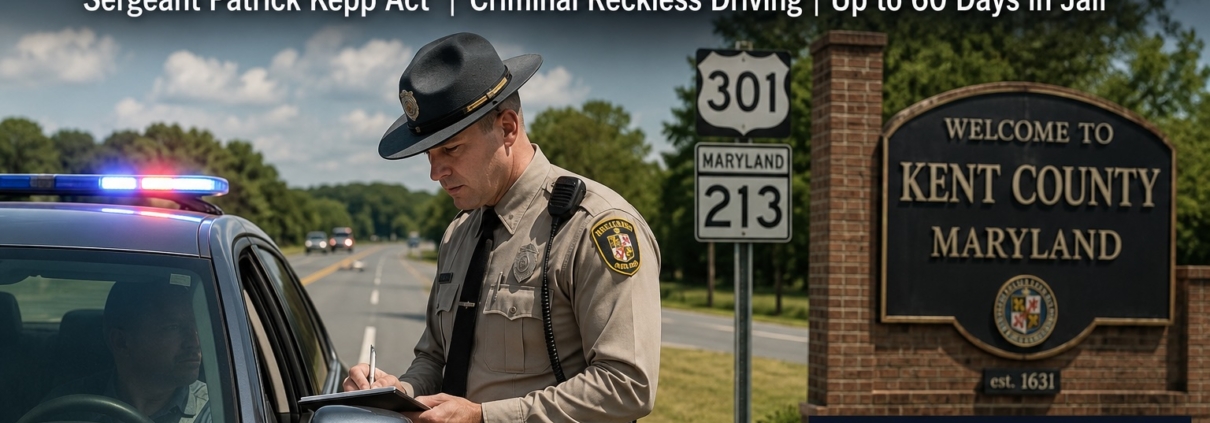
Facing a “30 Over” Speeding Ticket in Kent County? Why You Could Realistically See Jail Time Under Maryland’s New Threshold
If you were pulled over on Route 301, Route 213, or any road in Kent County and the citation says you were going 30 miles per hour or more above the posted limit, you are not looking at a routine speeding ticket anymore. As of October 1, 2025, Maryland law reclassifies that conduct as criminal reckless driving — a charge that can carry up to 60 days in jail, a $1,000 fine, and six points on your license. This isn’t a scare tactic or an exaggeration of a minor statutory tweak. It’s a fundamental shift in how the State of Maryland treats extreme speeding, and it means the stakes for anyone cited in Kent County just went up dramatically.
This article breaks down exactly what changed, why it happened, what it means if you’re a Maryland resident or an out-of-state driver passing through Chestertown, and what the process looks like once your case lands at the Kent County District Court.
The Law That Changed Everything: The Sergeant Patrick Kepp Act
The new penalty structure comes from Senate Bill 590, Chapter 447, a piece of legislation known informally as the Sergeant Patrick Kepp Act. The law is named after Montgomery County Police Sergeant Patrick Kepp, who lost both of his legs after being struck while deploying stop sticks to try to stop a teenage driver who had a history of illegal street racing and who was reportedly clocked at roughly 160 mph on Interstate 270 (Maryland Injury Attorney Blog). That incident became the catalyst for lawmakers to close what many viewed as a dangerous gap in Maryland’s traffic code — the fact that even extreme, life-threatening speeding was often treated as nothing more than a high-dollar traffic ticket.
The legislation took effect on October 1, 2025, and it did three things at once (FrizWoods):
- Redefined reckless driving to explicitly include driving 30 mph or more over the posted speed limit, with penalties increased to up to 60 days in jail and a $1,000 fine.
- Increased negligent driving penalties to a fine of up to $750.
- Broadened the definition of aggressive driving, making it easier for prosecutors to charge a driver who commits three or more qualifying violations — speeding, tailgating, unsafe lane changes, or failure to yield, among others — during a single continuous stretch of driving.
Before this law, the reckless driving statute relied on a somewhat subjective standard: driving in “wanton or willful disregard for the safety of persons or property.” Prosecutors had to argue that a driver’s behavior met that threshold, which left plenty of room for negotiation and dismissal. Now, hitting 30 mph over the limit is enough on its own to trigger a reckless driving charge under Md. Code, Transportation Article § 21-901.1, regardless of road conditions, traffic, or intent (David Waranch Law).
Old Penalty vs. New Penalty: The Numbers Tell the Story
To understand how significant this shift is, it helps to compare the “before” and “after” side by side. Under the old framework, a driver caught going 30 mph over the speed limit would typically face five points on their driving record and a fine in the range of $290 (Maronick Law). It was expensive and it hurt your insurance, but it was still, fundamentally, a civil traffic infraction. You paid the fine, you took the points, and you moved on with your life.
Under the current law, that same 30-over citation now carries:
- Up to 60 days in jail
- A fine of up to $1,000
- Six points on your license — the maximum a speed-related offense can carry
- Mandatory court appearance — this is no longer a “pay and forget it” ticket
- A criminal record, since reckless driving is classified as a misdemeanor
That last point deserves emphasis. A misdemeanor conviction isn’t just a line on your driving abstract — it becomes part of your permanent criminal history. That can complicate background checks for employment, professional licensing, security clearances, and even loan applications (Maronick Law). A speeding ticket that once cost you a few hundred dollars and a bump in your insurance premium can now follow you into job interviews and rental applications.
It’s also worth noting that Maryland didn’t stop at reckless driving. Negligent driving penalties increased to a $750 fine, and the aggressive driving statute was streamlined so that prosecutors have an easier time stacking multiple minor infractions — say, speeding plus following too closely plus an unsafe lane change — into a single, more serious charge (carscounsel.com). The overall effect is that Maryland’s traffic code, across the board, now treats aggressive and excessive driving behavior far less forgivingly than it did a year ago.
Why Kent County Drivers Are Especially Exposed
Kent County sits along some of the most heavily traveled corridors on Maryland’s Eastern Shore, including Route 301, Route 213, and Route 20. These roads see a mix of local commuters, agricultural traffic, and — especially in the warmer months — heavy volumes of out-of-state travelers heading to and from the beaches, Delaware, and points north via the Bay Bridge corridor. That combination of long, relatively open stretches of highway and heavy seasonal traffic has historically made Kent County a common location for high-speed citations.
Under the old law, an officer clocking a driver at 95 mph in a 65 zone on Route 301 would write a serious speeding ticket, but it stayed within the civil infraction system. Today, that same stop can result in the driver being arrested, or at minimum issued a criminal summons, for reckless driving. Local law enforcement agencies have been explicit that the new law effectively makes driving 30 mph or more over the limit an arrestable offense (Maryland Injury Attorney Blog).
If you’re cited in Kent County, your case begins at the District Court of Maryland for Kent County, located at 103 N. Cross Street in Chestertown (Maryland Courts). Because reckless driving is a criminal misdemeanor rather than a civil infraction, you are required to appear in person — this is not a charge you can resolve by mailing in a payment. If you request a jury trial rather than accepting a bench trial, the case is transferred to the Kent County Circuit Court, which can add another 60 to 90 days to the timeline of your case (SRIS, P.C.).
Maryland’s point system compounds the risk. The Motor Vehicle Administration triggers an administrative hearing once a driver accumulates 8 points, and a license can be revoked at 12 points (SRIS, P.C.). A single reckless driving conviction carrying six points puts most drivers uncomfortably close to that threshold — especially anyone who already has a violation or two on their record from the past two years.
What About Out-of-State Drivers Passing Through?
A significant share of the extreme-speeding citations written in Kent County involve drivers who don’t live in Maryland at all — commuters cutting through on their way to Delaware, vacationers heading to the shore, or truckers running the 301 corridor. For these drivers, a reckless driving charge is not something to shrug off and forget about once they cross back into their home state.
Maryland is a member of the Driver License Compact and Non-Resident Violator Compact with most states, meaning a Maryland conviction typically gets reported back to your home state’s licensing agency and can affect your driving record and insurance rates there as well. And because reckless driving in Maryland is a criminal charge requiring a court appearance, an out-of-state driver who simply skips the court date risks a bench warrant being issued — which can turn a traffic stop into a much bigger legal problem the next time that driver is anywhere near Maryland, or if they’re ever stopped in another state that shares warrant information.
For commercial drivers, the exposure is even greater. A reckless driving conviction can trigger a disqualification of a commercial driver’s license (CDL), since federal regulations treat certain traffic convictions as serious violations for CDL holders regardless of what vehicle they were driving at the time (David Waranch Law). A trucker who picks up a 30-over citation on Route 301 in Kent County could be looking at consequences that follow them well beyond Maryland’s borders and directly threaten their livelihood.
Why Local, Maryland-Based Counsel Matters More Than Ever
Because reckless driving is now a criminal charge rather than a civil infraction, the way it’s handled in court has changed too. Prosecutors in Kent County, like elsewhere in Maryland, often carry heavy caseloads, and a well-prepared defense that raises legitimate legal or factual challenges can open the door to a more favorable resolution — whether that’s a reduction to a non-point violation or a disposition like Probation Before Judgment (PBJ), which allows a driver to avoid formal points on their record upon successful completion of probation (SRIS, P.C.).
Getting to that kind of outcome requires more than a general understanding of traffic law — it requires familiarity with how a specific courthouse operates: which judges tend to be receptive to certain arguments, how the local State’s Attorney’s office typically approaches reckless driving cases under the new statute, and how to challenge the accuracy of speed measurement devices or the circumstances of the stop itself. An attorney who was born and raised in Maryland, who has spent years working in and around Eastern Shore courthouses, brings a level of local insight that out-of-town firms simply can’t replicate. Knowing the physical layout of the Kent County District Court, the clerk’s procedures, and the tendencies of the judges who sit on the bench there can make a meaningful difference in how a case unfolds.
What to Do If You’re Cited for Reckless Driving in Kent County
If you’ve received a citation for driving 30 mph or more over the posted limit, here’s what matters most in the days immediately after:
- Don’t ignore the court date. Because this is now a criminal charge, failing to appear can result in a bench warrant for your arrest.
- Preserve any evidence from the stop. Note the weather and road conditions, the type of speed detection device used (radar, lidar, or pacing), and anything unusual about how the stop was conducted.
- Understand what’s actually on the table. A conviction carries up to 60 days in jail and $1,000 in fines, but that doesn’t mean every case results in the maximum penalty — prosecutors have discretion, and a defense attorney can negotiate (Maryland Criminal Defense Law Group).
- Talk to an attorney before your court date, not the morning of. Early involvement gives your lawyer time to review the citation, request discovery, and identify weaknesses in the state’s case.
The Bottom Line
Maryland’s traffic laws changed in a way that catches a lot of people off guard. Plenty of drivers still assume that going well over the speed limit means nothing worse than a big fine and a few points — an assumption that was accurate for decades but simply isn’t true anymore. The Sergeant Patrick Kepp Act turned extreme speeding into a criminal offense with real jail exposure, and Kent County’s busy through-roads mean local drivers and out-of-state travelers alike are increasingly finding themselves on the wrong end of this new law.
If you or someone you know has been cited for reckless driving, negligent driving, or aggressive driving anywhere in Kent County or the surrounding Eastern Shore, the time to get ahead of the case is now — not the week of your court date.
Been cited for reckless driving, a 30-over speeding violation, or an aggressive driving offense in Kent County or the surrounding area? Don’t wait to find out what the new law means for your record, your license, or your freedom. Reach out today for a consultation.
👉🏼 Contact David N. Mabrey, Attorney at Law
Two convenient locations:
Chestertown
107 Court St, Chestertown, MD 21620
Office: 410-778-1630
Pasadena
8611 Fort Smallwood Rd C, Pasadena, MD 21122
Office: 443-702-7708
Fax: 443-702-7709
Cell: 443-848-2878 (Cell for Emergency/New Accident Only)
Frequently Asked Questions
Is driving 30 mph over the speed limit really a criminal charge in Maryland now?
Yes. As of October 1, 2025, under the Sergeant Patrick Kepp Act (Senate Bill 590, Chapter 447), driving 30 mph or more over the posted speed limit is automatically classified as reckless driving under Md. Code, Transportation Article § 21-901.1. Reckless driving is a criminal misdemeanor, not a civil traffic infraction, which means it carries the possibility of a criminal record, mandatory court appearance, and jail time (David Waranch Law).
What’s the maximum penalty I could actually face?
The maximum penalty is up to 60 days in jail, a $1,000 fine, and six points on your driver’s license. A conviction doesn’t automatically mean the maximum sentence, but prosecutors have the discretion to request it, and judges have the authority to impose it (Maryland Criminal Defense Law Group).
Can I just pay a fine and skip my court date, like a regular speeding ticket?
No. Because reckless driving is now a criminal charge, you’re required to appear in court. Missing your court date can result in a bench warrant being issued for your arrest, which creates a much bigger problem than the original citation ever was.
What happens if I’m from out of state and got cited passing through Kent County?
You’re still required to appear in Maryland court, even if you live elsewhere. Because Maryland participates in interstate driver license compacts, a conviction can be reported back to your home state and affect your license and insurance there too. Skipping the court date can lead to a warrant that follows you well beyond Maryland’s borders — and for commercial drivers, a reckless driving conviction can also trigger CDL disqualification under federal regulations (David Waranch Law).
Where will my case be heard if I’m cited in Kent County?
Reckless driving cases in Kent County begin at the District Court of Maryland for Kent County, located at 103 N. Cross Street in Chestertown (Maryland Courts). If you request a jury trial instead of a bench trial, your case is transferred to the Kent County Circuit Court, which typically adds another 60 to 90 days to the process (SRIS, P.C.).
Will a reckless driving conviction show up on background checks?
Yes. Because reckless driving is a criminal misdemeanor, a conviction becomes part of your criminal record, not just your driving record. That can surface during employment background checks, professional licensing applications, and even certain loan or rental applications (Maronick Law).
Is there any way to avoid points or a conviction on my record?
In some cases, yes. Depending on the facts of the stop and your prior record, an attorney may be able to negotiate a reduction to a non-point violation or a disposition like Probation Before Judgment (PBJ), which lets you avoid formal points after successfully completing probation (SRIS, P.C.). These outcomes aren’t automatic — they typically depend on a prepared defense and early legal involvement.
How quickly should I contact an attorney after getting cited?
As soon as possible, ideally well before your scheduled court date. Early involvement gives your attorney time to review the citation, request discovery, examine the speed detection method used, and identify any weaknesses in the officer’s stop or report — all of which take time to build properly.