
Maryland Wills vs. Trusts: Which One Is Right for Your Family?
Planning for the future isn’t just about protecting assets — it’s about protecting people. If you live in Maryland and are thinking about estate planning, you’ve likely asked the same question many families do:
Should I create a will, a trust, or both?
The answer depends on your goals, your family dynamics, and the level of control you want over what happens next. Here’s a clear breakdown to help you understand the difference — and decide what may be right for your family.
What Is a Will?
A Last Will and Testament is a legal document that outlines how your assets will be distributed after your death. In Maryland, a will can also:
- Name a personal representative (executor) to manage your estate
- Designate guardians for minor children
- Specify how debts and taxes should be handled
- Leave specific gifts to individuals or charities
How It Works in Maryland
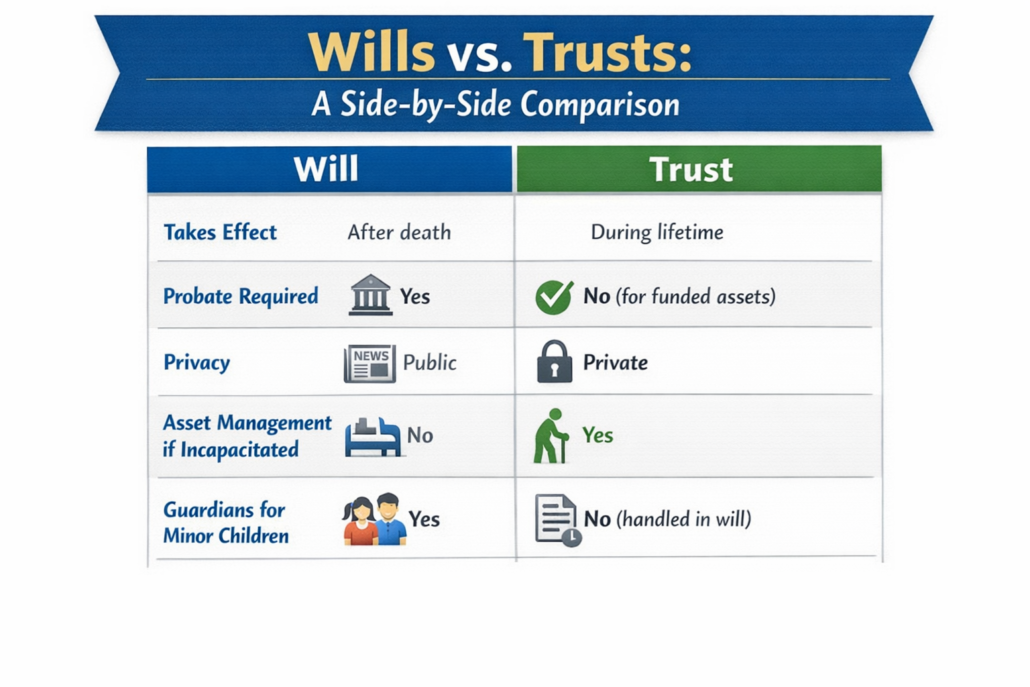
After someone passes away, their will goes through probate — a court-supervised process that validates the will and oversees distribution of assets.
In Maryland, probate is handled through the Register of Wills in the county where the deceased lived. While Maryland’s probate process can be relatively straightforward in simple estates, it is still:
- Public record
- Time-consuming (often several months or more)
- Associated with court fees and administrative costs
For many families, a will is the foundational estate planning document — but it’s not always the complete solution.
What Is a Trust?
A trust is a legal arrangement where one party (the trustee) holds and manages assets for the benefit of another (the beneficiary).
The most common type used in estate planning is a revocable living trust. You create it during your lifetime, maintain control over your assets, and can modify or revoke it as long as you are mentally competent.
Key Benefits of a Trust in Maryland
- Avoids probate for assets placed inside the trust
- Maintains privacy (unlike a will, trusts are not public record)
- Allows for ongoing management of assets after death
- Can provide structured distributions for children or beneficiaries
For families with minor children, blended families, real estate in multiple states, or more complex financial situations, a trust often provides greater flexibility and control.
Important note: Even if you create a trust, you still need a will — typically a “pour-over will” — to ensure any assets not formally transferred into the trust are directed appropriately.
Estate planning isn’t about choosing one over the other in isolation. It’s about building the right structure.
When a Will May Be Enough
A simple will may be appropriate if:
- You have a smaller estate
- You don’t own property in multiple states
- You’re comfortable with the probate process
- Your distribution plan is straightforward
For many Maryland residents, this is a practical and effective option.
When a Trust May Be the Better Fit
A trust may be the better solution if:
- You want to avoid probate
- You value privacy
- You have minor children and want staged distributions
- You have beneficiaries who need asset protection
- You want to plan for incapacity
- You have a blended family and want clarity
Trusts offer greater control — not just over who receives assets, but how and when they receive them.
What Most Families Don’t Realize
Estate planning isn’t just about what happens after you pass away. It’s also about what happens if you become incapacitated.
A comprehensive Maryland estate plan typically includes:
- A will
- A trust (if appropriate)
- Financial power of attorney
- Advance medical directive
Without these documents in place, your family may need court involvement just to manage your affairs — at the exact moment they’re already under stress.
The Right Choice Is Personal
There’s no one-size-fits-all answer. A will works well for some families. A trust is essential for others. Most comprehensive plans use both strategically.
The key is designing an estate plan around:
- Your assets
- Your family structure
- Your long-term goals
- Your desire for privacy and control
Estate planning isn’t about paperwork. It’s about clarity, protection, and making things easier for the people you care about most.
Ready to Protect What Matters Most?
If you’re unsure whether a will, a trust, or a combination of both is right for your family, the best next step is a conversation.
The Law Office of David N. Mabrey helps Maryland families build estate plans that are clear, customized, and designed to work when they’re needed most.
Contact us today to schedule a consultation and start building the right plan for your family’s future.
👉🏼 https://davidnmabreylaw.com/contact-us/
Frequently Asked Questions
1. Do I need a will if I have a trust in Maryland?
Yes. Even if you create a revocable living trust, you still need a will — typically a “pour-over will.” This ensures that any assets not formally transferred into your trust during your lifetime are directed into it after your death. It also allows you to name guardians for minor children, which a trust does not do.
2. What happens if I die without a will in Maryland?
If you pass away without a will, your estate is distributed according to Maryland’s intestacy laws. That means the state decides who inherits your property — not you. The outcome may not reflect your wishes, especially in blended families or situations involving unmarried partners.
3. Does a trust completely avoid probate in Maryland?
A properly funded trust avoids probate for the assets titled in the name of the trust. However, any assets not transferred into the trust during your lifetime may still go through probate. Funding the trust correctly is just as important as creating it.
4. Is probate always a bad thing?
Not necessarily. Maryland’s probate process can be manageable for smaller or straightforward estates. However, it is public, can take months (or longer), and involves court oversight and fees. Many families prefer to avoid it for privacy and efficiency.
5. Are trusts only for wealthy families?
No. Trusts are about control and structure — not just wealth. They can be especially helpful for families with minor children, beneficiaries who may need asset protection, or anyone who wants to avoid probate and maintain privacy.
6. Which is more expensive: a will or a trust?
A trust-based estate plan generally costs more upfront than a simple will because it involves more planning and documentation. However, a trust can reduce future court costs, delays, and administrative expenses. The real question isn’t price — it’s whether the structure matches your goals.
7. Can I change my will or trust later?
Yes. As long as you are mentally competent, you can update or revoke your will or revocable living trust at any time. Estate planning should evolve as your life changes — marriage, children, divorce, new assets, or retirement.
8. What happens if I become incapacitated?
A will does not help if you become incapacitated. A trust can allow a successor trustee to manage your assets without court involvement. A complete Maryland estate plan should also include a financial power of attorney and advance medical directive to protect you during your lifetime.
9. How do I know which option is right for my family?
The right answer depends on your assets, family dynamics, and long-term goals. Some families need a straightforward will. Others benefit from the structure and flexibility of a trust. Many use both together as part of a comprehensive plan.
Ready to Make the Right Decision for Your Family?
Estate planning shouldn’t feel overwhelming — and it shouldn’t be generic. The right strategy is personal.
If you’re weighing a will vs. a trust in Maryland, schedule a consultation to discuss what makes the most sense for your situation.
Contact The Law Office of David N. Mabrey today and start building a plan that protects your family with clarity and confidence.