
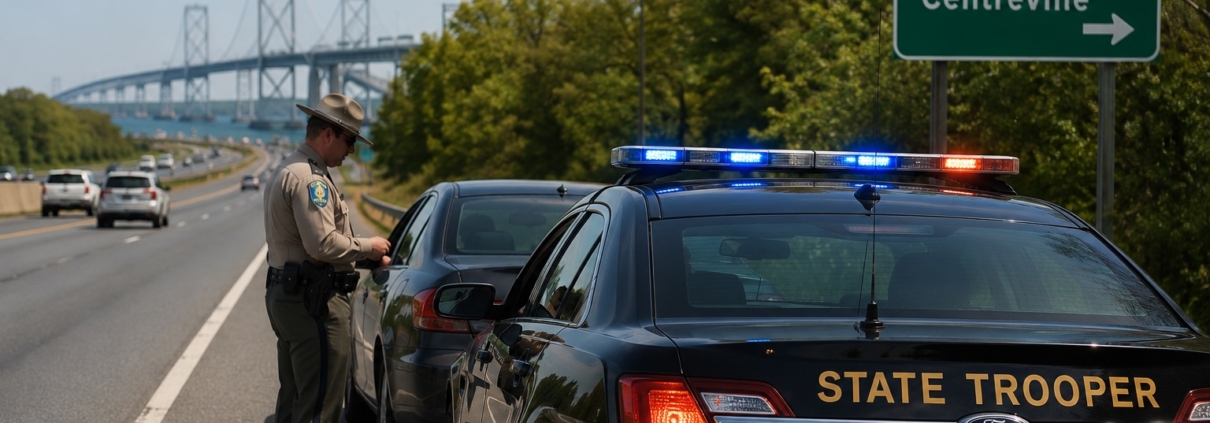
Navigating the Queen Anne’s County Traffic Hub: What to Do if You’re Pulled Over in Centreville
If you drive Route 50 or Route 301 through Queen Anne’s County with any regularity, you already know it’s one of the busiest — and most heavily enforced — stretches of road on Maryland’s Eastern Shore. Every summer, the corridor leading to and from the Chesapeake Bay Bridge fills with beach traffic, and every summer, state and local police respond with high-visibility enforcement pushes designed to catch speeders before they reach the bridge. If you’ve been pulled over anywhere near Centreville, Grasonville, Queenstown, or Kent Island, understanding exactly what you’re facing — and how the process works from here — makes a real difference in the outcome.
This article walks through what typically happens after a traffic stop in Queen Anne’s County, the difference between a routine speeding ticket and a criminal reckless driving charge, how to protect your MVA record, and what the local court process actually looks like.
Why Queen Anne’s County Sees So Much Traffic Enforcement
Queen Anne’s County sits at a geographic chokepoint. U.S. 50 and U.S. 301 both funnel through the county on their way to and from the Bay Bridge, and traffic volumes on that corridor have grown substantially in recent years — the U.S. 301 corridor through the county has seen roughly a 40% increase in traffic volume since 2019, along with a corresponding rise in excessive speeding (Maryland Department of Transportation).
That volume translates directly into enforcement. Ahead of major travel weekends, the Maryland Transportation Authority Police, Maryland State Police, Anne Arundel County Police, and Queen Anne’s County Police routinely coordinate “high visibility” enforcement details along U.S. 50 near the Bay Bridge. During one recent Memorial Day weekend push alone, officers stopped 189 vehicles and issued 277 citations in a single day (WTOP News). These operations aren’t occasional — they happen every summer, and they aren’t limited to speeding. Officers running these details are also watching for suspended licenses, open warrants, and impaired driving, which means a routine stop for going a few miles over the limit can escalate quickly if something else turns up during the encounter.
Governor Wes Moore’s administration has also launched a statewide “Slow the Fast Down” campaign specifically targeting speeding-related crashes, reinforcing that the current environment for enforcement on corridors like Route 50 is more aggressive, not less (Star Democrat). If you’re driving through Queen Anne’s County, especially during the summer travel season, you should assume the odds of encountering a checkpoint or a patrol officer are meaningfully higher than on an average Maryland roadway.
Routine Speeding Ticket vs. Reckless Driving: Where the Line Is
Not every citation issued in Queen Anne’s County carries the same weight, and understanding the difference matters enormously for how you should respond.
A routine speeding ticket — say, 10 to 20 mph over the posted limit — is a civil infraction. It comes with points on your license and a fine, and while it can still affect your insurance premiums, it doesn’t require a criminal court appearance and doesn’t put you at risk of a criminal record.
Reckless driving is a different animal entirely. Under Maryland’s Sergeant Patrick Kepp Act, which took effect statewide on October 1, 2025, driving 30 mph or more over the posted speed limit is automatically classified as criminal reckless driving, carrying up to 60 days in jail, a $1,000 fine, and six points on your license (FrizWoods). That law applies just as fully in Queen Anne’s County as it does anywhere else in the state, and given how fast traffic tends to move on Route 50 and Route 301 in this corridor, it’s not a hypothetical risk — it’s a genuinely common outcome of enforcement pushes near the bridge.
Reckless driving can also be charged based on the officer’s judgment that a driver operated their vehicle in willful or wanton disregard for the safety of others, independent of the 30-over threshold — meaning erratic lane changes, tailgating at high speed, or unsafe passing near the bridge approach can all trigger the charge even below that specific speed differential.
There’s also aggressive driving, a separate charge that applies when a driver commits three or more qualifying violations — speeding, following too closely, unsafe lane changes, failing to yield — during a single, continuous period of driving. The law defining aggressive driving was broadened under the same 2025 legislation, making it easier for prosecutors to bring that charge when a driver’s overall pattern of behavior, not just one isolated violation, looks dangerous (carscounsel.com).
Knowing which of these three categories your citation falls into — civil infraction, reckless driving, or aggressive driving — should be the first thing you and your attorney establish, because it determines everything from whether you’re required to appear in court to how many points are actually on the table.
Keeping Points Off Your Maryland MVA Record
For most drivers, the real long-term cost of a traffic citation isn’t the fine — it’s the points. Maryland’s point system is cumulative, and the consequences escalate the more points you accumulate:
- 8 points triggers a mandatory MVA administrative hearing to review your driving privileges.
- 12 points can result in license revocation (SRIS, P.C.).
A single reckless driving conviction carries six points on its own — enough to put most drivers dangerously close to that 8-point hearing threshold, especially if they already have a violation or two on their record from the prior two years. Insurance premiums also respond directly to points on your MVA record, often for three years or more after a conviction.
This is where a proactive legal strategy matters. Depending on the facts of your stop — how the speed was measured, the officer’s basis for the stop, prior driving history, and the specific charge — an attorney may be able to negotiate:
- A reduction to a non-point violation, which resolves the case without adding to your MVA record at all.
- Probation Before Judgment (PBJ), a disposition that allows a driver to avoid formal conviction and points upon successfully completing a period of probation.
- A dismissal or amendment of the charge where the stop or the citation itself has legal or factual weaknesses.
None of these outcomes happen automatically, and none of them happen well if you walk into the Queen Anne’s County District Court unprepared or plan to simply plead guilty on the day of your hearing. The stronger and earlier the defense, the more room there is to negotiate an outcome that protects your license and your insurance rate.
What the Local Court Process Actually Looks Like
If you’re cited in Queen Anne’s County, your case is heard at the District Court of Maryland for Queen Anne’s County, located at 120 Broadway, Suite #1, in Centreville (Maryland Courts). The court sits at the intersection of Broadway and Route 213, right in the heart of Centreville’s historic downtown — a courthouse area that also houses the county’s Circuit Court, just a short distance away on North Commerce Street.
A few practical points about how cases move through this court:
- The District Court does not conduct jury trials. If your case involves a criminal charge like reckless driving and you want a jury trial, it gets transferred to the Queen Anne’s County Circuit Court, which typically adds weeks to months to the process.
- Civil infraction speeding tickets can often be resolved without a mandatory in-person appearance, but criminal charges like reckless or aggressive driving require you to show up.
- Location matters for jurisdiction. The Bay Bridge and its immediate approaches straddle Anne Arundel and Queen Anne’s County depending on exactly where the stop occurred, and if you were stopped further east toward Easton or Chestertown, your case might actually belong to Talbot or Kent County instead. Always check the court location printed on your citation — it tells you exactly where you’re required to appear (David N. Mabrey, Esq.).
Because Queen Anne’s County shares this corridor with neighboring counties, it’s common for drivers to be genuinely unsure which courthouse their case belongs to, or to assume incorrectly that a citation issued “near the bridge” automatically means one specific county. Getting that detail wrong — showing up at the wrong courthouse, or missing a court date because you assumed the case was elsewhere — can create complications that are entirely avoidable with the right guidance up front.
Why an Accessible, Regionally Focused Attorney Matters
The Law Offices of David N. Mabrey aren’t based in Centreville, but that regional distance doesn’t translate into a disadvantage — if anything, it reflects how this entire corridor actually works. Drivers moving through Queen Anne’s County on Route 50 and Route 301 are, by definition, regional travelers: commuters heading toward Anne Arundel County and Baltimore, Eastern Shore residents heading toward Kent and Talbot counties, and vacationers passing through from all directions. An attorney who represents clients across this entire Eastern Shore corridor — not just one county — brings a genuinely useful vantage point: familiarity with how Queen Anne’s County District Court operates, how it compares to neighboring Kent and Talbot County courts, and how enforcement patterns along Route 50 and Route 301 tend to play out season to season.
That regional familiarity matters in practice. Understanding which stretch of a citation likely came from a coordinated Bay Bridge enforcement detail versus a routine patrol stop, knowing how a particular court tends to handle first-time reckless driving charges versus repeat offenders, and being able to move quickly between courthouses in Chestertown, Centreville, and beyond — these are the kinds of details that come from working this specific corridor consistently, not from a single office location.
What to Do If You’re Pulled Over in Queen Anne’s County
If you’ve just been cited, or you’re bracing for an upcoming court date, here’s what actually matters in the days that follow:
- Read your citation carefully. Confirm which court it directs you to and whether it’s a civil infraction or a criminal charge like reckless or aggressive driving.
- Don’t assume you can just pay it off if it’s a criminal charge. Reckless and aggressive driving both typically require an in-person court appearance.
- Write down what you remember while it’s fresh — road conditions, how the officer measured your speed, and anything unusual about the stop itself.
- Get legal advice before your court date, not the morning of. The earlier an attorney can review your citation and the underlying stop, the more options remain on the table for negotiating a favorable outcome.
The Bottom Line
Queen Anne’s County — and the Route 50/301 corridor running through it — is one of the most heavily patrolled stretches of road in Maryland, particularly during the summer travel season. Whether you’ve been cited for a routine speeding violation or something more serious like reckless or aggressive driving, understanding exactly what you’re facing, and getting ahead of it with the right legal strategy, is the difference between a manageable outcome and a conviction that follows you for years through points, insurance costs, and even a criminal record.
Cited for speeding, reckless driving, or aggressive driving in Queen Anne’s County? Don’t wait until your court date to find out what’s actually at stake. Get experienced Eastern Shore traffic defense on your side today.
👉🏼 Contact David N. Mabrey, Attorney at Law
Two convenient locations:
Chestertown
107 Court St, Chestertown, MD 21620
Office: 410-778-1630
Pasadena
8611 Fort Smallwood Rd C, Pasadena, MD 21122
Office: 443-702-7708
Fax: 443-702-7709
Cell: 443-848-2878 (Cell for Emergency/New Accident Only)
Frequently Asked Questions
What’s the difference between a speeding ticket and a reckless driving charge in Queen Anne’s County?
A routine speeding ticket is a civil infraction — you get points and a fine, but no criminal record and no mandatory court appearance in most cases. Reckless driving is a criminal misdemeanor, triggered automatically by driving 30 mph or more over the posted limit, or by an officer’s determination that you drove in willful or wanton disregard for others’ safety. It carries up to 60 days in jail, a $1,000 fine, six points, and a required court appearance (FrizWoods).
Why does Queen Anne’s County have so much traffic enforcement?
The county sits at the geographic chokepoint where U.S. 50 and U.S. 301 funnel toward the Chesapeake Bay Bridge. Traffic volume on this corridor has grown roughly 40% since 2019, and law enforcement agencies — including the Maryland Transportation Authority Police, Maryland State Police, and county police — regularly run coordinated high-visibility enforcement details near the bridge, especially before major summer travel weekends (Maryland Department of Transportation; WTOP News).
Can I get points kept off my Maryland MVA record?
In some cases, yes. Depending on the facts of your stop and your driving history, an attorney may be able to negotiate a reduction to a non-point violation or a Probation Before Judgment (PBJ) disposition, which allows you to avoid formal points after successfully completing probation. This isn’t automatic — it depends on a prepared defense and how early you get legal help involved (SRIS, P.C.).
How many points until I’m at risk of losing my license?
Maryland’s point system triggers a mandatory MVA administrative hearing at 8 points, and your license can be revoked at 12 points. A single reckless driving conviction carries six points on its own, which is often enough to put a driver dangerously close to that 8-point threshold if they already have other violations on record (SRIS, P.C.).
Where is the Queen Anne’s County District Court, and does it handle jury trials?
The District Court of Maryland for Queen Anne’s County is located at 120 Broadway, Suite #1, in Centreville, at the intersection of Broadway and Route 213 (Maryland Courts). The District Court does not conduct jury trials — if you request one on a criminal charge like reckless driving, your case is transferred to the Queen Anne’s County Circuit Court, which typically adds significant time to the process.
I was pulled over near the Bay Bridge — how do I know which county’s court I need to appear in?
The Bay Bridge and its immediate approaches fall in either Anne Arundel or Queen Anne’s County depending on exactly where the stop occurred, and stops further east toward Easton or Chestertown may actually belong to Talbot or Kent County. Your citation will list the specific court you’re required to appear in — always check that document directly rather than assuming based on where you think the stop happened (David N. Mabrey, Esq.).
Can a traffic stop turn into something more serious than the original violation?
Yes. During high-visibility enforcement pushes, officers are also checking for suspended licenses, open warrants, and impairment. A routine stop for speeding can escalate if the officer discovers an outstanding warrant, a suspended license, or other criminal indicators during the encounter — which is common enough that law enforcement agencies report multiple such arrests during a single enforcement detail.
Do I need a local Queen Anne’s County attorney, or can any Maryland traffic attorney handle my case?
You don’t need an attorney physically headquartered in Centreville, but you do want one who regularly works this specific corridor. Familiarity with how the Queen Anne’s County District Court operates, how it compares to neighboring Kent and Talbot County courts, and how enforcement patterns along Route 50 and Route 301 tend to shift seasonally all come from consistent experience across this Eastern Shore region — not simply from a nearby office address.