House keys on a folder of deed paperwork on a kitchen table, with a brick home outside the window

Maryland Transfer-on-Death Deeds: How to Pass Your Home Without Probate

Maryland homeowners have a new estate-planning option. Since October 1, 2026, a transfer-on-death (TOD) deed can let you name who receives your real estate when you die without putting that property through probate. You remain the owner while you are alive, and you can change your plans. But the deed must be prepared and recorded correctly, and it does not solve every estate-planning problem.

If you own a home in Anne Arundel County, Kent County or elsewhere in Maryland, here is what the new law means and when it may be worth speaking with an attorney.

What Is a Transfer-on-Death Deed in Maryland?

A transfer-on-death deed is a document that identifies one or more people or other eligible beneficiaries who will receive an interest in Maryland real estat…

Maryland’s Transfer-on-Death Deed Act took effect October 1, 2026, and appears in the Real Property Article, sections 14-1001 through 14-1014. The law applies to qualifying TOD deeds made before, on or after that date when the owner dies on or after October 1, 2026.

This is one option among several. For example, some jointly owned property and property already held in a properly funded trust may also pass outside probate. The best choice depends on how title is held, who should inherit and the rest of the estate plan.

How to Create a Valid Maryland TOD Deed

  1. Identify the property and check its current title. The deed needs an accurate legal description, and existing ownership arrangements matter.

  2. Name the beneficiaries. Consider backup beneficiaries in case your first choice dies before you.

  3. Prepare and sign a compliant deed. It must meet Maryland deed requirements, clearly state that the transfer occurs at death, and be properly acknowledged before a notary or other authorized official.

  4. Record the deed before death in the land records for every county where the real estate lies. A signed deed kept at home is not enough.

Maryland provides an optional statutory deed form, but a form does not resolve every ownership or family situation. Beneficiaries do not have to sign, accept or receive notice of the deed for it to be effective. Still, telling the right people where the deed is recorded can reduce confusion later.

For property in Pasadena, recording is through the Anne Arundel County Circuit Court land records. For property in Cheste…

What Happens While You Are Alive?

You keep your ownership rights. You may generally sell the property, refinance, place a mortgage on it or make a qualifying change to your TOD deed. Recording the TOD deed does not give the named beneficiary a present ownership interest. It also does not stop your creditors from pursuing rights they otherwise have.

Can You Change or Cancel a TOD Deed?

Yes. Before death, an owner may revoke or replace a recorded TOD deed by properly executing, acknowledging and recording a later TOD deed, a revocation instrument, or an applicable lifetime deed that revokes it expressly or by inconsistency. The rules become more complicated when several owners are involved.

You cannot cancel a recorded TOD deed simply by destroying your copy or by writing a conflicting instruction in a later will. If you marry, divorce or experience another major family change, have the deed reviewed promptly: Maryland law makes TOD transfers subject to particular protections and revocation rules concerning spouses and children.

What Happens After the Owner Dies?

If the TOD deed is effective and the beneficiary survives the owner, the beneficiary receives the interest described in the deed without probate for that property transfer. An alternate beneficiary may receive the property if the original beneficiary dies first and the deed provides for that result. Beneficiaries may disclaim an interest under Maryland law.

A TOD deed does not erase mortgages, liens, contracts or other valid interests affecting the property. The recipient takes subject to those obligations, and the statute does not provide a warranty of title.

Joint ownership deserves special attention. When the property is held by joint owners with survivorship rights, the surviving joint owner generally takes before the TOD designation becomes effective upon the last surviving joint owner’s death. Tenants in common are treated differently. If you own real estate with another person, review the current deed rather than assuming the TOD rules work the same way for everyone.

Where more than one beneficiary is named, Maryland provides a default of joint tenancy with right of survivorship unless the TOD deed specifies another form of ownership. That default may not fit every family.

What a TOD Deed Does Not Do

  • It does not avoid every tax. Maryland inheritance tax may still apply depending on the beneficiary. Close family members are generally exempt; other …

A separate rule exempts a TOD deed involving the owner’s primary or secondary residence from Maryland recordation tax and applicable state and county transfer taxes. That does not mean every property qualifies, that clerks charge no filing fees, or that an inheritance-tax obligation disappears. Investment property or farmland should be reviewed individually.

Is a TOD Deed a Good Fit for Your Maryland Home or Farm?

A TOD deed may be useful for an owner who wants a particular parcel of real estate to pass directly to clearly identified beneficiaries while preserving control during life. But it is not automatically the simplest answer for everyone.

Get individualized advice if you share ownership with someone else, have a blended family, want to leave property to a minor, have a beneficiary receiving needs-based benefits, own farmland or rental property, anticipate long-term-care expenses, or hold the property through a business entity. The right plan depends on the deed, the people involved and your broader goals.

Talk With David About Your Maryland Estate Plan

A transfer-on-death deed can be a useful tool, but choosing the wrong beneficiaries or overlooking h…

A transfer-on-death deed can be a useful tool, but choosing the wrong beneficiaries or overlooking how the property is titled can create problems for the people you intend to help. The Law Offices of David N. Mabrey serves clients in Anne Arundel and Kent Counties. To discuss whether a TOD deed fits your circumstances, call 443-702-7708 or reach out through the firm’s contact form.

Statutory sources: Md. Code Ann., Real Prop. §§ 14-1001 through 14-1014 (Maryland Transfer-on-Death Deed Act); 2026 Md. Laws ch. 750 (

The information in this article is provided for general informational purposes only and may not reflect the current law applicable to your particular circumstances. Nothing in this article constitutes legal advice or creates an attorney-client relationship. You should consult a licensed attorney about the specific facts and circumstances of your case.

Statutory sources: Md. Code Ann., Real Prop. §§ 14-1001 through 14-1014 (Maryland Transfer-on-Death Deed Act); 2026 Md. Laws ch. 750 (SB 651) and ch. 751 (HB 738) (effective Oct. 1, 2026).

Frequently Asked Questions

Do I need a lawyer to create a TOD deed in Maryland?

Maryland provides an optional statutory form, and a homeowner is not generally required to retain a lawyer solely to use it. However, a legal description, title issue, beneficiary designation or recording error can defeat the intended result. An attorney can review how the deed fits into the rest of your plan.

Can I use a transfer-on-death deed if my house has a mortgage?

Yes. A mortgage does not automatically prevent you from using a TOD deed. The mortgage remains attached to the property, and the beneficiary receives the property subject to existing obligations.

Does the beneficiary have to know about the TOD deed?

No. The law does not require notice, delivery or acceptance by the beneficiary while you are alive. It can still be useful to explain where important estate documents are kept.

What if my beneficiary dies before me?

A beneficiary who does not survive the owner generally cannot take under that designation. Naming an alternate beneficiary can help address that situation. Have the deed reviewed if your family circumstances change.

Is a TOD deed better than a living trust?

Neither is automatically better. A TOD deed addresses a transfer of real estate at death. A properly structured and funded trust may coordinate multiple assets and provide additional management options. The appropriate choice depends on your family, property and goals.

Three generations of a family walk together beside a working waterfront farm on Maryland's Eastern Shore, discussing the future of their family-owned land and business at sunset.

Passing Down the Family Farm or Business: Crucial Estate Planning for Eastern Shore Families

Along the Chester River corridor, from the grain farms of Kennedyville to the crabbing operations off Comegys Bight, family-owned land and businesses represent far more than economic assets. They are legacies — held across generations by the same surnames that appear on Kent County deed books stretching back centuries. But without a carefully constructed estate plan, that legacy is vulnerable to tax liability, probate delays, and the kind of sibling disputes that no family anticipates and every estate attorney has seen.

This guide is written specifically for Eastern Shore families — farmers, watermen, small business owners, and landowners in Kent County and the surrounding region — who want to understand their options and take action before a crisis forces the issue.

Why the Eastern Shore Is Different

Maryland’s Eastern Shore presents a unique estate planning environment. Land values in Kent County have climbed steadily, driven by agricultural productivity, proximity to the Chesapeake Bay, and the desirability of rural acreage among out-of-state buyers.¹ That appreciation is a double-edged sword: it grows family wealth, but it also grows potential estate tax exposure and complicates fair distribution among heirs.

Many farm and fishing families operate under tight cash-flow conditions. A property that appraises at $2 million on paper may generate modest annual income relative to its value. When estate taxes or the costs of probate come due, heirs are sometimes forced to sell the very land they inherited simply to pay the bill — a phenomenon so common it has a name among agricultural attorneys: the “estate sale spiral.”²

Maryland compounds this challenge with its own estate tax, separate from the federal system. While the federal exemption sits at $15 million per individual for 2026, Maryland’s exemption is only $5 million — meaning many Eastern Shore estates that would sail through federal review still face a state-level tax bill.³ For a multi-generational farm or a well-established business, that can mean six figures owed within nine months of death.

Maryland is also the only state that levies both an estate tax and an inheritance tax. The inheritance tax does not apply to close family members such as spouses, children, parents and siblings, but it can apply to nieces, nephews, friends and others. Proper planning can legally reduce both.

The Core Problem: Farms and Businesses Don’t Divide Easily

Financial assets — stocks, savings accounts, retirement funds — can be apportioned among heirs with relative precision. A farm cannot. Neither can a family crabbing license, a processing facility, or a Main Street business in Chestertown that has operated under the same name for thirty years.

When a parent dies without a clear succession plan, courts and families face a fundamental conflict: the heir who wants to continue the operation versus the heirs who need liquidity. In Maryland, any co-owner of real property can petition for partition — a legal proceeding that can force a sale of the property over the objection of other owners.⁴ Courts have divided farmland this way for generations. The family business, once sold, rarely comes back.

The American Farmland Trust estimates that 40 percent of all U.S. farmland will change hands within the next two decades, largely through estate transfers, and that a significant portion of that land will leave agricultural use permanently.⁵ Maryland’s own Department of Agriculture has acknowledged the succession challenge as one of the primary threats to the state’s farming economy.⁶

Essential Tools for Succession Planning

Revocable Living Trusts

A revocable living trust is one of the most effective instruments for avoiding probate entirely. Unlike a will — which must pass through Maryland’s Orphans’ Court process before assets can transfer — a trust allows property to move directly to named beneficiaries at death, without court supervision, without public record, and without the delays (often six months to over a year) that probate imposes.⁷

For farm families, this matters enormously. During probate, farm operations must often continue without clear legal authority over assets. Equipment purchases, lease renewals, and crop-year financing decisions can all be complicated by an unresolved estate. A properly funded trust eliminates that limbo.

Qualified Use Valuations Under IRC § 2032A

Federal tax law provides a powerful estate tax break specifically designed for family farms and closely held businesses. Under Internal Revenue Code Section 2032A, qualifying agricultural and business property can be valued based on its current use rather than its highest and best use at the time of death.⁸

In practical terms: if your Kent County farmland would be worth $3 million to a developer but only $1.2 million as operating farmland, the estate can value it at $1.2 million for tax purposes — provided the heirs continue farming it for at least ten years. The maximum reduction allowable under 2032A is more than $1.3 million and is indexed for inflation each year. This is one of the most underutilized provisions in agricultural estate planning.⁹

Family Limited Partnerships and LLCs

Transferring a farm or business into a Family Limited Partnership (FLP) or a family-held LLC allows the senior generation to gift ownership interests to heirs gradually — often at a valuation discount — while retaining management control during their lifetime.¹⁰

Minority interests in a closely held entity are generally valued at a discount relative to their proportional share of underlying assets, because a minority owner cannot force a sale or control operations. These “lack of control” and “lack of marketability” discounts, typically ranging from 15 to 40 percent, can significantly reduce the taxable value of transferred interests.¹¹ An LLC also formalizes the business structure, making it easier to document ownership, bring in the next generation, and protect against creditor claims.

Grantor Retained Annuity Trusts (GRATs)

A GRAT is an irrevocable trust into which you transfer an appreciating asset — say, farmland expected to rise in value or a business with growing revenues. You receive a fixed annuity payment back for a set term; at the end of the term, any remaining value passes to heirs with little or no gift tax.¹² GRATs work best when the transferred asset appreciates faster than the IRS hurdle rate, making them a tool worth discussing with your attorney when interest rates are favorable.

Agricultural Conservation Easements

Maryland’s agricultural preservation program — one of the nation’s oldest and most active — allows landowners to sell development rights to the state or a land trust while retaining ownership and the right to farm.¹³ The proceeds from selling a conservation easement can fund estate taxes or equalize inheritances among heirs: one heir continues farming while others receive a cash equivalent.

Additionally, the donated portion of an easement may generate a charitable deduction for federal income tax purposes, and an easement-encumbered property’s value for estate tax purposes is reduced to reflect the restriction.¹⁴ Kent County has among the highest per-acre easement values in the state through the Maryland Agricultural Land Preservation Foundation (MALPF).

Buy-Sell Agreements for Family Businesses

If you co-own a business — whether a farm operation, a retail establishment, or a service company — a buy-sell agreement is essential. This legally binding document establishes what happens to an owner’s interest upon death, disability, divorce, or retirement: who can buy it, at what price, and on what terms.¹⁵

Without one, a deceased owner’s interest passes to their estate and then to heirs who may have no interest in or aptitude for the business. Co-owners may find themselves in business with a deceased partner’s surviving spouse or estranged children — a situation that frequently ends in litigation or a forced sale. Buy-sell agreements are often funded with life insurance, ensuring surviving owners have the capital to purchase the departing owner’s interest promptly.

The Maryland Probate Process: What Your Family Faces Without a Plan

Maryland’s estate administration is governed by the Estates and Trusts Article and administered through the Orphans’ Court in each county.¹⁶ In Kent County, that court sits right here in Chestertown. The process is public — any interested party can review the inventory of your estate’s assets — and it takes time.

A typical Maryland probate involves filing an inventory of assets within three months of appointment, publishing notice to creditors, waiting a six-month creditor claim period from the date of death, resolving any disputes, and obtaining court approval before distribution.¹⁷ For a complex estate involving real property, a business, or disputed valuation, the timeline stretches further.

During this period, family members seeking to operate the farm or business face legal uncertainty. A comprehensive estate plan — anchored by a trust, supported by properly titled assets, and paired with durable powers of attorney — keeps the family in control from day one.

Planning for Incapacity, Not Just Death

One aspect of estate planning that farm and business families often overlook is the period before death — the months or years during which a family patriarch or matriarch may become incapacitated due to illness or injury.

Without a durable financial power of attorney, family members cannot legally manage the farm’s finances, sign operating loan renewals, or sell grain on behalf of an incapacitated owner. A court-supervised guardianship proceeding may be required — an expensive, time-consuming process that puts a judge, rather than the family, in control of the business.¹⁸

A properly drafted durable power of attorney grants a trusted agent authority to act immediately, without court involvement, and can include specific provisions tailored to agricultural operations: authority to manage crop insurance, sign USDA program enrollment forms, and operate farm equipment accounts.

Treating Heirs Fairly Without Selling the Farm

One of the most emotionally charged challenges in farm and business succession is fairness. When one child has worked the land for decades and another has built a career elsewhere, how do you distribute assets equitably without forcing a sale?

A few strategies help resolve this:

Life insurance as an equalizer. A policy owned by an irrevocable life insurance trust (ILIT) can provide a cash inheritance to non-farming heirs while the farm passes intact to the successor — and the ILIT structure keeps the death benefit outside your taxable estate.¹⁹

Compensating labor with an unequal share. Formalizing through a lifetime employment agreement and documented salary arrangements — with an explicit acknowledgment in the estate plan — reduces the likelihood of a post-death dispute when one heir has worked for below-market wages for decades.

Conservation easement proceeds. Selling a partial easement on the most development-pressured portion of the property generates cash that can be distributed to non-farming heirs, while the encumbered farmland passes to the successor at a lower taxable value.

Installment sales between family members. The farming heir purchases the property from the estate over time, generating income for non-farming beneficiaries without requiring an outside sale. Properly structured, an installment sale can qualify for favorable capital gains treatment.²⁰

Don’t Wait for a Health Event to Start Planning

Estate planning conversations often begin in the wrong order. A diagnosis, a hospitalization, or a sudden death prompts the call to an attorney — but by then, options have narrowed. Transferring interests into an FLP, funding a GRAT, or completing a conservation easement application through MALPF all require time and a legally competent grantor. MALPF applications alone can take years from submission to closing.

The federal estate tax exemption is $15 million per person for 2026 and is indexed for inflation going forward, after a 2025 federal law removed the scheduled sunset of the 2017 increase.²¹ Planning now — rather than waiting on legislative outcomes — protects your family under current law and positions you for whatever changes follow.

The families who navigate succession most successfully are those who began the conversation early, while the senior generation was still healthy and actively farming, and who revisited the plan regularly as the law changed and the business grew.

Your family built it. Let’s make sure it stays in the family.

If you own farmland, a working waterfront operation, or a small business on the Eastern Shore, Mabrey Law can help you design an estate plan that protects what you’ve built — and makes the transition to the next generation as smooth as possible.

Schedule a Consultation →

Chestertown — 107 Court St, Chestertown, MD 21620 · (410) 778-1630

Pasadena — 8611 Fort Smallwood Rd C, Pasadena, MD 21122 · (443) 702-7708

This article is for general informational purposes only and does not constitute legal advice. Consult an attorney for guidance specific to your situation.

Frequently Asked Questions

Do I need an estate plan if I already have a will?

A will is a starting point, not a complete plan. For farm and business owners, a will alone has significant limitations — it still goes through probate, it becomes public record, and it cannot help your family manage the operation during the months the estate is being administered. Most Eastern Shore landowners benefit from a combination of a revocable living trust, a durable power of attorney, and a will working together.

What happens to my farm if I die without any estate plan in Maryland?

Your property passes under Maryland’s intestacy laws, which divide assets among heirs in a fixed formula regardless of your wishes. More critically, the estate goes through Orphans’ Court probate in Kent County, which is public, can take a year or more, and leaves your family without clear legal authority to operate the business in the meantime. If heirs disagree on what to do with the land, any one of them can petition the court to force a sale.

How is Maryland’s estate tax different from the federal estate tax?

The federal estate tax exemption is $15 million per person for 2026 — so most estates don’t trigger it. Maryland’s exemption is only $5 million, meaning a farm or property portfolio that clears the federal threshold can still owe significant state tax. Maryland also has a separate inheritance tax depending on who inherits. Planning addresses both.

Can I reduce what my farm is worth for estate tax purposes?

Yes — and this is one of the most valuable tools available to Eastern Shore families. Under IRC § 2032A, qualifying farmland can be valued at its current agricultural use rather than its development value. If your land is worth $3 million to a developer but $1.2 million as a working farm, the estate can use the lower number, provided heirs continue farming for at least ten years. The savings can be substantial.

What if I want one child to take over the farm but I have other children to provide for?

This is the most common challenge in agricultural succession planning, and there are several ways to handle it fairly. Life insurance held in an irrevocable trust can provide a cash inheritance to non-farming children while the farm passes intact. Conservation easement proceeds, installment sale arrangements, and clearly documented employment compensation for the farming heir are other tools that help balance the outcome without forcing a sale.

What is a conservation easement and should I consider one?

A conservation easement is an agreement where you sell or donate your land’s development rights to the state or a land trust, while keeping ownership and the right to farm. Maryland’s program through MALPF is one of the most active in the country, and Kent County easement values are among the highest in the state. Beyond preserving the land, easement proceeds can fund estate taxes and equalize inheritances — making it both a conservation tool and an estate planning tool.

Does my business need a buy-sell agreement?

If you have any co-owner — a sibling, a business partner, anyone — yes. Without one, a deceased owner’s interest passes to their heirs, who may have no interest in or knowledge of the business. Surviving co-owners can end up in business with someone they never chose. A buy-sell agreement sets the terms in advance: who can buy the interest, at what price, and how it’s funded, usually through life insurance.

When should I start estate planning?

As early as possible, and well before any health event forces the issue. Some strategies — like transferring interests into a family LLC or completing a conservation easement application — take years to execute properly. The federal estate tax exemption is also subject to change; Congress can change it again, and waiting on legislative outcomes is a risk you don’t need to take. The best time to plan is when you have the most options available to you.

How do I get started with Mabrey Law?

Reach out to schedule a consultation at our Chestertown office — 107 Court St, Chestertown, MD 21620, (410) 778-1630 — or our Pasadena location at 8611 Fort Smallwood Rd C, (443) 702-7708. You can also contact us directly at davidnmabreylaw.com/contact-us.

Sources

  1. Maryland Department of Agriculture, Maryland Agricultural Statistics, 2023 Annual Report. mda.maryland.gov.
  2. American Farm Bureau Federation, Keeping the Farm in the Family: Estate Planning Essentials (2022). fb.org.
  3. Md. Code Ann., Tax-Gen. § 7-309; IRS Rev. Proc. 2023-34 (2024 federal exemption figures).
  4. Maryland Code, Real Property Article § 14-107 (partition of real property).
  5. American Farmland Trust, Farms Under Threat: The State of the States (2020). farmlandinfo.org.
  6. Maryland Department of Agriculture, Beginning Farmer Succession and Transfer Program. mda.maryland.gov.
  7. Maryland Estates and Trusts Article § 9-102; Maryland Rules, Title 6 (estate administration).
  8. Internal Revenue Code § 2032A (special use valuation for farm and business real property).
  9. IRS Rev. Proc. 2023-34 (§ 2032A indexed ceiling for 2024).
  10. Akers, Family Limited Partnerships, American Bar Association Section of Real Property, Trust and Estate Law (2023).
  11. Estate of Powell v. Commissioner, 148 T.C. 392 (2017).
  12. IRC § 2702; Treas. Reg. § 25.2702-3 (grantor retained annuity trust rules).
  13. Maryland Agricultural Land Preservation Foundation, Program Overview. mda.maryland.gov/malpf.
  14. IRC § 170(h) (conservation easement deduction); Md. Code Ann., Tax-Prop. § 8-211.
  15. Stuckey, Buy-Sell Agreements for Closely Held Businesses, 4th ed. (Practising Law Institute, 2022).
  16. Maryland Estates and Trusts Article §§ 5-101 et seq.; Maryland Courts Article § 2-302.
  17. Maryland Estates and Trusts Article § 7-103 (inventory); § 8-103 (creditor claim period).
  18. Maryland Code, Estates and Trusts Article § 13-201; § 15-102 (guardianship of the property).
  19. IRC § 2042; IRC §§ 2036–2038 (ILIT planning to exclude life insurance proceeds).
  20. IRC § 453 (installment sales); IRC § 1231 (treatment of gains on farm property).
  21. Tax Cuts and Jobs Act of 2017, Pub. L. No. 115-97 § 11061 (sunset provision).

Couple reviewing an estate plan with a Maryland attorney to choose an executor

How to Choose an Executor for Your Maryland Estate (And Why It Matters)

When most people sit down to write a will, they spend the most time thinking about who gets what. The house, the savings account, the family heirlooms. What they spend far less time on — and often get wrong — is who will be in charge of making all of it actually happen.

That person is your executor. In Maryland, they are officially called your Personal Representative, and choosing the right one may be the single most consequential decision in your entire estate plan.

What Does an Executor Actually Do?

Before you can choose the right person, it helps to understand exactly what you are asking them to take on.

The Personal Representative is the person that settles up your affairs after death and handles the administration of your will. Importantly, the Personal Representative is NOT the person receiving property and assets of the estate. The Personal Representative is legally put in place — with fiduciary obligations — to manage a decedent’s assets on behalf of the estate, the heirs, and the beneficiaries. Md. Code, Est. & Trusts § 7-101

In practical terms, that means your executor will be responsible for:

  • Filing your will with the Register of Wills in the county where you lived
  • Petitioning the court to open your estate and obtain Letters of Administration
  • Taking possession of and securing all estate assets
  • Notifying creditors and beneficiaries
  • Paying outstanding debts, taxes, and expenses from estate funds
  • Filing your final income tax returns and any estate tax returns
  • Inventorying and appraising all estate property
  • Distributing remaining assets to your beneficiaries
  • Filing a final accounting with the court

The personal representative must file an Inventory and Information Report within three months after being appointed. Md. Code, Est. & Trusts § 7-201 The personal representative must secure the decedent’s assets, appraise or value each asset, and prepare a detailed inventory to file with the Register of Wills. Depending on the nature of the assets, the personal representative may need to retain a professional appraiser to value specific assets. Md. Code, Est. & Trusts § 7-202

Within 20 days of appointment, the personal representative is required to file with the court a list of names and addresses of the beneficiaries named in the will and the decedent’s next-of-kin who would inherit in the absence of a will. Md. Code, Est. & Trusts § 7-104

This is not a passive role. Depending on the size and complexity of your estate, serving as Personal Representative can take anywhere from several months to well over a year. It involves real deadlines, legal filings, financial decisions, and direct interaction with courts, creditors, and beneficiaries — often while grieving.

Who Can Legally Serve as an Executor in Maryland?

Maryland law sets specific eligibility requirements that your chosen executor must meet before the Register of Wills will appoint them.

In Maryland, the executor must be at least 18 years old and of sound mind. They cannot have been convicted of a serious crime. Maryland law also generally requires that the executor be a U.S. citizen. A permanent resident who is not a citizen can serve only if they are the decedent’s spouse, ancestor, descendant, or sibling. Md. Code, Est. & Trusts § 5-105

In Maryland, you can’t name an executor who has been convicted of a “serious crime” unless this person demonstrates a good reason to serve as executor. For example, someone who has been convicted of fraud, extortion, embezzlement, forgery, perjury, or theft would in most cases be ineligible to serve. Nolo

Maryland also has a slayer statute — a person who feloniously and intentionally kills someone is prohibited from being appointed executor of that person’s estate. Nolo

What if your executor lives out of state? This is a common situation — a trusted sibling or adult child who has moved away. It is not disqualifying, but it does create an additional requirement. In Maryland, a nonresident executor must appoint someone who lives in the state to act as a resident agent. Your executor’s in-state agent will accept legal papers on behalf of your estate. Nolo

For practical reasons, choosing someone local is still preferable whenever possible. Your Personal Representative may need to appear in person at the Register of Wills, manage physical property, and deal with local institutions — all of which become significantly more burdensome from out of state.

The Qualities That Actually Matter

Meeting the legal requirements is just the baseline. The qualities that make someone a truly effective Personal Representative go well beyond eligibility.

Trustworthiness

Your executor will have complete access to your financial accounts, personal records, and estate assets. They will be making decisions that directly affect your beneficiaries’ inheritance. Whether you’re considering a family member, close friend, or professional institution, the person or entity you select should be utterly trustworthy and uphold the highest standards of integrity. They’ll be handling your assets and possibly making significant financial decisions.

Organizational Ability

The Maryland probate process involves multiple deadlines, forms, and filings — all of which must be completed accurately and on time. Personal representatives should calendar all notice, inventory, accounting, and tax deadlines the day they are appointed. They must document decisions and keep receipts, statements, and beneficiary communications. A disorganized executor can cause delays, missed filings, and real financial harm to your estate.

Emotional Stability and Impartiality

Serving as an executor often means managing family members who are grieving, disagreeing, and under financial stress — sometimes all at once. Your executor may be asked to make decisions that disappoint or upset people they love. They need to be able to hold the line on what your will actually says, even under pressure.

Financial Literacy

Your executor does not need to be an accountant, but they should be comfortable handling financial documents, reading bank statements, and understanding basic tax concepts. They will need to manage an estate account, pay bills on time, and ensure the correct taxes are filed.

Availability

This is underestimated more than almost any other factor. Administering an estate is not a weekend project. It requires sustained attention over months, sometimes longer. Before naming someone, honestly assess whether they have the time and bandwidth to take this on — especially if they work full time, have young children, or have their own health concerns.

Common Mistakes People Make When Choosing an Executor

Choosing the oldest child out of tradition

Naming a firstborn child is a deeply ingrained cultural habit. But birth order has nothing to do with organizational ability, financial literacy, or temperament. The best executor for your estate is the most capable and available person — not necessarily the eldest.

Choosing someone who is also a major beneficiary without thinking through the conflict

There is nothing legally wrong with naming a beneficiary as your executor — it is actually quite common. But if your estate has the potential for disputes among heirs, putting a major beneficiary in charge of administration can create real or perceived conflicts of interest that poison family relationships and invite legal challenges.

Not naming an alternate

Life changes. The person you name today may predecease you, become incapacitated, or simply be unwilling to serve when the time comes. Always name a backup. In the will, you will name your chosen executor and, if desired, an alternate executor who can step in if the primary executor is unable or unwilling to serve.

Naming someone without asking them first

It is a good practice to discuss your choice with the person you wish to appoint to ensure they are willing to take on the responsibility. This conversation can help clarify any questions they might have about their role and provide them with an understanding of your wishes. Discovering you have been named executor for the first time after someone has already died is a jarring experience — and some people will decline. Have the conversation now.

Never updating your choice

The person who was perfect for the role ten years ago may no longer be. Circumstances change — health, geography, relationships, financial stability. Review your executor designation every few years and after any major life event.

Can You Name Co-Executors?

Yes. Maryland law permits the appointment of co-executors, which can be beneficial if you have multiple individuals you trust and who can share the responsibilities. However, co-executors must work together and agree on all decisions, which can sometimes lead to complications if there are disagreements. Md. Code, Est. & Trusts § 6-203

Co-executors work well when the two people are closely aligned, communicate well, and have complementary skills — for example, one who is financially savvy and one who is closer to the family. They work poorly when there is already tension between them or when they live in different states and will struggle to coordinate.

If you are considering co-executors specifically to avoid hurting anyone’s feelings, think carefully. A fractious co-administration can cause far more damage to family relationships than simply choosing one person and explaining your reasoning.

Should You Name a Professional as Your Executor?

For most estates, a trusted family member or close friend is the right choice. But there are circumstances where naming a professional — an attorney, a CPA, or a bank trust department — makes genuine sense.

Consider a professional executor if:

  • Your estate is large or complex, with business interests, investment portfolios, or property in multiple states
  • There is significant conflict among your beneficiaries and you want a neutral administrator
  • You do not have a family member or close friend who is capable, available, or willing to serve
  • You are concerned that a family member executor will be subjected to undue pressure

Maryland statutes permit you to name a corporation, such as a savings bank or trust company, as your executor. But think carefully before appointing a corporation. It’s almost always best to name an individual — consider an institution only if you don’t know anyone you trust enough to serve, or your estate is very large and complex. Nolo

Professional executors charge fees, typically a percentage of the estate’s value. That cost must be weighed against the peace of mind and expertise they bring, particularly for estates where a family member would likely need to hire an attorney anyway.

What Happens If You Die Without Naming an Executor?

If you die without a valid will — or if your named executor cannot or will not serve and you have no alternate — Maryland law determines who steps in.

Without a will, the law sets a specific pecking order starting with the surviving spouse. Either way, the person must file a formal petition, meet eligibility requirements, and receive court-issued letters before they have any legal authority over the estate. LegalClarity

The priority order under Maryland law generally runs: surviving spouse, children, other relatives, creditors, and finally any other person the court deems appropriate. The court does not know your family dynamics, your relationships, or your wishes. The person who ends up in charge may not be the person you would have chosen — and they will be distributing your assets according to Maryland’s intestacy laws, not according to any plan you had.

This is exactly why naming your own executor in a properly drafted will matters so much.

Frequently Asked Questions

What is the difference between an executor and a Personal Representative in Maryland?

They are the same role. Most states use the term executor. Maryland uses the term Personal Representative. If you encounter either term in an estate planning context, they refer to the same function — the person appointed to administer your estate after your death.

Does a Maryland executor get paid?

Yes, Personal Representatives in Maryland are entitled to reasonable compensation for their work. Executors may receive reasonable compensation or be reimbursed for out-of-pocket expenses, depending on the size of the estate and state law. In Maryland, compensation often requires court approval or alignment with the will’s terms. Many family members who serve as executor choose to waive compensation, but it is always available. Bridgelegal

Can an executor also be a beneficiary?

Yes. It is extremely common for the same person to serve both roles — a surviving spouse, for example, is often both the primary beneficiary and the Personal Representative. There is no legal prohibition, though it is worth considering whether this arrangement could create tension with other beneficiaries.

What happens if the executor makes a mistake?

Personal Representatives have fiduciary duties to the estate and its beneficiaries. A poor fit can bring delays, confusion, and hard feelings within the family. Assets can be put at risk if bills are ignored or paperwork sits in a drawer. When deadlines slip, tax penalties and interest often follow. Problems can include financial mistakes, unpaid creditors, missed court filings, and lawsuits between heirs. In serious cases of mismanagement, an executor can face personal liability. This is one of the strongest arguments for choosing carefully — and for having an experienced estate attorney guide the process.

Can an executor be removed?

Yes. Maryland courts can remove a Personal Representative who is not fulfilling their duties, who has a disqualifying conflict of interest, or who is mismanaging estate assets. Beneficiaries can petition the Orphans’ Court to seek removal. This process is disruptive and expensive, which is again why the initial choice matters so much.

Does my executor need to hire a lawyer?

They are not legally required to, but for most estates it is strongly advisable. Maryland’s probate process involves specific forms, deadlines, and court filings that are easy to get wrong. The cost of an estate attorney is typically paid from the estate itself, not out of pocket by the executor.

Ready to Choose the Right Executor for Your Maryland Estate?

Choosing your Personal Representative is not a formality. It is one of the most important decisions in your entire estate plan — and one that deserves a real conversation with an experienced Maryland estate planning attorney.

At the Law Offices of David N. Mabrey, we help families across Maryland put the right plans in place, including making sure the right person is named to carry those plans out. We work with clients at two convenient locations.

Chestertown Office 107 Court St, Chestertown, MD 21620 📞 410-778-1630

Pasadena Office 8611 Fort Smallwood Rd C, Pasadena, MD 21122 📞 443-702-7708 🚨 Emergency/New Accident: 443-848-2878

Contact us online here to schedule a consultation. We are ready to help you protect your family and your legacy.

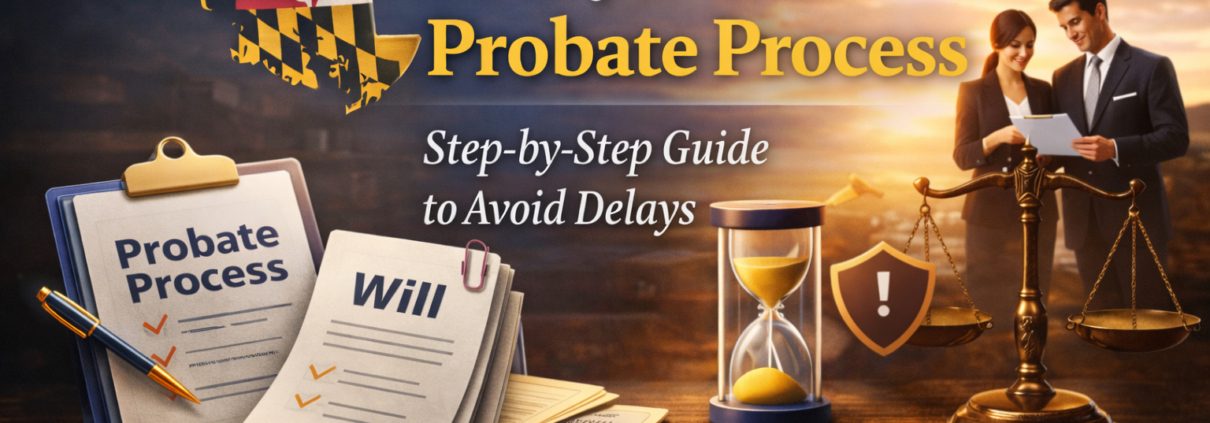
Maryland probate process step-by-step guide graphic

A Step-by-Step Guide to the Maryland Probate Process (and How to Avoid Delays)

When a loved one passes away, families are often left navigating grief and paperwork at the same time. One of the most common legal processes that follows is probate.

If you’re facing probate in Maryland — or planning ahead to make things easier for your family — here’s a clear, step-by-step breakdown of how the process works and how to avoid unnecessary delays.

What Is Probate?

Probate is the court-supervised process of settling a deceased person’s estate. It ensures that:

  • A valid will is recognized (if one exists)
  • Debts and taxes are paid
  • Remaining assets are distributed properly

In Maryland, probate is handled through the Register of Wills in the county where the person lived.

Not every asset goes through probate. Jointly owned property, life insurance with named beneficiaries, and assets held in a properly funded trust may pass outside of court. But when assets are titled solely in the deceased’s name, probate is typically required.

Step 1: Determine Whether Probate Is Required

Maryland offers two types of probate:

Small Estate Administration
Applies when the probate estate is valued at $50,000 or less (or $100,000 or less if the spouse is the sole heir).

Regular Estate Administration
Applies when the estate exceeds those thresholds.

The type of administration affects the paperwork, timeline, and complexity of the process.

Step 2: File the Petition with the Register of Wills

The personal representative (also known as the executor) must file:

  • The will (if there is one)
  • A petition for probate
  • A death certificate
  • Required forms and filing fees

Once approved, the court formally appoints the personal representative and issues “Letters of Administration.” This document gives legal authority to act on behalf of the estate.

Step 3: Notify Interested Parties and Creditors

Maryland law requires that:

  • Heirs and beneficiaries are formally notified
  • Creditors are notified through publication

Creditors generally must present claims within six months after the date of death, or within two months after receiving written notice from the personal representative, whichever is earlier. During this time, the estate cannot be fully closed.

This waiting period is one reason probate often takes longer than families expect.

Step 4: Inventory and Value the Estate

The personal representative must:

  • Identify all probate assets
  • Determine date-of-death values
  • File a formal inventory with the court

This can include bank accounts, real estate, vehicles, investments, and personal property.

Accurate valuation is critical. Errors here can create delays, tax complications, or disputes.

Step 5: Pay Debts, Taxes, and Expenses

Before any distributions are made, the estate must pay:

  • Funeral expenses
  • Valid creditor claims
  • Administrative expenses
  • Maryland inheritance tax (if applicable)
  • Final income taxes

Maryland does not have a state estate tax for smaller estates, but tax issues still arise in certain situations.

Step 6: Distribute Remaining Assets

After debts and claims are resolved, the personal representative submits an accounting to the court.

Once approved, remaining assets are distributed according to:

  • The terms of the will, or
  • Maryland intestacy laws (if there is no will)

Only after court approval can the estate be formally closed.

How Long Does Probate Take in Maryland?

Even in straightforward cases, probate often takes 9 to 18 months. More complex estates can take longer.

Common causes of delay include:

  • Missing or unclear estate documents
  • Disputes among heirs
  • Difficulty locating assets
  • Improperly filed paperwork
  • Tax complications

While some delays are unavoidable, many can be prevented with proper planning.

How to Avoid Probate Delays — or Probate Altogether

1. Create a Clear, Updated Will

Ambiguity leads to disputes. A properly drafted will reduces confusion and court challenges.

2. Consider a Revocable Living Trust

Assets held in a funded trust bypass probate entirely. This can significantly reduce time, costs, and public exposure.

3. Keep Beneficiary Designations Updated

Retirement accounts and life insurance policies pass outside probate when beneficiaries are clearly named.

4. Organize Financial Records

A well-organized estate is easier — and faster — to administer.

5. Work with an Experienced Maryland Probate Attorney

Guidance at the beginning often prevents months of complications later.

The Bigger Picture

Probate isn’t inherently “bad.” It’s a structured legal process designed to protect heirs and creditors.

But without planning, it can become time-consuming, expensive, and stressful — especially during an already difficult time.

The right estate plan doesn’t just distribute assets. It reduces friction, protects privacy, and gives your family clarity when they need it most.

Need Help Navigating Maryland Probate?

Whether you are currently serving as a personal representative or planning ahead to protect your family from delays, experienced legal guidance makes a difference.

The Law Office of David N. Mabrey helps Maryland families move through probate efficiently — and build estate plans that minimize court involvement whenever possible.

Contact us today to schedule a consultation and protect your family from unnecessary delays.

👉🏼 https://davidnmabreylaw.com/contact-us/

Frequently Asked Questions

1. How do I know if probate is required in Maryland?

Probate is generally required if the deceased person owned assets solely in their name without a designated beneficiary. If assets were jointly owned, placed in a trust, or had named beneficiaries (like life insurance or retirement accounts), those may pass outside of probate. A quick review of how assets are titled can clarify whether probate is necessary.

2. What qualifies as a “small estate” in Maryland?

In Maryland, a small estate is typically valued at $50,000 or less — or $100,000 or less if the surviving spouse is the sole heir. Small estate administration is usually faster and involves simplified procedures.

3. How long does probate take in Maryland?

Even in straightforward cases, probate often takes 9 to 18 months. The timeline depends on factors like creditor claims, court schedules, tax filings, and whether disputes arise among heirs.

4. Can assets be distributed before probate is finished?

Generally, no. The personal representative must first resolve creditor claims, pay taxes, and obtain court approval before distributing assets. Distributing assets too early can create personal liability for the representative.

5. What happens if someone dies without a will in Maryland?

If there is no will, Maryland’s intestacy laws determine who inherits. The distribution depends on whether the deceased had a spouse, children, or other close relatives. The court will appoint a personal representative to manage the estate.

6. What are the responsibilities of a personal representative?

The personal representative must:

  • File probate paperwork with the Register of Wills
  • Notify heirs and creditors
  • Inventory and value assets
  • Pay debts and taxes
  • Submit an accounting to the court
  • Distribute remaining assets

It’s a significant legal responsibility that must be handled carefully.

7. Are probate records public in Maryland?

Yes. Probate proceedings are part of the public record. Anyone can access information about the estate, including asset values and distributions. Families concerned about privacy often consider trust-based planning to avoid this.

8. Can probate be avoided entirely?

In many cases, yes. Assets held in a properly funded revocable living trust, jointly owned property, and accounts with beneficiary designations typically bypass probate. Strategic estate planning can significantly reduce or eliminate the need for court involvement.

9. Do I need an attorney for probate in Maryland?

While not legally required in every case, probate involves strict deadlines, filings, and legal obligations. Mistakes can cause delays or personal liability for the representative. Many families choose to work with an experienced probate attorney to ensure the process runs smoothly.

Need Guidance Through Probate?

Probate can feel overwhelming — especially during a difficult time. The right legal guidance can help you move forward with clarity and confidence.

If you have questions about the Maryland probate process or want to plan ahead to avoid delays, contact The Law Office of David N. Mabrey today.

👉🏼 https://davidnmabreylaw.com/contact-us/

Maryland wills vs. trusts graphic with a gavel, a last will and a living trust

Maryland Wills vs. Trusts: Which One Is Right for Your Family?

Planning for the future isn’t just about protecting assets — it’s about protecting people. If you live in Maryland and are thinking about estate planning, you’ve likely asked the same question many families do:

Should I create a will, a trust, or both?

The answer depends on your goals, your family dynamics, and the level of control you want over what happens next. Here’s a clear breakdown to help you understand the difference — and decide what may be right for your family.

What Is a Will?

A Last Will and Testament is a legal document that outlines how your assets will be distributed after your death. In Maryland, a will can also:

  • Name a personal representative (executor) to manage your estate
  • Designate guardians for minor children
  • Specify how debts and taxes should be handled
  • Leave specific gifts to individuals or charities

How It Works in Maryland

After someone passes away, their will goes through probate — a court-supervised process that validates the will and oversees distribution of assets.

In Maryland, probate is handled through the Register of Wills in the county where the deceased lived. While Maryland’s probate process can be relatively straightforward in simple estates, it is still:

  • Public record
  • Time-consuming (often several months or more)
  • Associated with court fees and administrative costs

For many families, a will is the foundational estate planning document — but it’s not always the complete solution.

What Is a Trust?

A trust is a legal arrangement where one party (the trustee) holds and manages assets for the benefit of another (the beneficiary).

The most common type used in estate planning is a revocable living trust. You create it during your lifetime, maintain control over your assets, and can modify or revoke it as long as you are mentally competent.

Key Benefits of a Trust in Maryland

  • Avoids probate for assets placed inside the trust
  • Maintains privacy (unlike a will, trusts are not public record)
  • Allows for ongoing management of assets after death
  • Can provide structured distributions for children or beneficiaries

For families with minor children, blended families, real estate in multiple states, or more complex financial situations, a trust often provides greater flexibility and control.

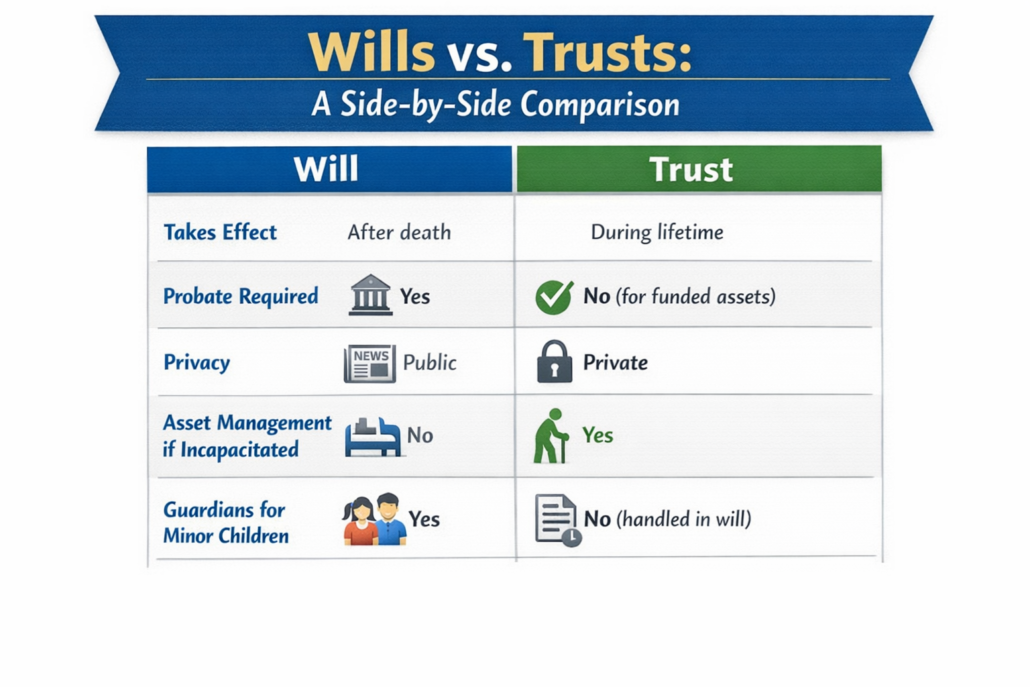
Wills vs. trusts side-by-side comparison chart covering probate, privacy, incapacity and guardians

Important note: Even if you create a trust, you still need a will — typically a “pour-over will” — to ensure any assets not formally transferred into the trust are directed appropriately.

Estate planning isn’t about choosing one over the other in isolation. It’s about building the right structure.

When a Will May Be Enough

A simple will may be appropriate if:

  • You have a smaller estate
  • You don’t own property in multiple states
  • You’re comfortable with the probate process
  • Your distribution plan is straightforward

For many Maryland residents, this is a practical and effective option.

When a Trust May Be the Better Fit

A trust may be the better solution if:

  • You want to avoid probate
  • You value privacy
  • You have minor children and want staged distributions
  • You have beneficiaries who need asset protection
  • You want to plan for incapacity
  • You have a blended family and want clarity

Trusts offer greater control — not just over who receives assets, but how and when they receive them.

What Most Families Don’t Realize

Estate planning isn’t just about what happens after you pass away. It’s also about what happens if you become incapacitated.

A comprehensive Maryland estate plan typically includes:

  • A will
  • A trust (if appropriate)
  • Financial power of attorney
  • Advance medical directive

Without these documents in place, your family may need court involvement just to manage your affairs — at the exact moment they’re already under stress.

The Right Choice Is Personal

There’s no one-size-fits-all answer. A will works well for some families. A trust is essential for others. Most comprehensive plans use both strategically.

The key is designing an estate plan around:

  • Your assets
  • Your family structure
  • Your long-term goals
  • Your desire for privacy and control

Estate planning isn’t about paperwork. It’s about clarity, protection, and making things easier for the people you care about most.

Ready to Protect What Matters Most?

If you’re unsure whether a will, a trust, or a combination of both is right for your family, the best next step is a conversation.

The Law Office of David N. Mabrey helps Maryland families build estate plans that are clear, customized, and designed to work when they’re needed most.

Contact us today to schedule a consultation and start building the right plan for your family’s future.

👉🏼 https://davidnmabreylaw.com/contact-us/

Frequently Asked Questions

1. Do I need a will if I have a trust in Maryland?

Yes. Even if you create a revocable living trust, you still need a will — typically a “pour-over will.” This ensures that any assets not formally transferred into your trust during your lifetime are directed into it after your death. It also allows you to name guardians for minor children, which a trust does not do.

2. What happens if I die without a will in Maryland?

If you pass away without a will, your estate is distributed according to Maryland’s intestacy laws. That means the state decides who inherits your property — not you. The outcome may not reflect your wishes, especially in blended families or situations involving unmarried partners.

3. Does a trust completely avoid probate in Maryland?

A properly funded trust avoids probate for the assets titled in the name of the trust. However, any assets not transferred into the trust during your lifetime may still go through probate. Funding the trust correctly is just as important as creating it.

4. Is probate always a bad thing?

Not necessarily. Maryland’s probate process can be manageable for smaller or straightforward estates. However, it is public, can take months (or longer), and involves court oversight and fees. Many families prefer to avoid it for privacy and efficiency.

5. Are trusts only for wealthy families?

No. Trusts are about control and structure — not just wealth. They can be especially helpful for families with minor children, beneficiaries who may need asset protection, or anyone who wants to avoid probate and maintain privacy.

6. Which is more expensive: a will or a trust?

A trust-based estate plan generally costs more upfront than a simple will because it involves more planning and documentation. However, a trust can reduce future court costs, delays, and administrative expenses. The real question isn’t price — it’s whether the structure matches your goals.

7. Can I change my will or trust later?

Yes. As long as you are mentally competent, you can update or revoke your will or revocable living trust at any time. Estate planning should evolve as your life changes — marriage, children, divorce, new assets, or retirement.

8. What happens if I become incapacitated?

A will does not help if you become incapacitated. A trust can allow a successor trustee to manage your assets without court involvement. A complete Maryland estate plan should also include a financial power of attorney and advance medical directive to protect you during your lifetime.

9. How do I know which option is right for my family?

The right answer depends on your assets, family dynamics, and long-term goals. Some families need a straightforward will. Others benefit from the structure and flexibility of a trust. Many use both together as part of a comprehensive plan.

Ready to Make the Right Decision for Your Family?

Estate planning shouldn’t feel overwhelming — and it shouldn’t be generic. The right strategy is personal.

If you’re weighing a will vs. a trust in Maryland, schedule a consultation to discuss what makes the most sense for your situation.

Contact The Law Office of David N. Mabrey today and start building a plan that protects your family with clarity and confidence.

👉🏼 https://davidnmabreylaw.com/contact-us/

Law Offices of David N. Mabrey P.C. logo

Two convenient locations!

CHESTERTOWN

107 Court St, Chestertown, MD 21620

Office: 410-778-1630

PASADENA

8611 Fort Smallwood Rd, Suite C, Pasadena, MD 21122

Office: 443-702-7708
Fax: 443-702-7709
Cell: 443-848-2878 (Cell for Emergency/New Accident Only)

FIND US ONLINE

Google Reviews | Facebook | LinkedIn