Posts

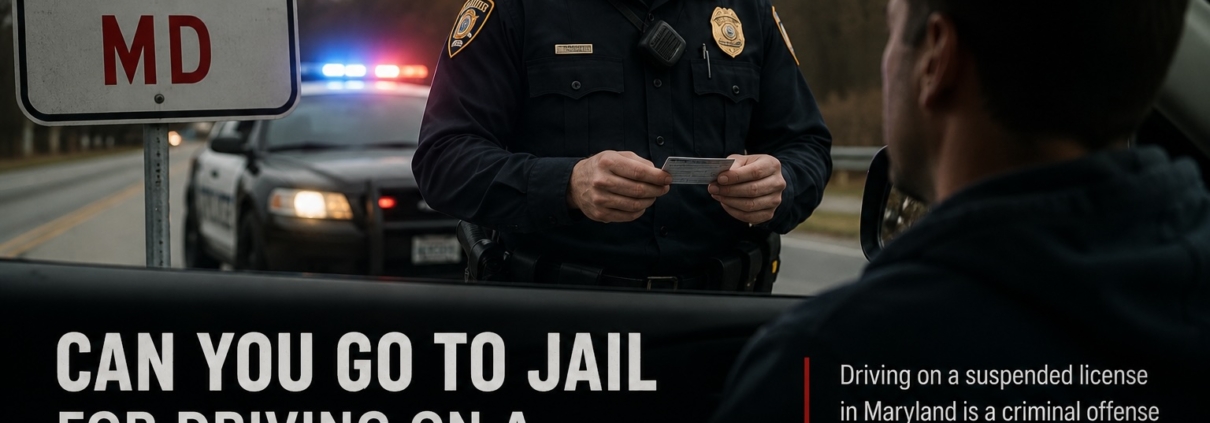
Maryland police officer conducting a traffic stop with flashing patrol lights while checking a driver’s license beside a “License Suspended MD” sign and blog headline about jail time for driving on a suspended license.

Can You Go to Jail for Driving on a Suspended License in Maryland?

The short answer is yes — and it happens more often than most people expect.

Driving on a suspended license in Maryland is not a payable traffic fine. It is a criminal misdemeanor that carries the potential for jail time, significant fines, and points that can permanently complicate your driving record. It is also a must-appear offense, which means you cannot pay it online, send someone else to court, or simply ignore it and hope it goes away.

What most people do not know — and what makes a real difference in how these cases resolve — is that not all suspended license charges are the same under Maryland law. The charge you face depends entirely on why your license was suspended, and that distinction can mean the difference between no jail time at all and a year behind bars.

The Two-Tier Charge System Most Drivers Don’t Know About

Most people are unaware that there are two types of driving on a suspended license in Maryland. One violation carries 12 points, a year in jail, and a $1,000 fine as a maximum sentence. The other does not result in jail time at all and only carries a maximum penalty of a $500 fine with three points attached to it. Both kinds are must-appear offenses. Fslawoffice

Here is how the distinction works:

The Less Serious Charge: § 16-303(h)

If your driver’s license is suspended due to the failure to pay a traffic ticket, the failure to appear in court for a traffic violation, or for unpaid child support, then the proper charge is under Section 16-303(h). These offenses do not carry jail time. Fslawoffice

The maximum penalty under this section is a $500 fine and 3 points on your driving record. It is still a criminal traffic charge and still a must-appear offense — but there is no risk of incarceration.

The More Serious Charge: § 16-303(c)

If your suspension was for any other reason — accumulation of points, a DUI or DWI conviction, failure to submit to a breath test, or a suspension ordered by the Medical Advisory Board — the penalties jump to up to 1 year in jail, a fine of up to $1,000, and 12 points on your driving record. A second offense committed within 3 years can mean up to 2 years in jail. Davidnmabreylaw

The Critical Problem: Officers Usually Charge the More Serious Version

Unfortunately, police officers almost always charge the more serious violation under a different section, even when the facts of the case actually warrant the lesser charge. Fslawoffice

This means that someone whose license was suspended for nothing more than an unpaid parking ticket can find themselves facing a charge that carries up to a year in jail — simply because the officer at the scene charged the wrong section. An experienced Maryland traffic attorney will identify this immediately and move to have the charge corrected or reduced. Most people who represent themselves never realize this distinction exists.

So Will You Actually Go to Jail?

It depends on several factors — and the answer is not automatic for a first offense.

It is possible, but unlikely, that a first-time offender will be sent to jail in Maryland. However, a lengthy jail sentence is a possibility for someone who is a repeat offender, especially if this person continues to drive while their license is suspended or revoked. Criminallawsmaryland

The factors Maryland courts look at when deciding on jail time include:

Your prior record. A first offense with no prior criminal history is treated very differently from a third or fourth offense by a habitual offender. Judges take repeat driving while suspended charges seriously — they reflect ongoing disregard for the law, not a one-time mistake.

Whether you knew your license was suspended. In order to be convicted of driving on a suspended or revoked license, you must have knowledge that your driver’s license has been suspended or revoked. This is not just actual knowledge but inferred knowledge as well. The judge can infer from the circumstances that you either knew or should have known. The most common way the prosecution establishes this is by showing that the MVA mailed a suspension notice to your address. If you never received it because you moved, that may be a viable defense. Macmullanlaw

Whether you have other charges from the same stop. A driving while suspended charge stacked on top of a DUI, reckless driving, or an accident significantly increases the likelihood of jail time and heightens the seriousness of the overall case.

Whether you were on probation at the time. Driving on a suspended license while on probation for another offense is a serious probation violation that courts treat very harshly, independent of the suspended license charge itself.

Whether your license was suspended or revoked. If you are caught driving while revoked, the penalties can increase to 2 years in jail for subsequent offenses. A revocation is a full termination of driving privileges requiring reapplication through the MVA — it is treated more seriously than a temporary suspension. Michaeltaylorlaw

The 12-Point Problem Nobody Talks About

Beyond the immediate question of jail time, there is a secondary consequence of the more serious suspended license charge that causes enormous long-term problems: the points.

In Maryland, accumulating 12 or more points within a two-year period results in automatic revocation of your driving privileges. If you’re already carrying points from prior violations, a § 16-303(c) conviction that adds 12 points in one shot can put you in a far worse position than where you started — and make reinstating your license dramatically more complicated. Davidnmabreylaw

In other words, a conviction under the more serious version of this charge does not just result in a fine and possible jail time. It can trigger a full revocation of your license — meaning you then need to reapply entirely to drive again — on top of whatever suspension you were already dealing with. For people trying to get their driving privileges back, this is a trap that can set them back by years.

Common Reasons Licenses Get Suspended — And Why People Often Don’t Know

One of the most consistent themes in suspended license cases is genuine surprise. A significant number of people pulled over for driving while suspended did not know their license was suspended when they got behind the wheel.

Common reasons Maryland licenses get suspended include:

  • Failure to pay a traffic fine
  • Failure to appear for a traffic court date
  • Accumulation of points on your driving record
  • A DUI or DWI conviction
  • Failure to submit to a breathalyzer test
  • Failure to maintain required auto insurance
  • Unpaid child support
  • An order from the Medical Advisory Board
  • Out-of-state violations reported to Maryland’s MVA through the Driver License Compact

The MVA sends suspension notices by mail to the address on your license. If you have moved and not updated your address, or if the notice got lost or was overlooked, you may have been driving on a suspended license without knowing it. The Maryland Motor Vehicle Administration provides online services where you can request your driving record so you can check your status at any time. If you have any doubt about whether your license is currently valid, check before you drive. Frizwoods

What Happens If You Are Stopped While Suspended

The moment an officer runs your license and sees the suspension, the stop changes character. What began as a traffic stop for speeding or a broken taillight is now a criminal investigation. You will likely be issued a must-appear citation — and in some cases arrested on the spot, depending on the nature of the suspension and whether there are outstanding warrants.

You are required to appear in court on the date specified. Missing your court date on a criminal traffic offense might result in a warrant being issued for your arrest. A bench warrant compounds your situation significantly — now you have both the suspended license charge and a failure to appear warrant, and every subsequent traffic stop carries the risk of arrest. Frizwoods

The Single Most Effective Thing You Can Do Before Your Court Date

The most effective defense in these cases is often compliance. If you can walk into court with a valid, reinstated plastic license in your hand, a traffic lawyer can often negotiate with the prosecutor to have the criminal charges reduced to a minor non-incarcerable offense that carries no jail time and fewer points. Michaeltaylorlaw

This is not a guarantee — but it changes the conversation in court dramatically. A judge and prosecutor looking at a defendant who has taken the steps to fix the underlying problem are far more likely to show leniency than one looking at someone who still cannot legally drive.

Steps to take between your citation and your court date:

  1. Find out exactly why your license is suspended. Request a driving record from the MVA online or at any branch office. Understanding the specific reason determines what you need to do to reinstate.
  2. Address the underlying cause. Pay outstanding fines. Satisfy the insurance requirement. Address the child support arrears. Complete whatever the MVA requires for reinstatement based on your specific suspension reason.
  3. Apply for reinstatement through the MVA. Depending on the reason for suspension, there may be a waiting period, a reinstatement fee, or additional requirements such as completing a driver improvement program or providing proof of insurance.
  4. Bring documentation to court. Bring your reinstated license, your driving record showing the suspension has lifted, and any documentation of the steps you took to resolve the underlying issue.
  5. Hire an attorney. A Maryland traffic attorney familiar with the local courts can present your reinstatement to the prosecutor, argue for the charge to be reduced to the less serious version if it was incorrectly charged, and negotiate a disposition that protects your record and keeps you out of jail.

Defenses Available in a Maryland Suspended License Case

A suspended license charge is not automatically a conviction. Several defenses are available depending on the facts of your case.

Lack of knowledge. The prosecution must prove you knew — or should have known — that your license was suspended. The most common way to show you knew your license had been revoked or suspended is to show that the MVA mailed a letter to you informing you of that fact. If the notice was sent to a wrong address, never received, or the suspension was triggered by an error, lack of knowledge can be a viable defense. Macmullanlaw

Incorrect charge section. As discussed above, if your suspension was for an administrative reason like an unpaid fine but you were charged under the more serious § 16-303(c), an attorney can challenge the section of the charge and seek reduction to the lesser offense.

Unlawful stop. Every piece of evidence in a traffic case flows from the validity of the initial stop. If the officer did not have reasonable suspicion to pull you over in the first place, any evidence obtained — including the discovery of your suspension — may be suppressible.

MVA error. Suspension notices are occasionally sent based on administrative errors. If your license was suspended due to a mistake by the MVA, that can be a complete defense.

Reinstatement before the date of the stop. In some cases, a person believed their license had been reinstated but the MVA’s records had not yet updated. Documentation showing reinstatement can be critical.

Frequently Asked Questions

Is driving on a suspended license a felony or a misdemeanor in Maryland?

Driving suspended or on a revoked license is a misdemeanor crime in Maryland. It is not a felony. However, being a misdemeanor does not make it minor — it still creates a criminal record, carries potential jail time, and adds significant points to your driving record. Criminallawsmaryland

Can I get a Probation Before Judgment (PBJ) for driving while suspended?

Potentially yes. A lawyer can help you get Probation Before Judgment, allowing you to avoid jail time and keep a conviction off your permanent record. PBJ is not guaranteed and depends on your record, the court, and the specific circumstances of your case — but it is a realistic outcome in many first-offense situations where the defendant has taken steps to reinstate their license. Azari Law LLC

What if I didn’t know my license was suspended?

Lack of knowledge is a legitimate defense. However, the prosecution can attempt to establish knowledge through circumstantial evidence — including showing that the MVA mailed a notice to the address on your license. If you genuinely did not know, gather any evidence that supports that: evidence of an address change that was not reflected in MVA records, evidence of a mail delivery problem, or documentation showing an MVA error.

Will this appear on my criminal record?

Yes, if convicted. Driving while suspended under the more serious charge is a misdemeanor conviction that appears on your criminal record and in Maryland Case Search. This can affect employment background checks, professional licensing, and other areas where a criminal record matters. Pursuing a PBJ or a reduction to a non-conviction disposition specifically avoids this.

What if I have been charged multiple times for driving while suspended?

Repeat offenses are where the potential consequences become most serious. A pattern of driving on a suspended license signals to judges that ordinary penalties are not deterring the behavior, and sentencing tends to escalate accordingly. If you have multiple prior charges, legal representation is not optional — it is essential.

Can I get a hardship or restricted license while suspended?

In some cases yes. In some cases, the MVA may grant a restricted or provisional license that allows for limited driving, such as commuting to work or school, during a suspension period. However, this is not guaranteed and often requires a persuasive argument at a hearing after a timely request. An attorney can advise you on whether you are eligible and help prepare the strongest possible case for a restricted license. Frizwoods

Charged With Driving on a Suspended License in Maryland? Talk to Us First.

At the Law Offices of David N. Mabrey, we handle driving while suspended cases across Maryland — including in Queen Anne’s County, Kent County, Anne Arundel County, and throughout the Eastern Shore. Whether this is your first offense or you have prior charges on your record, we can review the specific reason for your suspension, identify whether the charge was correctly filed, help you pursue reinstatement before your court date, and fight for the best possible outcome.

Do not walk into a Maryland courtroom on a criminal traffic charge without representation.

Chestertown Office 107 Court St, Chestertown, MD 21620 📞 410-778-1630

Pasadena Office 8611 Fort Smallwood Rd C, Pasadena, MD 21122 📞 443-702-7708 🚨 Emergency/New Accident: 443-848-2878

Contact us online here — we are ready to help.

Maryland state trooper conducting a summer traffic stop on Route 50 near Route 301 with police lights flashing and Ocean City highway signs visible.

Summer Traffic Stops on Route 50 and Route 301: When a Simple Citation Turns Into a Criminal Charge

Every summer, millions of drivers pour onto Route 50 and Route 301 heading to the Eastern Shore — DC and Baltimore commuters escaping to the beach, families heading to Ocean City, boaters making for Kent Island and the Chesapeake Bay. And every summer, Maryland law enforcement floods those same corridors with heightened enforcement operations that catch far more than just speeders.

What most drivers do not realize is how quickly a routine traffic stop on the Eastern Shore can escalate into something much more serious than a citation. A speeding ticket becomes a suspended license charge. An open container becomes a DUI investigation. A warrant from another county turns a minor infraction into an arrest on the side of Route 50.

Here is what is actually happening on these roads in summer — and what to do if a traffic stop takes a turn you did not expect.

Why Route 50 and Route 301 Are Active Enforcement Corridors Every Summer

This is not coincidence or random patrol activity. Maryland law enforcement specifically targets these routes during summer travel season as part of coordinated high-visibility enforcement operations.

Maryland Transportation Authority Police Officers conducted high visibility traffic enforcement along US-50 near the Bay Bridge ahead of Memorial Day weekend and the busy summer travel season, joined by troopers from the Maryland State Police, officers from the Anne Arundel County Police Department, and deputies from the Queen Anne’s County Office of the Sheriff. Officers conducted 189 traffic stops and issued 277 citations, warnings, and repair orders during a single initiative. One driver was charged with driving under the influence, and two drivers were charged with drug offenses. maryland

Maryland State Police increase enforcement efforts on impaired, aggressive, and distracted driving through every major holiday weekend, with troopers from all barracks conducting high-visibility enforcement along Route 50 and state roads throughout their respective counties. Maryland State Police

The result is a corridor where enforcement density during summer weekends is among the highest in the state — and where a stop for a minor violation is far more likely to lead to additional scrutiny than it would be on a typical weekday in a less-trafficked area.

How a Simple Traffic Stop Escalates: The Most Common Scenarios

Speeding + Suspended License = Criminal Charge

This combination happens constantly on Route 50 and 301. A driver gets pulled over for speeding — a routine stop. The officer runs the license. It comes back suspended. What was a payable traffic citation is now a criminal charge.

Driving on a suspended license in Maryland is not a traffic infraction. It is a criminal offense that can result in arrest, jail time, additional fines, and a charge that goes on your criminal record. Many people driving with suspended licenses do not know their license is suspended — they missed a court date, failed to pay a fine, or were never properly notified. The suspension happened anyway.

The summer traffic volume on Route 50 means that officers are running license checks at high frequency. If your license has any issue — a suspension, a revocation, an outstanding failure to comply — the odds of it being discovered are significantly higher than they would be during a slow Tuesday in February.

Speeding + New Maryland Aggressive Driving Law

Maryland significantly expanded its aggressive driving statute effective October 1, 2025. Aggressive driving will now be triggered by committing two or more listed traffic violations in a single driving period, reduced from three. A conviction carries a fine of up to $1,000. Additionally, driving 30 mph or more over the posted limit will now be classified as reckless driving, carrying a fine of up to $1,000 or jail time, with six points added to the driver’s record. CBS News

On a highway like Route 50, the combination of speeding and an unsafe lane change — something that happens routinely in heavy beach traffic — can now satisfy the threshold for an aggressive driving charge. That is no longer just a point offense. It is a criminal misdemeanor.

For drivers approaching the Eastern Shore from the Bay Bridge, where traffic moves fast and lane discipline deteriorates during congestion, this is a genuine trap that many summer drivers are unaware of.

Open Container in the Car

An open container violation in Maryland might seem minor, but it can quickly lead to more serious legal trouble. When police find alcohol near the driver or in the passenger area, it often triggers more questions and a closer look at the driver’s behavior and level of impairment. What might have started as a routine traffic stop for a broken taillight or speeding can turn into a full DUI or DWI investigation if an officer smells alcohol, sees an open bottle, or suspects recent use. Andrewalpert

Maryland prohibits open alcoholic beverage containers anywhere in the passenger compartment of a vehicle — by any occupant. The open container law may not apply if the alcohol is not in the passenger area. This includes alcohol kept in the trunk, behind the rearmost upright seat in vehicles without a trunk, or in a locked glove compartment. Andrewalpert

The exception applies to hired vehicles — taxis, rideshares, limousines — but not to personal vehicles. A car full of passengers heading home from a crab feast on Kent Island, with a half-consumed bottle of wine in the back seat, is an open container violation that can open the door to a full DUI investigation.

Cannabis in the Vehicle

Maryland legalized recreational cannabis in 2023, which created genuine confusion about what is and is not permissible in a vehicle. The rules are more nuanced than most people realize.

Officers cannot conduct a traffic stop or search your vehicle based solely on the smell of cannabis or observation of a personal use amount of cannabis in the vehicle. However, the smell of cannabis can still be used as one factor if an officer suspects that a driver is impaired. Howard County

Possession limits matter enormously. Under Maryland law, possession of less than 1.5 ounces is no crime or civil penalty. Possession of between 1.5 and 2.5 ounces is a civil offense subject to a fine of up to $250. Possession of between 2.5 ounces and less than 50 pounds is a criminal misdemeanor — conviction can lead to a sentence of up to one year in jail, a fine of up to $1,000, or both. Castrolawgroup

Smoking or consuming cannabis in a vehicle on a public road is a separate violation regardless of the amount possessed. A driver of a motor vehicle may not consume an alcoholic beverage, or smoke or consume cannabis, in a passenger area of a motor vehicle on a highway. Justia

The practical problem: people returning from legal dispensary purchases, or bringing cannabis to the beach from home, frequently have quantities that cross from “legal personal use” into criminal territory without realizing it. And a stop for speeding on Route 50, combined with visible cannabis in the vehicle or the smell of recent use, can quickly become a drug charge layered on top of the original traffic violation.

The Warrant Discovery

During a single large-scale traffic enforcement initiative, four drivers were arrested on open warrants. This happens routinely at every major enforcement push on Route 50 and Route 301. Warrants from missed court dates, unpaid fines, or unresolved criminal matters in any Maryland county show up the moment an officer runs your name. A driver pulled over for following too closely near the Bay Bridge who has an outstanding warrant in Queen Anne’s County — or from a prior year in Baltimore City — is going to leave in handcuffs, not with a citation. maryland

If you have any reason to believe there might be an outstanding warrant in your name in any Maryland jurisdiction, do not wait to find out at a traffic stop on the way to the beach. Contact an attorney now and address it proactively — before it surfaces at the worst possible time.

What to Do During a Traffic Stop on Route 50 or 301

Stay calm and be cooperative

Pull over promptly, turn off the engine, place your hands on the steering wheel, and wait for the officer to approach. Do not reach for anything until asked.

Provide what is required — nothing more

You are required to provide your driver’s license, vehicle registration, and proof of insurance. You are not required to answer questions about where you are going, where you have been, whether you have been drinking, or whether there is anything in the car. You can decline to answer politely: “I’d prefer not to answer questions without an attorney.”

Do not consent to a search

If an officer asks whether they can search your vehicle, you have the right to decline. Saying “I do not consent to a search” does not give the officer permission to search — it preserves your rights if the search later becomes a legal issue. An officer with probable cause can search without consent. But many searches happen because drivers give permission when they did not have to.

Do not argue about the stop at the scene

If you believe the stop was unlawful, the roadside is not the place to make that argument. Comply, be polite, document what you can remember afterward, and raise the legal challenge with an attorney in court. Arguing at the scene rarely helps and sometimes hurts.

Call an attorney before your court date

A traffic citation with a must-appear designation is a court date — not an optional fine. A criminal charge of any kind — driving on a suspended license, aggressive driving, drug possession — requires legal representation. The courts in Queen Anne’s County, Kent County, and Talbot County handle these cases with their own judges and local prosecutors, and having an attorney who knows those courtrooms makes a real difference.

Queen Anne’s County and Kent County Traffic Court: What to Expect

The District Court in Centreville handles the bulk of traffic and criminal matters arising from stops on Route 50, Route 213, and the surrounding Eastern Shore corridors. The District Court in Chestertown handles Kent County matters.

These are smaller, tighter-knit courts than what DC or Baltimore drivers are accustomed to. Prosecutors and judges are familiar with the patterns of summer enforcement, and the cases are handled with seriousness. An out-of-state driver who assumes a Maryland traffic charge will simply go away, or who misses a court date because they have gone home, will quickly discover that Maryland warrants follow them through the Driver License Compact.

Local representation matters. An attorney who regularly appears in Centreville District Court or Chestertown District Court knows the local practices, the prosecutors’ typical positions, and what arguments are likely to be effective in front of specific judges.

Frequently Asked Questions

I got a speeding ticket on Route 50. Do I need a lawyer?

It depends on the speed and your record. A minor speeding citation can often be handled without an attorney. But if the speed was significant, if you have prior points on your license, or if the citation is a must-appear offense, legal representation is worth the investment. Points accumulate quickly, and enough of them in a short period triggers a license suspension hearing.

The officer asked if they could search my car and I said yes. Can I undo that?

Not easily — but the search may still be challengeable on other grounds. Whether the initial stop was lawful, whether the consent was truly voluntary, and what was actually found all affect how the evidence can be used. Talk to an attorney before concluding that the consent makes your situation hopeless.

I was stopped on Route 50 and found out I have a warrant. What happens now?

You may have been arrested on the spot or released with a notice to appear depending on the nature of the warrant. Either way, the warrant needs to be resolved — a motion to recall it filed, a new court date obtained, and the underlying matter addressed. Do not wait. An active warrant means every future traffic stop carries the same risk.

Cannabis is legal in Maryland now. Why was I charged?

Recreational cannabis is legal in limited quantities and in limited circumstances. Smoking it in a vehicle is illegal regardless of quantity. Possessing more than 2.5 ounces is a criminal misdemeanor. And driving while impaired by cannabis is a DUI charge, just like alcohol. The legalization of cannabis did not make it legal in all contexts — and many people are charged because they assumed it did.

I live in DC or Virginia. Does a Maryland traffic charge affect my home license?

Yes. Maryland participates in the Driver License Compact and the Non-Resident Violator Compact. Convictions in Maryland result in points that your home state can act on. Failure to appear on a Maryland citation can trigger suspension of your home state license. Treat a Maryland charge with the same seriousness you would give a charge in your home state.

The stop was on Route 50 near the Bay Bridge. Which court handles my case?

The Bay Bridge and the immediate approaches fall in Anne Arundel and Queen Anne’s County depending on which side you were stopped. The District Court of Maryland for Queen Anne’s County sits in Centreville. If you were stopped further east — on Route 50 past Grasonville toward Easton, or on Route 213 toward Chestertown — the case may be in Talbot or Kent County. Your citation will indicate the court location.

Charged After a Traffic Stop on the Eastern Shore? We Can Help.

At the Law Offices of David N. Mabrey, we represent clients across Maryland’s Eastern Shore in traffic and criminal matters — including charges arising from stops on Route 50, Route 301, Route 213, and throughout Queen Anne’s, Kent, and Talbot Counties. Whether you are facing a speeding charge, an aggressive driving allegation, a suspended license charge, or something more serious that developed from a routine stop, we provide the local representation that makes a difference in these courts.

Chestertown Office 107 Court St, Chestertown, MD 21620 📞 410-778-1630

Pasadena Office 8611 Fort Smallwood Rd C, Pasadena, MD 21122 📞 443-702-7708 🚨 Emergency/New Accident: 443-848-2878

Contact us online here — we handle urgent matters and are here when you need us.

Welcome sign for Maryland’s Eastern Shore beside a coastal highway at sunset, symbolizing relocation and new resident legal considerations.

Moving to Maryland’s Eastern Shore? Common Legal Mistakes New Residents Make in Centreville, Stevensville, and Chestertown

People are moving to Maryland’s Eastern Shore in growing numbers — drawn by lower housing costs, waterfront living, a slower pace, and the ability to work remotely from places like Stevensville, Centreville, and Chestertown that were once considered too far from the metro corridor to be practical.

What most newcomers do not realize is that Maryland has some genuinely unusual laws — and the Eastern Shore has its own local character when it comes to enforcement, courts, and community expectations. The legal mistakes new residents make here are rarely intentional. They are almost always the result of assuming Maryland works the way their home state did.

Here are the most common — and most costly — legal mistakes new residents make when they arrive on the Eastern Shore.

Mistake 1: Assuming Your Out-of-State Gun Laws Still Apply

This is the single most dangerous assumption new residents make, and it creates real criminal exposure for people who have done nothing wrong in their home state.

Maryland has some of the most restrictive firearm laws in the country — and they apply the moment you cross the state line. Your Virginia concealed carry permit, your Pennsylvania license to carry, your Florida permit — none of them are recognized in Maryland. A traveler without a Maryland permit may not carry a handgun on foot or in a vehicle in a loaded or readily accessible manner. Gunlawguide

The rules for transporting a handgun in a vehicle are specific and strict. The firearm must be stored separately, must not be loaded, and cannot be readily accessible to the driver. Transporting a firearm is illegal anytime it is not stored properly in the vehicle and is readily accessible to the driver. To properly store a firearm when transporting it in Maryland, make sure the ammo is stored separately from the firearm, in cases, and locked. Mdcriminalattorney

The legal exceptions for transporting a handgun are narrow. Legal transport is permitted for a person transporting a handgun used in connection with a target shoot, formal or informal target practice, sport shooting event, hunting, or similar activity, while the person is on the way to or returning from that activity, if the handgun is unloaded and carried in an enclosed case or holster. Transport between bona fide residences is also permitted — but only if done directly, without stops. Justia

We have seen numerous cases where out-of-state residents from places with more reasonable firearm laws have been arrested for simply driving through Maryland with a gun in their car. In almost all of these cases the gun was unloaded and in the trunk, and in many cases the defendants were driving to or from a residence, which under the statute is legal. But cops on the scene rarely ask the right questions, and few defendants know the law. The result of these stops is usually an arrest for a serious criminal offense that carries a 30-day minimum mandatory jail sentence and a maximum sentence of up to 5 years. The Herbst Firm

What new residents should do: Before you move your firearms into Maryland, consult with a Maryland attorney who handles gun law matters. The rules here are genuinely different from most other states and the consequences of getting it wrong are severe.

Mistake 2: Not Updating Your License and Registration Within 60 Days

This one catches people constantly — especially those who moved to the Eastern Shore while still working remotely or maintaining ties to their previous state.

You must obtain your Maryland driver’s license and Maryland vehicle title and registration within 60 days of becoming a Maryland resident. Maryland Motor Vehicle Administration

An out-of-state driver’s license must be updated to a Maryland driver’s license within 60 days of moving to Maryland. An out-of-state commercial driver’s license must be transferred within 30 days of moving to Maryland. Failure to meet the deadline may result in penalties. Maryland Motor Vehicle Administration

The vehicle registration deadline is equally strict. If you delay beyond 60 days, you will not be eligible for a tax credit for any titling tax paid in another state, and you may be subject to a citation for an out of state registration. Mdspeedytags

People who are renting temporarily, spending time between two properties, or still in the process of fully relocating often convince themselves they are not yet “really” Maryland residents. Maryland law defines residency more broadly than most people assume — if you are living in the state for other than a temporary or transitory purpose, the clock is running.

A traffic stop with an out-of-state plate and a year-old out-of-state license, on a car you have been driving around Queen Anne’s County for four months, is a problem you did not need to create.

What new residents should do: Schedule your MVA appointment before your 60-day window closes. You can handle your driver’s license and vehicle registration in a single visit. Do not put it off.

Mistake 3: Moving Here With a Custody Order Without Telling the Other Parent

This is perhaps the most emotionally charged mistake on this list — and also the one with the most severe legal consequences.

People move to the Eastern Shore for good reasons all the time: a new job, a parent who needs care, lower cost of living, a relationship, a fresh start. If you have children and a custody order, moving to Kent County or Queen Anne’s County is not just a personal decision — it is a legal event.

Under Maryland law, a custodial parent wishing to relocate must provide written notice of their intention to move at least 90 days prior to the intended relocation. This rule applies to both in-state and out-of-state moves. The purpose of this requirement is to give the non-relocating parent sufficient time to object to the relocation if they believe it will negatively impact the child or their relationship with the child. Rodier Family Law

That notice must be formal — not a text message, not an email. The notice should be sent by certified mail with return receipt requested to the other parent’s last known address. Shah & Kishore

What happens if you move without giving notice? Some parents mistakenly believe it is better to ask for forgiveness than permission. This is a catastrophic error in judgment in Maryland family court. Violating that order by unilaterally relocating the child is seen as a direct affront to the court’s authority and a willful disregard for the other parent’s rights. The non-moving parent can file an emergency petition with the court. A judge will view the parent’s unilateral action as evidence that they are not willing to foster a relationship between the child and the other parent — a critical factor in any custody determination. The judge may be heavily inclined to strip the moving parent of primary physical custody. Srislawyer

Failure to provide 90 days’ notice can lead to parental kidnapping charges. Shelly Ingram Law

This applies even if you are the custodial parent. Even if the move is across state lines — from Virginia or Delaware into Maryland. Even if you have sole custody. The notice requirement exists to protect both parents’ rights and the child’s relationship with the non-moving parent.

What new residents should do: If you have an existing custody or visitation order and you are planning to move to the Eastern Shore, speak with a family law attorney before you move — not after. The 90-day timeline needs to be planned for, not reacted to.

Mistake 4: Starting a Business Without Understanding Local Licensing Requirements

The Eastern Shore is attracting a wave of entrepreneurs — people opening shops in Chestertown’s historic downtown, starting marine services businesses on Kent Island, launching farm-to-table operations in Talbot County, or setting up home-based businesses after relocating from suburban areas where zoning was more permissive.

What works in one county or one state may not work here. Maryland has state-level business licensing requirements, but Queen Anne’s County, Kent County, and Talbot County each have their own local zoning rules, occupancy requirements, and permit processes that can vary significantly — sometimes even at the municipality level.

Common pitfalls include:

Operating without a trade name registration. If you are doing business under any name other than your own full legal name, Maryland requires you to register a trade name with the State Department of Assessments and Taxation. Operating without one exposes you to fines and can create problems with banking and contracts.

Assuming rural zoning allows home-based businesses. Agricultural and rural zones on the Eastern Shore have specific restrictions on commercial activity, signage, customer traffic, and employee numbers. What is permitted in a suburban neighborhood in Northern Virginia may not be permitted on a farm parcel in Caroline County.

Missing the requirement for a Trader’s License. Maryland requires a Trader’s License for most businesses that sell goods. It is issued by the county clerk’s office — not the state — and the requirements vary by county and by sales volume.

Not registering for Maryland sales tax. If you are selling taxable goods or services in Maryland, you need a sales and use tax license from the Comptroller’s office before you begin — not after your first transaction.

What new residents should do: Before you open your doors, consult with a Maryland business attorney familiar with the county you are operating in. A short consultation can prevent months of compliance problems down the road.

Mistake 5: Ignoring How Maryland Traffic Laws Differ From Your Home State

Traffic laws vary more than most drivers realize across state lines, and the Eastern Shore has its own enforcement patterns that new residents are frequently surprised by.

A few specific differences that catch newcomers:

Speed enforcement on rural roads. Route 50 through the Eastern Shore, Route 213 through Kent County, and the approach roads to Chestertown all have speed limits that are actively enforced — and Maryland courts treat speeding as a point offense with real consequences. Enough points on your record within a short period can trigger a license suspension hearing. Maryland’s point system counts violations from all U.S. states, so if you moved here with points already on your record, you may be closer to a suspension threshold than you realize.

Aggressive driving statutes. Maryland has a specific aggressive driving law that can apply when multiple traffic violations occur in sequence — tailgating, unsafe lane changes, and speeding together can result in an aggressive driving charge that carries criminal penalties beyond a simple traffic fine.

Open container laws. Maryland strictly prohibits open alcoholic beverage containers anywhere in the passenger compartment of a vehicle, by any occupant — including passengers. This surprises visitors from states with more permissive open container rules, particularly on the way home from Eastern Shore events, crab feasts, or waterfront venues.

Cell phone and hands-free requirements. Maryland prohibits the use of a handheld cell phone while driving entirely. The fine for a first violation is modest, but a second violation within two years results in points on your license.

What new residents should do: Treat your first few months on Eastern Shore roads as an adjustment period. A traffic attorney can help if a citation creates a point problem — and acting early, before a suspension is triggered, leaves far more options available.

Mistake 6: Not Understanding That Maryland Is a Contributory Negligence State

This one is less visible day-to-day but enormously consequential if you are ever in an accident.

Most states follow a comparative negligence standard — meaning that even if you were partially at fault for an accident, you can still recover some compensation proportional to the other party’s fault. Maryland does not. Maryland is one of only five jurisdictions in the country that still follows pure contributory negligence.

Under Maryland’s rule, if you are found even 1% at fault for an accident, you may be completely barred from recovering any compensation — regardless of how responsible the other driver was. Insurance companies know this and use it aggressively.

For new residents who have never lived under contributory negligence before, this creates a specific behavioral warning: anything you say at an accident scene — any apology, any admission, any casual statement about what happened — can be used to assign partial fault to you and eliminate your right to compensation entirely.

What new residents should do: After any accident in Maryland, say only what is necessary to exchange information and cooperate with law enforcement. Do not apologize, speculate, or estimate fault. Consult a personal injury attorney before speaking with any insurance adjuster.

Frequently Asked Questions

Do I need a Maryland attorney if I already have one in my home state?

For most Maryland-specific legal matters — traffic violations, criminal charges, business licensing, custody modifications, and real estate — yes. Your home state attorney is not licensed to practice in Maryland and is unlikely to be familiar with local court practices in Queen Anne’s, Kent, or Talbot County. For matters that cross state lines, such as a custody order that was issued in another state, a Maryland attorney can work alongside your prior counsel.

I have a concealed carry permit from another state. Can I bring my handgun when I move?

Your out-of-state permit is not recognized in Maryland. You may transport an unloaded handgun in a locked case directly between residences, but you cannot carry it on your person or in an accessible location in your vehicle without a Maryland wear and carry permit — which is a separate application process. Get legal advice before transporting any firearms into the state.

What if my custody order was issued in another state?

Out-of-state custody orders are generally enforceable in Maryland under the Uniform Child Custody Jurisdiction and Enforcement Act (UCCJEA). However, once you become a Maryland resident, Maryland courts can and will assert jurisdiction over custody matters involving children living here. The 90-day relocation notice requirement may still apply depending on the terms of your order. Review your order with a Maryland family law attorney before you move.

Can I operate a small home-based business without registering in Maryland?

Almost certainly no. Even home-based businesses typically require trade name registration, local zoning compliance, and in many cases a Trader’s License or sales tax registration. The Eastern Shore’s county governments are smaller and more hands-on than large suburban jurisdictions — operating without proper licensing tends to come to light faster than it might elsewhere.

My traffic ticket from back home just followed me here. Does Maryland care about it?

Yes. Maryland participates in the Driver License Compact and the Non-Resident Violator Compact, which means out-of-state convictions can result in points on your Maryland record and out-of-state failures to appear can trigger suspension of your Maryland license. If you have unresolved traffic matters from another state, address them promptly.

New to the Eastern Shore and Have Legal Questions? We Are Here.

At the Law Offices of David N. Mabrey, we serve clients across Maryland’s Eastern Shore from our Chestertown office — including residents of Kent County, Queen Anne’s County, Talbot County, and beyond. Whether you are navigating a firearms question, a custody relocation issue, a business licensing matter, or anything else that comes with starting a new chapter in a new state, we provide the straightforward local legal guidance you need.

Chestertown Office 107 Court St, Chestertown, MD 21620 📞 410-778-1630

Pasadena Office 8611 Fort Smallwood Rd C, Pasadena, MD 21122 📞 443-702-7708 🚨 Emergency/New Accident: 443-848-2878

Contact us online here to schedule a consultation.

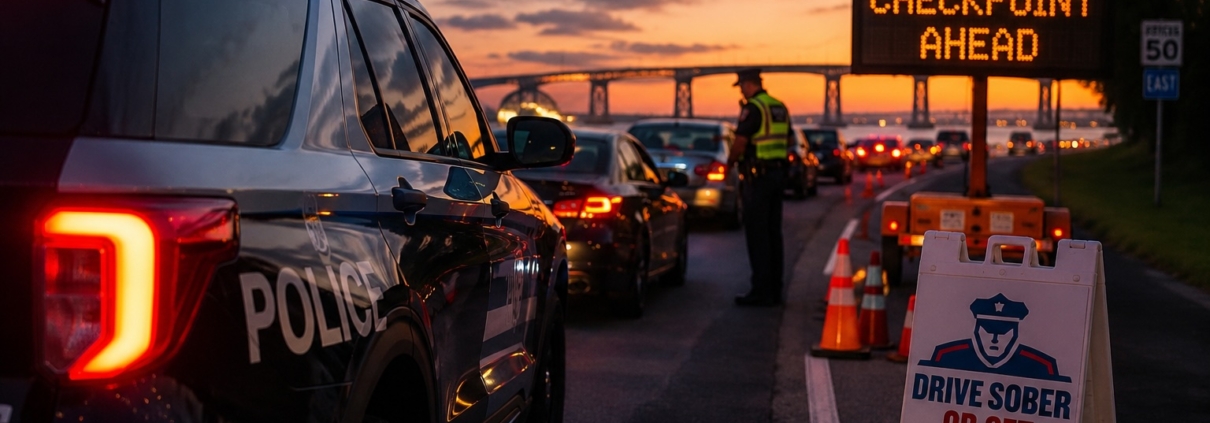
Maryland State Police officer conducting a Memorial Day weekend DUI checkpoint near the Chesapeake Bay Bridge at sunset on Maryland’s Eastern Shore.

Memorial Day Weekend Arrests on Maryland’s Eastern Shore: What to Do if You’re Charged in Ocean City, Kent Island, or Easton

Memorial Day weekend is the unofficial start of summer on Maryland’s Eastern Shore — and law enforcement knows it. Every year, the same pattern plays out: the crowds arrive, the bars fill up, the boats go out, and police presence across the region spikes dramatically. More arrests happen on Memorial Day weekend than almost any other time of year.

If you or someone you know was arrested over Memorial Day weekend in Ocean City, Kent Island, Chestertown, Easton, or anywhere on the Eastern Shore, here is what you need to know right now.

Why Memorial Day Weekend Means Elevated Enforcement on the Eastern Shore

This is not an accident and it is not random. Over 60% of DUI arrests in the Ocean City area happen between Memorial Day and Labor Day. More police patrols are out in full force during busy times. Sobriety checkpoints are set up near bars and clubs to catch unsafe drivers. Cullen Burke

Troopers from the Maryland State Police Centreville, Easton, and Berlin barracks conduct high visibility enforcement along U.S. Routes 13, 50, and 404, and throughout their respective counties during major holiday weekends. That means Route 50 across the Bay Bridge, Route 404 through Caroline and Talbot Counties, and the approaches to Ocean City are all active enforcement corridors every Memorial Day. Maryland State Police

Nearly 40% of people arrested are out-of-state visitors who didn’t know Maryland’s laws. Visiting from another state does not protect you. Maryland law applies to everyone on Maryland roads and waterways — and a conviction here can follow you home through the Driver License Compact, which allows states to share driving record information across state lines. Cullen Burke

The Most Common Memorial Day Weekend Charges on the Eastern Shore

DUI and DWI

The most common arrest by far. Maryland distinguishes between two levels of impaired driving:

  • DUI (Driving Under the Influence): Charged when your blood alcohol concentration (BAC) is .08% or higher. A first DUI conviction in Maryland carries up to one year imprisonment and fines reaching $1,000. License suspension periods for first DUI convictions typically last six months. Scheuerman Law LLC
  • DWI (Driving While Impaired): A lesser but still serious charge, typically when BAC is between .06% and .07% or when there are signs of impairment. A first DWI carries a fine of $500, 8 points on your license, license suspension up to 60 days, and up to 60 days imprisonment. Tuckerlawpllc

Both are misdemeanors in Maryland, but both carry consequences that follow you well beyond the courthouse. The Motor Vehicle Administration will put points on the record of any driver convicted of a DUI or DWI. A driver convicted of a DWI will be assessed 8 points. A driver convicted of a DUI will be assessed 12 points. Twelve points makes your license eligible for revocation. Maryland People’s Law Library

There is also a critical time deadline most people miss: if you do not request an MVA hearing to review suspension of your license within 10 days of the traffic stop, your privilege to drive in Maryland will be automatically suspended upon expiration of the temporary license. That 10-day window starts ticking the moment you are pulled over. Do not let it expire. Marylandcriminalattorneyblog

DUI Checkpoints

Memorial Day weekend is one of the most active periods for sobriety checkpoints in Maryland. In Wicomico County and on the lower Eastern Shore, it is not unusual for there to be DUI checkpoints on the larger highways like Route 50 or Route 13. MD Defense

Checkpoints are legal in Maryland but must follow strict rules. The checkpoint must be systematic, non-arbitrary, and nondiscriminatory. Officials must give public notice in advance of the checkpoint. Roadway signs must give drivers advanced warning of an approaching sobriety checkpoint. Drivers must be given the option to turn their vehicle around to avoid passing through the checkpoint. MD Defense

Importantly, police officers cannot stop a vehicle just because a driver has chosen to turn around to avoid passing through a checkpoint, unless they have probable cause to do so. Knowing your rights at a checkpoint matters. You must provide your license, registration, and proof of insurance. You are not required to answer questions about where you have been or whether you have been drinking. Maronicklaw

Boating Under the Influence (BUI)

The Eastern Shore’s rivers, the Chesapeake Bay, and the Chester River are filled with recreational boaters every Memorial Day weekend — and Maryland Natural Resources Police are out in full force on the water.

Maryland treats BUI with the same seriousness as driving under the influence on land. Maryland law prohibits operating or attempting to operate a vessel while under the influence of or impaired by drugs or alcohol. A first-offense BUI is a misdemeanor and carries up to one year imprisonment and a maximum of $1,000 in fines. A second-offense BUI is a misdemeanor and carries up to two years imprisonment and a maximum of $2,000 in fines. Driving Laws

The .08% BAC threshold applies on the water just as it does on the road. A BUI conviction can also result in suspension of your boating privileges. If you were arrested on the Chester River, the Chesapeake Bay, or any Eastern Shore waterway this weekend, treat it with exactly the same urgency as a DUI charge on land.

Underage Drinking and Underage DUI

College students and younger visitors make up a significant portion of Memorial Day weekend crowds — and Maryland’s zero tolerance law is unforgiving.

As any amount of alcohol consumption is illegal for drivers under the age of 21, minors can be charged with a DUI if they have a BAC of .02 percent or higher. Minors who have purchased, possessed, or consumed alcohol can pay fines up to $500 for a first offense and up to $1,000 for subsequent offenses. Tuckerlawpllc

A conviction for violating the underage alcohol restriction results in a six-month license suspension for a first offense and complete revocation for any subsequent offense. The driver must also install an ignition interlock device. AllLaw

An underage DUI or alcohol possession charge is not a slap on the wrist. It creates a criminal record that can affect college admissions, scholarship eligibility, professional licensing, and future employment. If a young person in your family was arrested this weekend, get legal help immediately.

Disorderly Conduct and Other Common Weekend Charges

Not every Memorial Day arrest involves a vehicle or a boat. Common charges during high-traffic holiday weekends on the Eastern Shore also include:

  • Disorderly conduct — public intoxication, fighting, or disturbing the peace on the Ocean City boardwalk or at marinas
  • Minor in possession — possession of alcohol by anyone under 21
  • Open container violations — in public spaces or vehicles
  • Trespassing — after-hours access to beaches, private property, or closed venues
  • Drug possession — marijuana and controlled substances, even in small amounts

Each of these charges has its own set of consequences and defenses. None of them should be ignored or handled without at least consulting an attorney.

What to Do Immediately After an Eastern Shore Arrest

1. Do Not Make Statements Without an Attorney

Everything you say after an arrest can be used against you. This is not a cliché — it is the reality of how criminal cases are built. Remember that everything you do and say is being recorded on bodycam and/or dashcam footage and can be used as evidence against you. Be polite and cooperative with law enforcement. Provide your identification. Beyond that, exercise your right to remain silent and ask for an attorney. Marylandcriminalattorneyblog

2. Act on the MVA 10-Day Deadline

If you were charged with DUI or DWI in Maryland, you have a narrow window to protect your driving privileges. If you do not request an MVA hearing within 30 days of the stop, you will have completely waived your right to contest suspension of your license. But to prevent suspension from beginning automatically, the request must be made within 10 days. Call an attorney today — not next week. Marylandcriminalattorneyblog

3. Write Down Everything You Remember

While details are still fresh: write down exactly where and when you were stopped, what the officer said and did, what field sobriety tests were administered, whether you submitted to a breathalyzer or refused, and any other details you can recall. This information will be critical for your defense attorney.

4. Do Not Miss Your Court Date

If you were released and given a court date, that date is not optional. Missing a court date in Maryland results in a bench warrant for your arrest and a separate failure to appear charge — compounding an already difficult situation significantly.

5. Call an Attorney As Soon As Possible

The earlier you have legal representation, the more options you have. An experienced Maryland criminal defense attorney can review the circumstances of your stop, challenge the legality of a checkpoint, question the administration of field sobriety tests, file for an MVA hearing to protect your license, negotiate with prosecutors, and build your defense from the ground up. Waiting costs you options.

Why Eastern Shore Cases Are Different

The Eastern Shore’s courts — in Queen Anne’s County, Talbot County, Kent County, Worcester County, and others — operate with their own judges, prosecutors, and local practices. Not all DUI cases are the same. Working with a local attorney who knows the courts, judges, and prosecutors in the local county can make a real difference. A lawyer familiar with local cases understands the area in ways that cannot be replaced by a generic search. Cullen Burke

An attorney who practices regularly in Chestertown, Centreville, Easton, and Ocean City understands the local landscape in ways that an attorney unfamiliar with the Eastern Shore simply does not.

Frequently Asked Questions

I was arrested in Ocean City but I live in another state. Do I still need to deal with this?

Yes — and ignoring it will make things significantly worse. Maryland participates in the Driver License Compact, which means your home state will be notified of your arrest and any conviction. A Maryland DUI can result in license suspension in your home state even if you never return to Maryland. Missing a Maryland court date will result in a bench warrant that can follow you across state lines. You need a Maryland attorney to represent you, ideally one who can appear on your behalf so you do not need to travel back for every hearing.

What happens if I refused the breathalyzer?

Refusing a breathalyzer triggers Maryland’s implied consent law. Refusal to be tested for drugs or alcohol can result in automatic license suspension of 270 days for the first offense, or participation in the Ignition Interlock Program for one year. Refusal also cannot be used as a defense — prosecutors can and will argue that refusal demonstrates consciousness of guilt. An attorney can advise you on how to handle a refusal case and whether challenging the stop itself is a viable strategy. Tuckerlawpllc

Can a first-offense DUI be reduced or dismissed in Maryland?

Potentially, yes. Maryland has a program called Accelerated Rehabilitative Disposition (ARD) for first-time offenders. Program participants must pay fines, complete a treatment program, accept a period of license suspension, and complete a period of community service. Successful completion can allow a first offender to avoid a formal conviction. Whether you qualify depends on the specific facts of your case, your record, and the county where you were charged. AllLaw

Is a BUI treated the same as a DUI in Maryland?

For practical purposes, yes. The penalties are comparable, the implied consent rules apply on the water as well as on the road, and a BUI conviction creates a criminal record just like a DUI. The enforcement agencies are different — Natural Resources Police on the water, not the usual traffic officers — but the seriousness of the charge is the same.

What if I was under 21 when I was arrested?

Maryland’s zero tolerance law means even a trace of alcohol can result in a DUI charge for drivers under 21. The penalties include license suspension, ignition interlock requirements, fines, and a criminal record that can affect your future in ways that extend well beyond the immediate sentence. An attorney may be able to pursue diversion, expungement eligibility, or other options that protect your record. Act quickly.

Arrested on the Eastern Shore This Weekend? Call Us Today.

At the Law Offices of David N. Mabrey, we represent clients across Maryland’s Eastern Shore — including in Kent County, Queen Anne’s County, Talbot County, and beyond. Whether you are facing a DUI, a BUI, an underage charge, or another arrest from this Memorial Day weekend, we are ready to help you understand your options and fight for the best possible outcome.

Time is critical. The MVA deadline, your court date, and the strength of your defense all depend on acting now.

Chestertown Office 107 Court St, Chestertown, MD 21620 📞 410-778-1630

Pasadena Office 8611 Fort Smallwood Rd C, Pasadena, MD 21122 📞 443-702-7708 🚨 Emergency/New Accident: 443-848-2878

Contact us online here — we handle urgent matters and are available when you need us most.

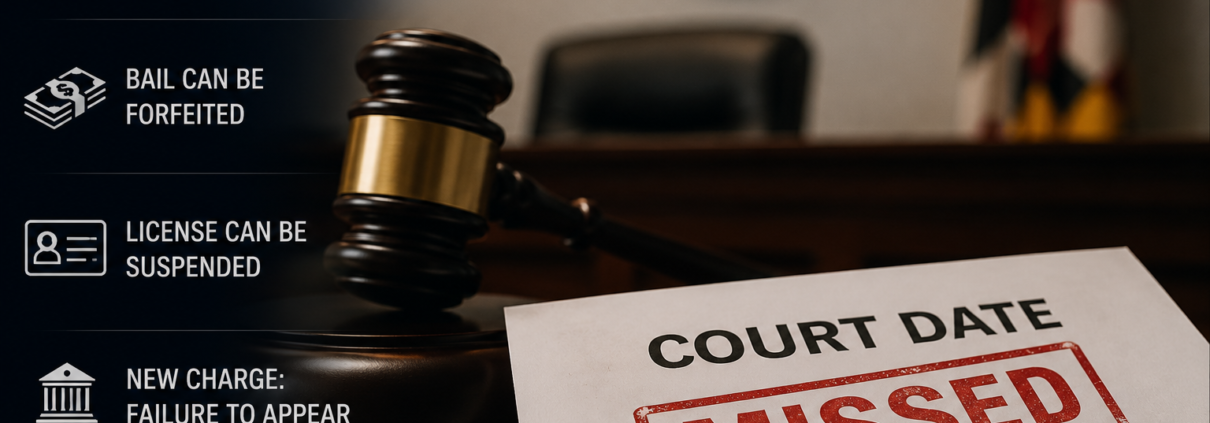
Court date notice stamped “MISSED” on a courtroom desk beside a judge’s gavel, illustrating the legal consequences of missing a court appearance in Maryland.

What Happens If You Miss a Court Date in Maryland?

Missing a court date is one of those situations that can spiral fast. Whether it happened because of a genuine emergency, a mix-up over the date, or something that just slipped through the cracks — the worst thing you can do right now is nothing.

Here is exactly what happens when you miss a court date in Maryland, what the consequences are, and the steps you need to take immediately to protect yourself.

The First Thing That Happens: A Bench Warrant

When you miss a court date, the judge typically issues a bench warrant for your arrest. A bench warrant authorizes law enforcement to take you into custody and bring you before the court. This can happen immediately or at a later time, depending on when and where you are located. Drewcochranlaw

A bench warrant does not expire. It sits in the system indefinitely until you are arrested or a judge recalls it. That means you are at risk every time you are pulled over for a traffic stop, every time law enforcement runs your name, and — in some cases — every time you show up for an unrelated court matter. People are arrested on outstanding bench warrants at work, at home, and during routine interactions with police they never saw coming.

The longer you wait, the more chances there are for that warrant to catch up with you in the worst possible way.

You Could Face a Separate Failure to Appear Charge

Missing court is not just a procedural problem — it can become its own criminal charge on top of whatever you were originally in court for.

If a person has been granted pretrial release either through bail or upon their own recognizance and then fails to appear in response to a citation, they face several penalties. First, the court may issue a bench warrant for the arrest of the defendant. Second, the person will be guilty of a misdemeanor punishable by up to 90 days in jail and a fine not to exceed $500. MD Defense

In more serious cases the stakes are even higher. It is a misdemeanor crime punishable by up to 3 years in jail and a $5,000 fine if you willfully failed to appear for a court date after being properly notified. This charge could be added to your existing case. Shepard Law

In other words, you could end up facing two separate cases — the original charge and the failure to appear — when you only had one to begin with.

Your Bail Can Be Forfeited

If you were released on bail, missing your court date could lead to bail forfeiture. This means that the court keeps the money you or your bail bondsman posted. In addition, the bail bondsman may seek to recover the forfeited amount from you, leading to further financial strain. Drewcochranlaw

Beyond losing the bail money itself, judges and pretrial services will consider your failure to appear when setting new court dates or pretrial release. It will not be to your advantage. Getting released again — and on reasonable terms — becomes significantly harder once you have a missed court date on your record. FindLaw

Your Driver’s License Could Be Suspended

In some cases, particularly those involving traffic violations, the court may notify the Department of Motor Vehicles about your failure to appear. This can result in the suspension of your driver’s license until the matter is resolved. Drewcochranlaw

For DUI cases specifically, the Maryland Motor Vehicle Administration will be notified, which can trigger an administrative license suspension. This happens automatically and can complicate future MVA hearings. Frizwoods

This is particularly damaging if you depend on your license for work, and it is a separate problem from the criminal case itself — meaning you may need to resolve both the court matter and the MVA issue independently.

It Makes Your Original Case Harder to Defend

Even if everything else gets sorted out, a missed court date follows you.

These failures to appear, or “FTAs,” can be used against a person in future hearings as an example to suggest that they may not appear in court. For example, at a bail review, the prosecution might bring up prior failures to appear as a basis for holding a person without bail. Frizwoods

Missing a court date often leads to harsher penalties if you are ultimately convicted of the original charge. Judges tend to view failure to appear as a sign of disrespect or non-compliance, which can result in longer sentences, higher fines, or more severe probation conditions. Missing a court date also sets a precedent that can influence future legal proceedings. Judges and prosecutors may be less inclined to offer leniency or favorable plea deals if they perceive you as unreliable or uncooperative. Drewcochranlaw

In short, a missed court date does not just create new problems — it makes your existing problem harder and more expensive to resolve.

Does It Matter Why You Missed Court?

Yes — but only if you act on it quickly and can back it up with documentation.

Courts in Maryland do distinguish between willful non-appearance and missing a date for a legitimate reason. Common valid reasons include medical emergencies, a documented family crisis, incorrect information about the court date, or a genuine miscommunication. The key word is documented. Saying you were sick is very different from having a hospital record or physician’s note that confirms it.

If you have a legitimate reason, your attorney can file a motion to recall the bench warrant and present that explanation to the court. The stronger your documentation, the better your chances of having the warrant recalled without additional penalties.

What courts are far less sympathetic about: forgetting, being afraid to show up, or assuming the court date was not serious. None of these are legal defenses, and none of them will help you.

What to Do Right Now

Step 1: Do Not Ignore It

The single worst thing you can do is hope the problem goes away. It will not. Bench warrants do not expire, and failure to appear charges do not resolve themselves. Every day you wait is another day the situation can get worse.

Step 2: Check Maryland Case Search

Even in your absence, the court proceedings may have continued. It is important to find out what decisions were made during the session. You can usually obtain this information from the court clerk or Maryland Case Search. Frizwoods

Knowing whether a warrant has already been issued — and what happened to your case in your absence — is essential before taking any next steps.

Step 3: Contact a Maryland Criminal Defense Attorney Immediately

This is not a situation to navigate on your own. If you failed to appear in court and the judge has issued a bench warrant for your arrest, an experienced criminal defense attorney can file a motion to recall the warrant. This motion can persuade a judge to remove or “quash” the warrant and set a new court date. Houlon Berman

An attorney can often resolve a bench warrant without you being taken into custody first — but that window is much easier to use before you have been arrested than after.

Step 4: Gather Any Documentation of Why You Missed

If there is a legitimate reason for your absence, start gathering evidence now. Medical records, hospital discharge papers, documentation of a family emergency, proof of a scheduling error — anything that supports your explanation needs to be in hand before your attorney files a motion.

Step 5: Do Not Turn Yourself In Without Legal Counsel

In many cases, voluntarily surrendering yourself to the authorities can demonstrate your willingness to cooperate and may result in more favorable treatment by the court. However, you should allow an attorney to advise you on the best way to do this. Drewcochranlaw

Walking into a police station without legal counsel and without a plan is rarely in your best interest. Let an attorney guide the process so that your surrender — if necessary — happens on the best possible terms.

Different Court Types, Different Consequences

It is worth noting that the consequences of missing a court date in Maryland can vary depending on the type of case involved.

Criminal cases carry the most serious consequences — bench warrants, misdemeanor failure to appear charges, bail forfeiture, and the risk of pretrial detention if you are re-arrested.

Traffic cases fall into two categories. Non-jailable traffic offenses — simple payable tickets — generally result in a license suspension and an additional fine rather than a bench warrant. If you missed a Maryland traffic court date for a non-serious or non-jailable case, it can be fixed. Jailable traffic offenses — driving on a suspended license, DUI, knowingly driving uninsured — are treated more like criminal cases, and a bench warrant will likely be issued. David R. Waranch

Civil cases — landlord-tenant disputes, contract matters, small claims — can result in a default judgment entered against you. In practical terms that means the other party wins automatically, and you may owe money or lose property with no opportunity to present your side.

Jury duty is its own category. Missing jury duty can result in up to 60 days in prison and a fine of up to $1,000. To avoid these penalties, you may be required to show good cause for missing the intended court date. Houlon Berman

Frequently Asked Questions

How long does a bench warrant stay active in Maryland?

A bench warrant in Maryland does not expire. It remains active until either you are arrested and brought before the court, or a judge recalls or quashes it. There is no waiting it out.

Can I get a bench warrant recalled without being arrested?

In many cases, yes. An attorney can file a motion to recall the bench warrant, presenting the court with an explanation for the missed appearance and asking that the warrant be withdrawn and a new court date set. This process is significantly smoother with legal representation than without it.

Will missing a court date show up on my record?

In Maryland, you will have a misdemeanor charge on your record for a failure to appear. This is regardless of the resolution of your original criminal charge. That is why acting quickly — before a formal FTA charge is entered — matters so much. FindLaw

What if I missed court because of a medical emergency?

A genuine medical emergency is one of the most commonly accepted reasons for a missed court date. You will need documentation — hospital records, physician notes, or similar evidence — to support the explanation. Your attorney can present this to the court when filing a motion to recall the warrant.

What if I just forgot?

Forgetting is not a legal defense, but it does not mean your situation is hopeless. Courts deal with missed appearances regularly. The critical factor is whether you act quickly and proactively after the fact. An attorney can help you present your situation in the most favorable light and work toward getting a new date without additional charges.

Does missing court affect my chances on the original charge?

Yes, in most cases it does. Judges have discretion in sentencing, and a failure to appear on your record signals unreliability. Prosecutors may also be less willing to offer favorable plea deals to defendants who have missed court. Getting ahead of the problem quickly — before the court forms a negative impression of you — is your best defense.

Missed a Court Date in Maryland? Call Us Before the Situation Gets Worse.

At the Law Offices of David N. Mabrey, we represent clients across Maryland who are dealing with bench warrants, failure to appear charges, and the fallout from missed court dates. Whether your case involves a criminal charge, a traffic matter, or something else entirely — we can help you understand your options and take the right steps before things escalate further.

Do not wait. The sooner you call, the more options you have.

Chestertown Office 107 Court St, Chestertown, MD 21620 📞 410-778-1630

Pasadena Office 8611 Fort Smallwood Rd C, Pasadena, MD 21122 📞 443-702-7708 🚨 Emergency/New Accident: 443-848-2878

Contact us online here — available for urgent matters.