
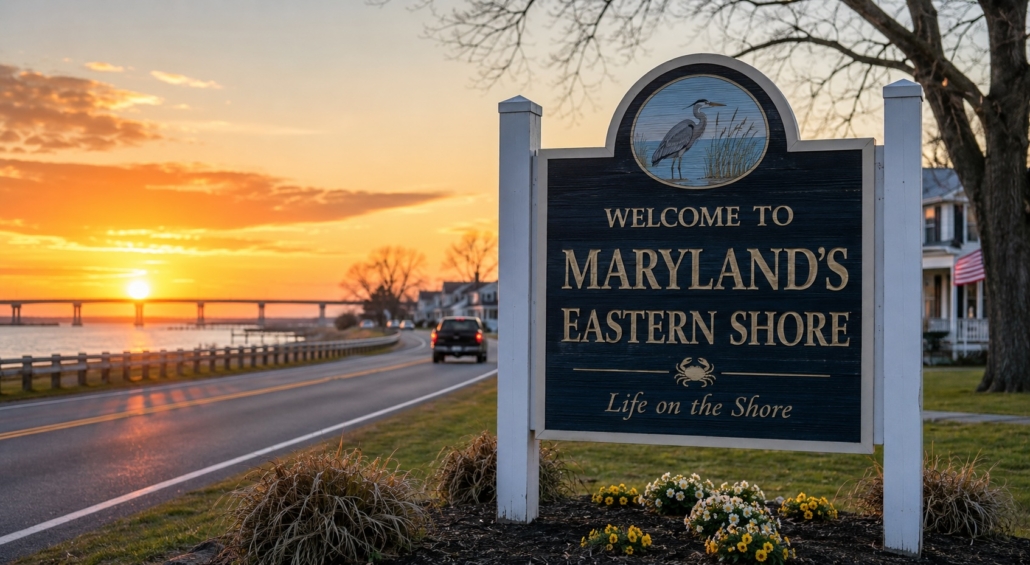
Moving to Maryland’s Eastern Shore? Common Legal Mistakes New Residents Make in Centreville, Stevensville, and Chestertown
People are moving to Maryland’s Eastern Shore in growing numbers — drawn by lower housing costs, waterfront living, a slower pace, and the ability to work remotely from places like Stevensville, Centreville, and Chestertown that were once considered too far from the metro corridor to be practical.
What most newcomers do not realize is that Maryland has some genuinely unusual laws — and the Eastern Shore has its own local character when it comes to enforcement, courts, and community expectations. The legal mistakes new residents make here are rarely intentional. They are almost always the result of assuming Maryland works the way their home state did.
Here are the most common — and most costly — legal mistakes new residents make when they arrive on the Eastern Shore.
Mistake 1: Assuming Your Out-of-State Gun Laws Still Apply
This is the single most dangerous assumption new residents make, and it creates real criminal exposure for people who have done nothing wrong in their home state.
Maryland has some of the most restrictive firearm laws in the country — and they apply the moment you cross the state line. Your Virginia concealed carry permit, your Pennsylvania license to carry, your Florida permit — none of them are recognized in Maryland. A traveler without a Maryland permit may not carry a handgun on foot or in a vehicle in a loaded or readily accessible manner. Gunlawguide
The rules for transporting a handgun in a vehicle are specific and strict. The firearm must be stored separately, must not be loaded, and cannot be readily accessible to the driver. Transporting a firearm is illegal anytime it is not stored properly in the vehicle and is readily accessible to the driver. To properly store a firearm when transporting it in Maryland, make sure the ammo is stored separately from the firearm, in cases, and locked. Mdcriminalattorney
The legal exceptions for transporting a handgun are narrow. Legal transport is permitted for a person transporting a handgun used in connection with a target shoot, formal or informal target practice, sport shooting event, hunting, or similar activity, while the person is on the way to or returning from that activity, if the handgun is unloaded and carried in an enclosed case or holster. Transport between bona fide residences is also permitted — but only if done directly, without stops. Justia
We have seen numerous cases where out-of-state residents from places with more reasonable firearm laws have been arrested for simply driving through Maryland with a gun in their car. In almost all of these cases the gun was unloaded and in the trunk, and in many cases the defendants were driving to or from a residence, which under the statute is legal. But cops on the scene rarely ask the right questions, and few defendants know the law. The result of these stops is usually an arrest for a serious criminal offense that carries a 30-day minimum mandatory jail sentence and a maximum sentence of up to 5 years. The Herbst Firm
What new residents should do: Before you move your firearms into Maryland, consult with a Maryland attorney who handles gun law matters. The rules here are genuinely different from most other states and the consequences of getting it wrong are severe.
Mistake 2: Not Updating Your License and Registration Within 60 Days
This one catches people constantly — especially those who moved to the Eastern Shore while still working remotely or maintaining ties to their previous state.
You must obtain your Maryland driver’s license and Maryland vehicle title and registration within 60 days of becoming a Maryland resident. Maryland Motor Vehicle Administration
An out-of-state driver’s license must be updated to a Maryland driver’s license within 60 days of moving to Maryland. An out-of-state commercial driver’s license must be transferred within 30 days of moving to Maryland. Failure to meet the deadline may result in penalties. Maryland Motor Vehicle Administration
The vehicle registration deadline is equally strict. If you delay beyond 60 days, you will not be eligible for a tax credit for any titling tax paid in another state, and you may be subject to a citation for an out of state registration. Mdspeedytags
People who are renting temporarily, spending time between two properties, or still in the process of fully relocating often convince themselves they are not yet “really” Maryland residents. Maryland law defines residency more broadly than most people assume — if you are living in the state for other than a temporary or transitory purpose, the clock is running.
A traffic stop with an out-of-state plate and a year-old out-of-state license, on a car you have been driving around Queen Anne’s County for four months, is a problem you did not need to create.
What new residents should do: Schedule your MVA appointment before your 60-day window closes. You can handle your driver’s license and vehicle registration in a single visit. Do not put it off.
Mistake 3: Moving Here With a Custody Order Without Telling the Other Parent
This is perhaps the most emotionally charged mistake on this list — and also the one with the most severe legal consequences.
People move to the Eastern Shore for good reasons all the time: a new job, a parent who needs care, lower cost of living, a relationship, a fresh start. If you have children and a custody order, moving to Kent County or Queen Anne’s County is not just a personal decision — it is a legal event.
Under Maryland law, a custodial parent wishing to relocate must provide written notice of their intention to move at least 90 days prior to the intended relocation. This rule applies to both in-state and out-of-state moves. The purpose of this requirement is to give the non-relocating parent sufficient time to object to the relocation if they believe it will negatively impact the child or their relationship with the child. Rodier Family Law
That notice must be formal — not a text message, not an email. The notice should be sent by certified mail with return receipt requested to the other parent’s last known address. Shah & Kishore
What happens if you move without giving notice? Some parents mistakenly believe it is better to ask for forgiveness than permission. This is a catastrophic error in judgment in Maryland family court. Violating that order by unilaterally relocating the child is seen as a direct affront to the court’s authority and a willful disregard for the other parent’s rights. The non-moving parent can file an emergency petition with the court. A judge will view the parent’s unilateral action as evidence that they are not willing to foster a relationship between the child and the other parent — a critical factor in any custody determination. The judge may be heavily inclined to strip the moving parent of primary physical custody. Srislawyer
Failure to provide 90 days’ notice can lead to parental kidnapping charges. Shelly Ingram Law
This applies even if you are the custodial parent. Even if the move is across state lines — from Virginia or Delaware into Maryland. Even if you have sole custody. The notice requirement exists to protect both parents’ rights and the child’s relationship with the non-moving parent.
What new residents should do: If you have an existing custody or visitation order and you are planning to move to the Eastern Shore, speak with a family law attorney before you move — not after. The 90-day timeline needs to be planned for, not reacted to.
Mistake 4: Starting a Business Without Understanding Local Licensing Requirements
The Eastern Shore is attracting a wave of entrepreneurs — people opening shops in Chestertown’s historic downtown, starting marine services businesses on Kent Island, launching farm-to-table operations in Talbot County, or setting up home-based businesses after relocating from suburban areas where zoning was more permissive.
What works in one county or one state may not work here. Maryland has state-level business licensing requirements, but Queen Anne’s County, Kent County, and Talbot County each have their own local zoning rules, occupancy requirements, and permit processes that can vary significantly — sometimes even at the municipality level.
Common pitfalls include:
Operating without a trade name registration. If you are doing business under any name other than your own full legal name, Maryland requires you to register a trade name with the State Department of Assessments and Taxation. Operating without one exposes you to fines and can create problems with banking and contracts.
Assuming rural zoning allows home-based businesses. Agricultural and rural zones on the Eastern Shore have specific restrictions on commercial activity, signage, customer traffic, and employee numbers. What is permitted in a suburban neighborhood in Northern Virginia may not be permitted on a farm parcel in Caroline County.
Missing the requirement for a Trader’s License. Maryland requires a Trader’s License for most businesses that sell goods. It is issued by the county clerk’s office — not the state — and the requirements vary by county and by sales volume.
Not registering for Maryland sales tax. If you are selling taxable goods or services in Maryland, you need a sales and use tax license from the Comptroller’s office before you begin — not after your first transaction.
What new residents should do: Before you open your doors, consult with a Maryland business attorney familiar with the county you are operating in. A short consultation can prevent months of compliance problems down the road.
Mistake 5: Ignoring How Maryland Traffic Laws Differ From Your Home State
Traffic laws vary more than most drivers realize across state lines, and the Eastern Shore has its own enforcement patterns that new residents are frequently surprised by.
A few specific differences that catch newcomers:
Speed enforcement on rural roads. Route 50 through the Eastern Shore, Route 213 through Kent County, and the approach roads to Chestertown all have speed limits that are actively enforced — and Maryland courts treat speeding as a point offense with real consequences. Enough points on your record within a short period can trigger a license suspension hearing. Maryland’s point system counts violations from all U.S. states, so if you moved here with points already on your record, you may be closer to a suspension threshold than you realize.
Aggressive driving statutes. Maryland has a specific aggressive driving law that can apply when multiple traffic violations occur in sequence — tailgating, unsafe lane changes, and speeding together can result in an aggressive driving charge that carries criminal penalties beyond a simple traffic fine.
Open container laws. Maryland strictly prohibits open alcoholic beverage containers anywhere in the passenger compartment of a vehicle, by any occupant — including passengers. This surprises visitors from states with more permissive open container rules, particularly on the way home from Eastern Shore events, crab feasts, or waterfront venues.
Cell phone and hands-free requirements. Maryland prohibits the use of a handheld cell phone while driving entirely. The fine for a first violation is modest, but a second violation within two years results in points on your license.
What new residents should do: Treat your first few months on Eastern Shore roads as an adjustment period. A traffic attorney can help if a citation creates a point problem — and acting early, before a suspension is triggered, leaves far more options available.
Mistake 6: Not Understanding That Maryland Is a Contributory Negligence State
This one is less visible day-to-day but enormously consequential if you are ever in an accident.
Most states follow a comparative negligence standard — meaning that even if you were partially at fault for an accident, you can still recover some compensation proportional to the other party’s fault. Maryland does not. Maryland is one of only five jurisdictions in the country that still follows pure contributory negligence.
Under Maryland’s rule, if you are found even 1% at fault for an accident, you may be completely barred from recovering any compensation — regardless of how responsible the other driver was. Insurance companies know this and use it aggressively.
For new residents who have never lived under contributory negligence before, this creates a specific behavioral warning: anything you say at an accident scene — any apology, any admission, any casual statement about what happened — can be used to assign partial fault to you and eliminate your right to compensation entirely.
What new residents should do: After any accident in Maryland, say only what is necessary to exchange information and cooperate with law enforcement. Do not apologize, speculate, or estimate fault. Consult a personal injury attorney before speaking with any insurance adjuster.
Frequently Asked Questions
Do I need a Maryland attorney if I already have one in my home state?
For most Maryland-specific legal matters — traffic violations, criminal charges, business licensing, custody modifications, and real estate — yes. Your home state attorney is not licensed to practice in Maryland and is unlikely to be familiar with local court practices in Queen Anne’s, Kent, or Talbot County. For matters that cross state lines, such as a custody order that was issued in another state, a Maryland attorney can work alongside your prior counsel.
I have a concealed carry permit from another state. Can I bring my handgun when I move?
Your out-of-state permit is not recognized in Maryland. You may transport an unloaded handgun in a locked case directly between residences, but you cannot carry it on your person or in an accessible location in your vehicle without a Maryland wear and carry permit — which is a separate application process. Get legal advice before transporting any firearms into the state.
What if my custody order was issued in another state?
Out-of-state custody orders are generally enforceable in Maryland under the Uniform Child Custody Jurisdiction and Enforcement Act (UCCJEA). However, once you become a Maryland resident, Maryland courts can and will assert jurisdiction over custody matters involving children living here. The 90-day relocation notice requirement may still apply depending on the terms of your order. Review your order with a Maryland family law attorney before you move.
Can I operate a small home-based business without registering in Maryland?
Almost certainly no. Even home-based businesses typically require trade name registration, local zoning compliance, and in many cases a Trader’s License or sales tax registration. The Eastern Shore’s county governments are smaller and more hands-on than large suburban jurisdictions — operating without proper licensing tends to come to light faster than it might elsewhere.
My traffic ticket from back home just followed me here. Does Maryland care about it?
Yes. Maryland participates in the Driver License Compact and the Non-Resident Violator Compact, which means out-of-state convictions can result in points on your Maryland record and out-of-state failures to appear can trigger suspension of your Maryland license. If you have unresolved traffic matters from another state, address them promptly.
New to the Eastern Shore and Have Legal Questions? We Are Here.
At the Law Offices of David N. Mabrey, we serve clients across Maryland’s Eastern Shore from our Chestertown office — including residents of Kent County, Queen Anne’s County, Talbot County, and beyond. Whether you are navigating a firearms question, a custody relocation issue, a business licensing matter, or anything else that comes with starting a new chapter in a new state, we provide the straightforward local legal guidance you need.
Chestertown Office 107 Court St, Chestertown, MD 21620 📞 410-778-1630
Pasadena Office 8611 Fort Smallwood Rd C, Pasadena, MD 21122 📞 443-702-7708 🚨 Emergency/New Accident: 443-848-2878
Contact us online here to schedule a consultation.






Leave a Reply
Want to join the discussion?Feel free to contribute!