
Route 50 and Bay Bridge Accident Guide: What to Do If an Out-of-State Driver Hits You
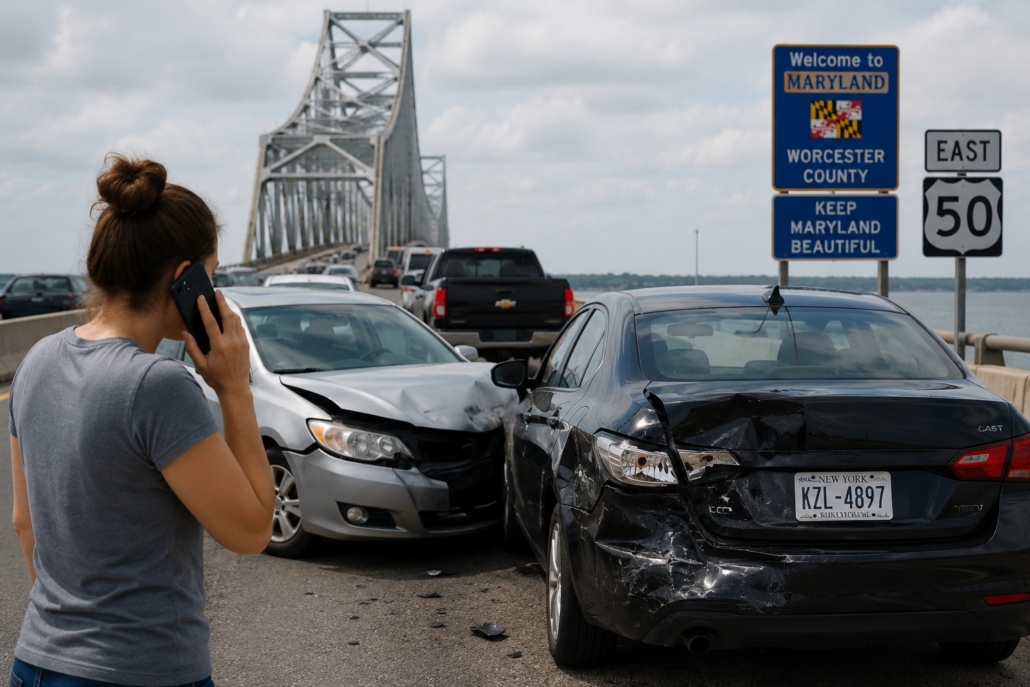
If you’ve driven Route 50 toward the Bay Bridge on a Friday afternoon in June, you already know what it looks like. The left lane backed up past Parole. Rental cars weaving. Pennsylvania plates tailgating at sixty miles an hour. New York drivers who haven’t touched a two-lane highway since the last time they drove to the Shore. And somewhere in the middle of all of it, a bottleneck at the bridge itself where four lanes of impatient summer traffic compress into two — and where the conditions for a serious rear-end collision are essentially engineered into the road.
Every summer, the stretch of US Route 50 running through Anne Arundel and Queen Anne’s Counties becomes one of the most congested and accident-prone corridors in the state of Maryland. The William Preston Lane Jr. Memorial Bridge — universally called the Bay Bridge — is the single choke point between the Baltimore-Washington metropolitan area and the beaches of Ocean City, Delaware, and beyond. On peak summer Fridays, the Maryland Transportation Authority estimates that more than 75,000 vehicles cross the bridge in a single day.¹ That volume, combined with unfamiliar drivers, distracted vacation behavior, and the abrupt slowdowns that characterize bridge approaches, produces a predictable surge in collisions every season.
When one of those collisions involves you — and the driver who caused it has Pennsylvania, Virginia, New York, or New Jersey plates — you are not dealing with a simple insurance claim. You are dealing with an out-of-state driver, an out-of-state insurance company, an out-of-state policy, and a set of legal complications that most accident victims don’t fully understand until they’re already deep into the process. This guide explains what happens after that kind of crash, why it’s more complicated than a standard Maryland accident claim, and what you need to do to protect yourself from the moment the collision happens.
Why Route 50 and the Bay Bridge Are So Dangerous in Summer
Understanding why this corridor produces so many serious accidents isn’t just background — it shapes how liability is established, how severity is documented, and how your case is built.
The Bay Bridge approach on the westbound side has long been identified as a crash concentration point. The transition from the multi-lane Route 50 corridor down to the bridge’s two lanes creates a forced merge that drivers unfamiliar with the road handle poorly. Sudden braking, late lane changes, and drivers who misjudge the deceleration of traffic ahead generate rear-end collisions at speeds that cause serious injury.² The eastbound approach has its own hazards — traffic that moves freely on Route 50 east of Annapolis suddenly encounters bridge toll plaza queuing, and the speed differential between moving traffic and stopped or slowing vehicles is substantial.
Beyond the bridge itself, the Route 50 corridor through Annapolis and into Queen Anne’s County has additional high-risk characteristics. The intersection at Route 50 and Route 301 near Bowie, the Parole interchange, and the stretch through Grasonville all generate significant accident volume. During summer months, these locations see a disproportionate share of out-of-state involvement — drivers who don’t know the road, don’t know the interchange patterns, and are navigating with GPS on a phone while managing children in the back seat.
Maryland State Police and the Anne Arundel County Police Department both have jurisdiction over portions of this corridor, and the agencies that respond to your accident, the reports they generate, and the courts that would hear your case all depend on exactly where the collision occurred. That local specificity matters enormously when building a claim.
The Immediate Aftermath: What to Do at the Scene
The steps you take in the minutes following a collision on Route 50 or at the Bay Bridge approach directly affect your ability to recover compensation later. Here is what matters most.
Call 911 and stay at the scene. Even if the collision seems minor, a police report is essential when the other driver is from out of state. Without a report, you have no official documentation of who was involved, what the other driver said at the scene, and what the responding officer observed. An out-of-state driver who seems cooperative at the scene has every incentive to tell a different story once they’re home in Pennsylvania and talking to their insurance company. The police report is your contemporaneous record.
Document everything before the vehicles move. Use your phone to photograph the positions of all vehicles before anything is moved, all points of impact on both vehicles, the other driver’s license plate, their license and insurance card, the road conditions, any skid marks or debris, and the surrounding area including road signs and traffic control devices. If there are witnesses — and on a busy summer Friday on Route 50 there usually are — get their names and phone numbers before they drive away. Witnesses who saw an out-of-state driver cause a collision are valuable, and they are under no obligation to stay.
Get medical attention, even if you feel fine. The adrenaline response following a collision can mask injury symptoms for hours or even days. Whiplash, soft tissue injuries, and traumatic brain injuries frequently present with delayed symptoms.³ If you decline medical attention at the scene and your injuries manifest later, the gap between the accident and your first medical visit becomes ammunition for the other driver’s insurance company to argue that your injuries were caused by something else. Go to the emergency room or urgent care the same day. Every time.
Be careful what you say. Do not apologize, do not speculate about what happened, and do not give a recorded statement to the other driver’s insurance company at the scene or in the immediate aftermath. Insurance adjusters are trained to use early statements — made when you are shaken, in pain, and not thinking clearly — to minimize your claim. Anything you say can and will be used against you in the claim process.
Request the police report number. Before the responding officer leaves the scene, get the report number and the officer’s name and badge number. In Anne Arundel County, reports are available through the Anne Arundel County Police Department or Maryland State Police, depending on where the accident occurred. In Queen Anne’s County, the Queen Anne’s County Sheriff’s Office or Maryland State Police handles most Route 50 corridor accidents. Knowing which agency filed the report saves significant time later.
Why Out-of-State Drivers Complicate Your Claim
A collision with a Maryland driver is complicated enough. A collision with an out-of-state driver introduces a layer of complexity at every stage of the process — from the initial insurance contact to litigation, if it comes to that.
Different state insurance requirements. Every state sets its own minimum auto insurance requirements, and those minimums vary significantly. A driver from a state with lower minimum liability coverage than Maryland may carry a policy that is inadequate to fully compensate you for your injuries and property damage. Maryland requires minimum liability coverage of $30,000 per person and $60,000 per accident for bodily injury, and $15,000 for property damage.⁴ Some neighboring states have lower minimums, and drivers carrying only the minimum in their home state may be underinsured relative to the severity of a serious injury claim.
Out-of-state insurance companies. When you file a claim against an out-of-state driver’s insurance, you are dealing with an insurer that has no particular interest in your jurisdiction, no local relationships to protect, and every financial incentive to minimize your payout. Large national carriers handle claims through centralized adjusting operations that process thousands of files. Local context — the specific conditions at the Bay Bridge, the particular characteristics of the Route 50 corridor, the standard of care expected of a driver approaching that merge — is not something their adjusters factor in unless it is put in front of them by someone who knows it.
Jurisdiction and where your case is heard. This is where local knowledge becomes particularly valuable. Even though the other driver is from out of state, the accident occurred in Maryland — which means Maryland law governs the substance of your claim, and Maryland courts have jurisdiction over the case.⁵ Specifically, the case would be filed in the circuit or district court for the county where the accident occurred: Anne Arundel County or Queen Anne’s County, depending on where the collision happened.
An attorney who practices regularly in those courts — who knows the judges, the local rules, the standard jury instructions used in that jurisdiction, and the typical resolution patterns for cases of similar severity — has a meaningful advantage over an out-of-state attorney or a large firm that treats your case as one of thousands. The Bay Bridge corridor is specific terrain, and familiarity with that terrain matters.
Locating and serving the out-of-state defendant. If your claim goes to litigation, the other driver must be properly served with the lawsuit. Maryland has a nonresident motorist statute that provides a mechanism for serving out-of-state drivers involved in accidents on Maryland roads — but the process requires knowing how to use it correctly.⁶ An attorney who handles Maryland accident litigation regularly knows this statute and how to invoke it efficiently.
Uninsured and underinsured motorist coverage. Maryland law requires auto insurance policies to include uninsured motorist coverage, and underinsured motorist coverage is available as well.⁷ If the out-of-state driver who hit you carries inadequate insurance — or if they flee the scene entirely, which happens more often than most people expect — your own policy’s UM/UIM coverage becomes your primary source of recovery. Understanding how to make that claim, and how to preserve your rights under your own policy while pursuing the at-fault driver, requires careful coordination that an experienced personal injury attorney manages as a matter of course.
Maryland’s Contributory Negligence Rule: Why It Matters Here
Maryland is one of only a handful of states that still follows the doctrine of pure contributory negligence.⁸ Under this rule, if you are found to be even one percent at fault for the accident — one percent — you are legally barred from recovering any compensation from the other driver. Not reduced compensation. Zero.
Most states have moved to comparative negligence systems that apportion fault and reduce recovery proportionally. Maryland has not. This makes the defense strategy employed by out-of-state insurance companies particularly aggressive: if their adjuster or their attorney can identify any arguable basis for claiming that you contributed to the collision — following too closely, failing to observe a traffic condition, an improper lane change — they will argue it, because in Maryland, any successful contributory negligence argument eliminates your recovery entirely.
This is not a theoretical risk on the Route 50 corridor. The nature of bridge approach traffic means that vehicles are often in close proximity, merging, and responding to sudden stops. An out-of-state insurer’s adjuster reviewing your claim from a desk in another state is not going to give you the benefit of the doubt on the sequence of events. They are going to look for any fact that supports a contributory negligence argument and deploy it.
Thorough documentation at the scene, prompt medical attention, a complete police report, and experienced legal representation are your best defenses against a contributory negligence argument that should not succeed but might, if the facts are not properly preserved and presented.
The Insurance Claim Process: What to Expect
After a collision with an out-of-state driver, the claims process typically unfolds in a predictable pattern — and knowing what to expect helps you avoid the mistakes that reduce recovery.
The other driver’s insurer will contact you quickly. Out-of-state insurers often reach out within days of an accident, sometimes within 24 hours. The adjuster will be friendly, sympathetic, and focused on getting a recorded statement and, eventually, a quick settlement. Early settlements — offered before the full extent of your injuries is known — are almost always inadequate. A soft tissue injury that seems manageable in the first week can require months of physical therapy. A concussion that isn’t immediately diagnosed can have lasting cognitive effects. Accepting a settlement before your medical treatment is complete means accepting compensation that does not account for future medical costs, lost wages, or long-term impact on your quality of life.
Maryland’s statute of limitations. In Maryland, the statute of limitations for personal injury claims arising from a motor vehicle accident is three years from the date of the accident.⁹ This does not mean you have three years to start thinking about it — evidence degrades, witnesses become unavailable, and the other driver’s insurer is not going to preserve evidence on your behalf. But it does mean that you have time to complete your medical treatment, understand the full scope of your injuries, and pursue a claim that reflects actual damages rather than a rushed estimate.
Property damage and diminished value. Your vehicle damage claim is separate from your personal injury claim and typically resolves faster. Maryland law allows recovery not only for the cost of repair but also for diminished value — the reduction in your vehicle’s market value that results from having been in a collision, even after repairs are completed.¹⁰ Many accident victims don’t know to claim diminished value, and insurance companies don’t volunteer to pay it.
Medical payment coverage. If your own Maryland auto insurance policy includes medical payment (MedPay) coverage, that coverage pays your medical bills regardless of fault — immediately, without waiting for the liability claim to resolve.¹¹ MedPay can cover emergency room visits, specialist appointments, physical therapy, and other treatment costs while your injury claim against the at-fault driver is pending. Using it does not affect your right to pursue the full claim against the other driver.
Why Local Representation Matters on This Corridor
There is a meaningful difference between hiring an attorney who handles personal injury cases generally and hiring an attorney who is specifically familiar with the Route 50 and Bay Bridge corridor, the courts in Anne Arundel and Queen Anne’s Counties, and the dynamics of out-of-state defendant cases in Maryland.
The Anne Arundel County Circuit Court and District Court handle a substantial volume of motor vehicle litigation. Judges and court staff in those courts develop patterns and expectations around how cases are presented, what evidence matters, and how damages are argued. An attorney who appears in those courts regularly — who knows the local rules, the local discovery practices, and the local judicial temperament — operates with context that a distant or unfamiliar attorney simply doesn’t have.
The same is true for investigation. Accident reconstruction on the Route 50 corridor involves specific knowledge of the road geometry, the traffic control patterns at the Bay Bridge approach, and the MDTA’s own incident records for that stretch of highway. A local attorney has relationships with investigators, accident reconstruction experts, and medical providers who understand this corridor and can support your case with evidence that is specific, credible, and locally grounded.
And practically speaking, an attorney who is geographically accessible to you — who you can meet with in person in Chestertown or Pasadena, who can appear at local court hearings without traveling from a distant office, and who returns calls with the attentiveness of a firm that depends on its local reputation — provides a level of service that large, out-of-area firms handling high volumes of cases do not consistently deliver.
What Compensation You May Be Entitled To
A serious injury claim arising from a Route 50 or Bay Bridge collision can encompass multiple categories of damages, and understanding what you’re entitled to recover is essential to evaluating any settlement offer.
Medical expenses. All reasonable and necessary medical costs arising from the accident — emergency care, hospitalization, surgery, specialist visits, physical therapy, chiropractic care, prescription medications, and anticipated future medical costs — are recoverable.¹²
Lost wages and lost earning capacity. If your injuries caused you to miss work, your lost wages are recoverable. If your injuries have long-term effects on your ability to earn — a construction worker with a back injury, a surgeon with a hand injury — the reduction in future earning capacity is also a compensable element of damages.¹³
Pain and suffering. Maryland allows recovery for the physical pain and emotional suffering caused by the accident and the injuries it produced. This is a non-economic damage, and its value depends on the severity and duration of your injuries, the nature of the treatment required, and the impact on your daily life.¹⁴
Loss of consortium. Serious injuries that affect your relationship with your spouse — including the loss of companionship, affection, and the ability to maintain a normal marital relationship — give rise to a loss of consortium claim by your spouse under Maryland law.¹⁵
Property damage and diminished value. As noted above, the cost of repairing or replacing your vehicle, plus the diminished value resulting from the collision history, are both recoverable.
Frequently Asked Questions
The other driver has out-of-state insurance. Do I file a claim in Maryland or their home state?
You file the claim in Maryland. The accident occurred in Maryland, Maryland law governs the claim, and Maryland courts have jurisdiction. The other driver’s insurer handles claims in every state — they will assign a Maryland adjuster or work with Maryland counsel if litigation is necessary. Your attorney files everything in the appropriate Maryland court for the county where the accident happened.
The out-of-state driver didn’t have enough insurance to cover my injuries. What are my options?
Your own underinsured motorist (UIM) coverage becomes relevant. Maryland requires insurers to offer UIM coverage, and if you have it, your own policy can cover the gap between what the at-fault driver’s policy pays and your actual damages, up to your UIM policy limit. An attorney can coordinate the pursuit of both the at-fault driver’s insurer and your own UIM claim simultaneously.
The other driver left the scene before the police arrived. Can I still recover?
Yes. Maryland’s uninsured motorist coverage — which your policy is required to include — covers hit-and-run accidents where the responsible driver cannot be identified.¹⁶ You must report the accident to the police and to your own insurer promptly, and there are procedural requirements for making a UM claim after a hit-and-run. An attorney familiar with these requirements can walk you through the process.
I felt fine at the scene but started having neck and back pain two days later. Is it too late to make a claim?
No — but the gap between the accident and your first medical visit is something the other driver’s insurer will use against you. Go to a doctor as soon as symptoms appear, and make sure you connect those symptoms to the accident clearly in your medical records. Delayed symptom presentation is medically well-documented and entirely consistent with whiplash and soft tissue injuries. An experienced personal injury attorney knows how to present delayed-onset injuries in a way that addresses the insurer’s skepticism.
How long will my claim take to resolve?
It depends on the severity of your injuries, how quickly your treatment concludes, and whether the case settles or goes to trial. Minor injury claims can resolve in a few months. Serious injury cases — involving surgery, extended rehabilitation, or permanent impairment — typically take longer, because you should not settle until the full extent of your damages is known. Maryland’s three-year statute of limitations gives you room to let the medical picture develop before resolving the claim.
Do I need an attorney, or can I handle this myself?
You can handle it yourself, and for very minor collisions with clear liability and minimal injury, some people do. For anything involving injury, out-of-state defendants, significant property damage, or disputed liability, handling it yourself puts you at a significant disadvantage. You are negotiating against an adjuster whose job is to pay as little as possible, who knows the process better than you do, and who is counting on you not knowing what your claim is actually worth. An experienced personal injury attorney levels that playing field — and typically recovers significantly more than unrepresented claimants even after attorney fees.
You shouldn’t have to fight an out-of-state insurance company alone from a hospital bed.
If you were injured in a collision on Route 50, at the Bay Bridge, or anywhere in Anne Arundel or Queen Anne’s County involving an out-of-state driver, Mabrey Law is ready to help. We know this corridor, we know these courts, and we know how to go up against out-of-state insurers who are counting on you not having local representation.
Chestertown — 107 Court St, Chestertown, MD 21620 · (410) 778-1630
Pasadena — 8611 Fort Smallwood Rd C, Pasadena, MD 21122 · (443) 702-7708
This article is for general informational purposes only and does not constitute legal advice. Consult an attorney regarding your specific situation.
Sources
- Maryland Transportation Authority, Bay Bridge Traffic Volume Statistics, mdta.maryland.gov (annual traffic data).
- Maryland State Highway Administration, Crash Data and Safety Reports, roads.maryland.gov.
- Cassidy, J.D. et al., Incidence, Risk Factors and Prevention of Mild Traumatic Brain Injury, Journal of Rehabilitation Medicine (2004).
- Md. Code Ann., Insurance Article § 19-505 (Maryland minimum liability insurance requirements).
- Restatement (Second) of Conflict of Laws § 145; Maryland courts apply the law of the state where the accident occurred for tort claims.
- Md. Code Ann., Courts and Judicial Proceedings Article § 6-103 (Maryland long-arm statute); Transportation Article § 17-106 (nonresident motorist service of process).
- Md. Code Ann., Insurance Article § 19-509 (uninsured motorist coverage requirements); § 19-509.1 (underinsured motorist coverage).
- Coleman v. Soccer Ass’n of Columbia, 432 Md. 679 (2013) (reaffirming Maryland’s contributory negligence doctrine).
- Md. Code Ann., Courts and Judicial Proceedings Article § 5-101 (three-year statute of limitations for personal injury).
- Averitt v. Southland Motor Inn, 49 Md. App. 136 (1981); Maryland recognizes diminished value as a recoverable element of property damage.
- Md. Code Ann., Insurance Article § 19-505.1 (medical payment coverage).
- Consolidated Eng’g Co. v. Martin, 176 Md. 269 (1939) (medical expenses as element of damages).
- Reifer v. Westport House, 250 Md. 375 (1968) (lost earning capacity as compensable damage).
- Md. Pattern Jury Instructions — Civil, MPJI-CV 10:2 (pain and suffering damages).
- Deems v. Western Maryland Railway Co., 247 Md. 95 (1967) (loss of consortium recognized under Maryland law).
- Md. Code Ann., Insurance Article § 19-509(c) (uninsured motorist coverage applicable to hit-and-run accidents).


Leave a Reply
Want to join the discussion?Feel free to contribute!