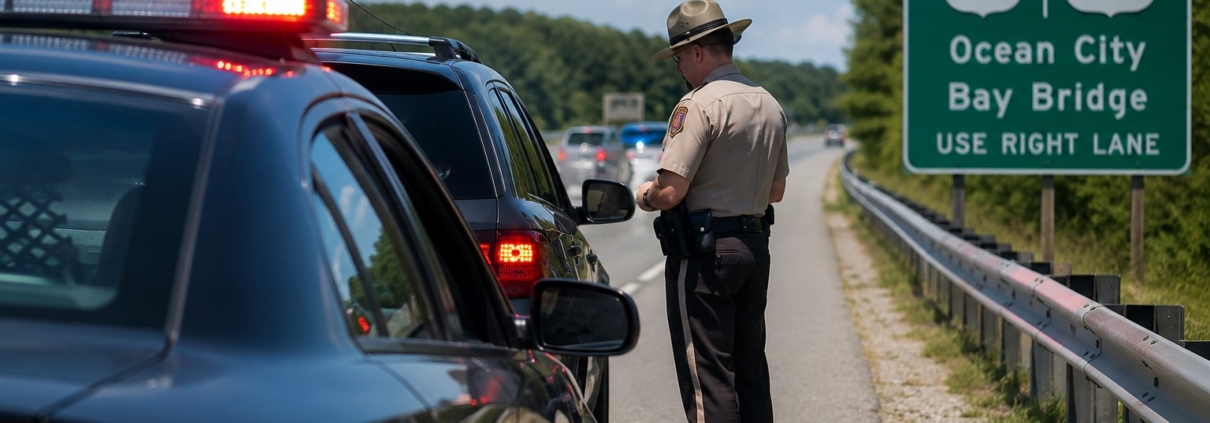
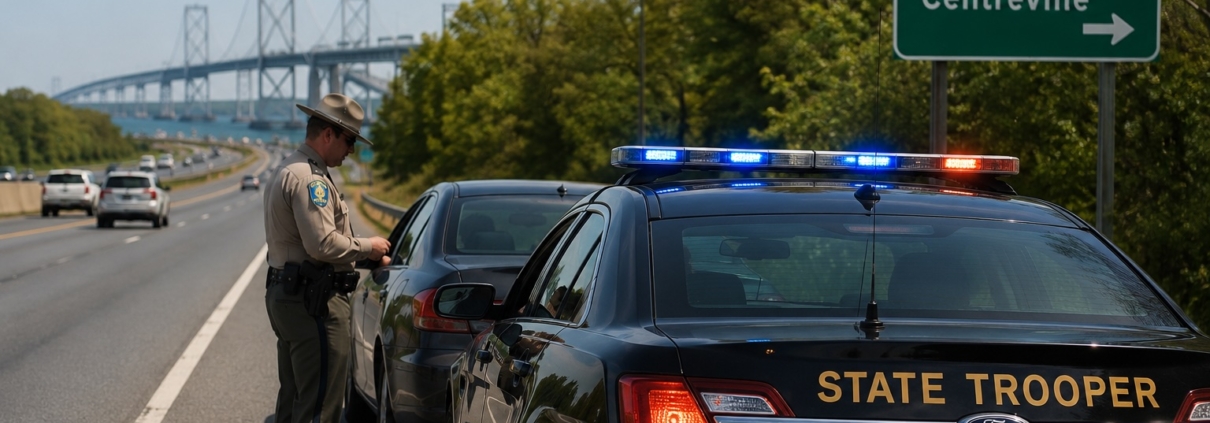
Maryland State Police officer conducting a traffic stop on Route 50 near Centreville with a highway sign for Routes 50 and 301 and the Chesapeake Bay Bridge visible in the distance.

Navigating the Queen Anne’s County Traffic Hub: What to Do if You’re Pulled Over in Centreville

If you drive Route 50 or Route 301 through Queen Anne’s County with any regularity, you already know it’s one of the busiest — and most heavily enforced — stretches of road on Maryland’s Eastern Shore. Every summer, the corridor leading to and from the Chesapeake Bay Bridge fills with beach traffic, and every summer, state and local police respond with high-visibility enforcement pushes designed to catch speeders before they reach the bridge. If you’ve been pulled over anywhere near Centreville, Grasonville, Queenstown, or Kent Island, understanding exactly what you’re facing — and how the process works from here — makes a real difference in the outcome.

This article walks through what typically happens after a traffic stop in Queen Anne’s County, the difference between a routine speeding ticket and a criminal reckless driving charge, how to protect your MVA record, and what the local court process actually looks like.

Why Queen Anne’s County Sees So Much Traffic Enforcement

Queen Anne’s County sits at a geographic chokepoint. U.S. 50 and U.S. 301 both funnel through the county on their way to and from the Bay Bridge, and traffic volumes on that corridor have grown substantially in recent years — the U.S. 301 corridor through the county has seen roughly a 40% increase in traffic volume since 2019, along with a corresponding rise in excessive speeding (Maryland Department of Transportation).

That volume translates directly into enforcement. Ahead of major travel weekends, the Maryland Transportation Authority Police, Maryland State Police, Anne Arundel County Police, and Queen Anne’s County Police routinely coordinate “high visibility” enforcement details along U.S. 50 near the Bay Bridge. During one recent Memorial Day weekend push alone, officers stopped 189 vehicles and issued 277 citations in a single day (WTOP News). These operations aren’t occasional — they happen every summer, and they aren’t limited to speeding. Officers running these details are also watching for suspended licenses, open warrants, and impaired driving, which means a routine stop for going a few miles over the limit can escalate quickly if something else turns up during the encounter.

Governor Wes Moore’s administration has also launched a statewide “Slow the Fast Down” campaign specifically targeting speeding-related crashes, reinforcing that the current environment for enforcement on corridors like Route 50 is more aggressive, not less (Star Democrat). If you’re driving through Queen Anne’s County, especially during the summer travel season, you should assume the odds of encountering a checkpoint or a patrol officer are meaningfully higher than on an average Maryland roadway.

Routine Speeding Ticket vs. Reckless Driving: Where the Line Is

Not every citation issued in Queen Anne’s County carries the same weight, and understanding the difference matters enormously for how you should respond.

A routine speeding ticket — say, 10 to 20 mph over the posted limit — is a payable traffic offense. It comes with points on your license and a fine, and while it can still affect your insurance premiums, you can usually pay it without going to court, and it does not carry jail time.

Reckless driving is a different animal entirely. Under Maryland’s Sergeant Patrick Kepp Act, which took effect statewide on October 1, 2025, driving 30 mph or more over the posted speed limit is automatically classified as criminal reckless driving, carrying up to 60 days in jail, a $1,000 fine, and six points on your license (SB 590 (2025), Sgt. Patrick Kepp Act). That law applies just as fully in Queen Anne’s County as it does anywhere else in the state, and given how fast traffic tends to move on Route 50 and Route 301 in this corridor, it’s not a hypothetical risk — it’s a genuinely common outcome of enforcement pushes near the bridge.

Reckless driving can also be charged based on the officer’s judgment that a driver operated their vehicle in willful or wanton disregard for the safety of others, independent of the 30-over threshold — meaning erratic lane changes, tailgating at high speed, or unsafe passing near the bridge approach can all trigger the charge even below that specific speed differential.

There’s also aggressive driving, a separate charge that applies when a driver commits three or more qualifying violations — speeding, following too closely, unsafe lane changes, failing to yield — during a single, continuous period of driving. The law defining aggressive driving was broadened under the same 2025 legislation, making it easier for prosecutors to bring that charge when a driver’s overall pattern of behavior, not just one isolated violation, looks dangerous (HB 744 Fiscal and Policy Note (2025)).

Knowing which of these three categories your citation falls into (a payable traffic offense, reckless driving, or aggressive driving) should be the first thing you and your attorney establish, because it determines everything from whether you’re required to appear in court to how many points are actually on the table.

Keeping Points Off Your Maryland MVA Record

For most drivers, the real long-term cost of a traffic citation isn’t the fine — it’s the points. Maryland’s point system is cumulative, and the consequences escalate the more points you accumulate:

  • 8 points triggers a mandatory MVA administrative hearing to review your driving privileges.
  • 12 points can result in license revocation (Md. Code, Transp. § 16-404).

A single reckless driving conviction carries six points on its own — enough to put most drivers dangerously close to that 8-point hearing threshold, especially if they already have a violation or two on their record from the prior two years. Insurance premiums also respond directly to points on your MVA record, often for three years or more after a conviction.

This is where a proactive legal strategy matters. Depending on the facts of your stop — how the speed was measured, the officer’s basis for the stop, prior driving history, and the specific charge — an attorney may be able to negotiate:

  • A reduction to a non-point violation, which resolves the case without adding to your MVA record at all.
  • Probation Before Judgment (PBJ), a disposition that allows a driver to avoid formal conviction and points upon successfully completing a period of probation.
  • A dismissal or amendment of the charge where the stop or the citation itself has legal or factual weaknesses.

None of these outcomes happen automatically, and none of them happen well if you walk into the Queen Anne’s County District Court unprepared or plan to simply plead guilty on the day of your hearing. The stronger and earlier the defense, the more room there is to negotiate an outcome that protects your license and your insurance rate.

What the Local Court Process Actually Looks Like

If you’re cited in Queen Anne’s County, your case is heard at the District Court of Maryland for Queen Anne’s County, located at 120 Broadway, Suite #1, in Centreville (Maryland Courts). The court sits at the intersection of Broadway and Route 213, right in the heart of Centreville’s historic downtown — a courthouse area that also houses the county’s Circuit Court, just a short distance away on North Commerce Street.

A few practical points about how cases move through this court:

  • The District Court does not conduct jury trials. If your case involves a criminal charge like reckless driving and you want a jury trial, it gets transferred to the Queen Anne’s County Circuit Court, which typically adds weeks to months to the process.
  • Civil infraction speeding tickets can often be resolved without a mandatory in-person appearance, but criminal charges like reckless or aggressive driving require you to show up.
  • Location matters for jurisdiction. The Bay Bridge and its immediate approaches straddle Anne Arundel and Queen Anne’s County depending on exactly where the stop occurred, and if you were stopped further east toward Easton or Chestertown, your case might actually belong to Talbot or Kent County instead. Always check the court location printed on your citation — it tells you exactly where you’re required to appear (David N. Mabrey, Esq.).

Because Queen Anne’s County shares this corridor with neighboring counties, it’s common for drivers to be genuinely unsure which courthouse their case belongs to, or to assume incorrectly that a citation issued “near the bridge” automatically means one specific county. Getting that detail wrong — showing up at the wrong courthouse, or missing a court date because you assumed the case was elsewhere — can create complications that are entirely avoidable with the right guidance up front.

Why an Accessible, Regionally Focused Attorney Matters

The Law Offices of David N. Mabrey aren’t based in Centreville, but that regional distance doesn’t translate into a disadvantage — if anything, it reflects how this entire corridor actually works. Drivers moving through Queen Anne’s County on Route 50 and Route 301 are, by definition, regional travelers: commuters heading toward Anne Arundel County and Baltimore, Eastern Shore residents heading toward Kent and Talbot counties, and vacationers passing through from all directions. An attorney who represents clients across this entire Eastern Shore corridor — not just one county — brings a genuinely useful vantage point: familiarity with how Queen Anne’s County District Court operates, how it compares to neighboring Kent and Talbot County courts, and how enforcement patterns along Route 50 and Route 301 tend to play out season to season.

That regional familiarity matters in practice. Understanding which stretch of a citation likely came from a coordinated Bay Bridge enforcement detail versus a routine patrol stop, knowing how a particular court tends to handle first-time reckless driving charges versus repeat offenders, and being able to move quickly between courthouses in Chestertown, Centreville, and beyond — these are the kinds of details that come from working this specific corridor consistently, not from a single office location.

What to Do If You’re Pulled Over in Queen Anne’s County

If you’ve just been cited, or you’re bracing for an upcoming court date, here’s what actually matters in the days that follow:

  • Read your citation carefully. Confirm which court it directs you to and whether it’s a payable traffic offense or a criminal charge like reckless or aggressive driving.
  • Don’t assume you can just pay it off if it’s a criminal charge. Reckless and aggressive driving both typically require an in-person court appearance.
  • Write down what you remember while it’s fresh — road conditions, how the officer measured your speed, and anything unusual about the stop itself.
  • Get legal advice before your court date, not the morning of. The earlier an attorney can review your citation and the underlying stop, the more options remain on the table for negotiating a favorable outcome.

The Bottom Line

Queen Anne’s County — and the Route 50/301 corridor running through it — is one of the most heavily patrolled stretches of road in Maryland, particularly during the summer travel season. Whether you’ve been cited for a routine speeding violation or something more serious like reckless or aggressive driving, understanding exactly what you’re facing, and getting ahead of it with the right legal strategy, is the difference between a manageable outcome and a conviction that follows you for years through points, insurance costs, and even a criminal record.

Cited for speeding, reckless driving, or aggressive driving in Queen Anne’s County? Don’t wait until your court date to find out what’s actually at stake. Get experienced Eastern Shore traffic defense on your side today.

👉🏼 Contact David N. Mabrey, Attorney at Law

Two convenient locations:

Chestertown
107 Court St, Chestertown, MD 21620
Office: 410-778-1630

Pasadena
8611 Fort Smallwood Rd C, Pasadena, MD 21122
Office: 443-702-7708
Fax: 443-702-7709
Cell: 443-848-2878 (Cell for Emergency/New Accident Only)

Frequently Asked Questions

What’s the difference between a speeding ticket and a reckless driving charge in Queen Anne’s County?

A routine speeding ticket is a payable traffic offense: you get points and a fine, it does not carry jail time, and in most cases you can pay it without a court appearance. Reckless driving is a criminal misdemeanor, triggered automatically by driving 30 mph or more over the posted limit, or by an officer’s determination that you drove in willful or wanton disregard for others’ safety. It carries up to 60 days in jail, a $1,000 fine, six points, and a required court appearance (HB 744 Fiscal and Policy Note (2025)).

Why does Queen Anne’s County have so much traffic enforcement?

The county sits at the geographic chokepoint where U.S. 50 and U.S. 301 funnel toward the Chesapeake Bay Bridge. Traffic volume on this corridor has grown roughly 40% since 2019, and law enforcement agencies — including the Maryland Transportation Authority Police, Maryland State Police, and county police — regularly run coordinated high-visibility enforcement details near the bridge, especially before major summer travel weekends (Maryland Department of Transportation; WTOP News).

Can I get points kept off my Maryland MVA record?

In some cases, yes. Depending on the facts of your stop and your driving history, an attorney may be able to negotiate a reduction to a non-point violation or a Probation Before Judgment (PBJ) disposition, which allows you to avoid formal points after successfully completing probation. This isn’t automatic — it depends on a prepared defense and how early you get legal help involved.

How many points until I’m at risk of losing my license?

Maryland’s point system triggers a mandatory MVA administrative hearing at 8 points, and your license can be revoked at 12 points. A single reckless driving conviction carries six points on its own, which is often enough to put a driver dangerously close to that 8-point threshold if they already have other violations on record (Md. Code, Transp. § 16-402).

Where is the Queen Anne’s County District Court, and does it handle jury trials?

The District Court of Maryland for Queen Anne’s County is located at 120 Broadway, Suite #1, in Centreville, at the intersection of Broadway and Route 213 (Maryland Courts). The District Court does not conduct jury trials — if you request one on a criminal charge like reckless driving, your case is transferred to the Queen Anne’s County Circuit Court, which typically adds significant time to the process.

I was pulled over near the Bay Bridge — how do I know which county’s court I need to appear in?

The Bay Bridge and its immediate approaches fall in either Anne Arundel or Queen Anne’s County depending on exactly where the stop occurred, and stops further east toward Easton or Chestertown may actually belong to Talbot or Kent County. Your citation will list the specific court you’re required to appear in — always check that document directly rather than assuming based on where you think the stop happened (David N. Mabrey, Esq.).

Can a traffic stop turn into something more serious than the original violation?

Yes. During high-visibility enforcement pushes, officers are also checking for suspended licenses, open warrants, and impairment. A routine stop for speeding can escalate if the officer discovers an outstanding warrant, a suspended license, or other criminal indicators during the encounter — which is common enough that law enforcement agencies report multiple such arrests during a single enforcement detail.

Do I need a local Queen Anne’s County attorney, or can any Maryland traffic attorney handle my case?

You don’t need an attorney physically headquartered in Centreville, but you do want one who regularly works this specific corridor. Familiarity with how the Queen Anne’s County District Court operates, how it compares to neighboring Kent and Talbot County courts, and how enforcement patterns along Route 50 and Route 301 tend to shift seasonally all come from consistent experience across this Eastern Shore region — not simply from a nearby office address.
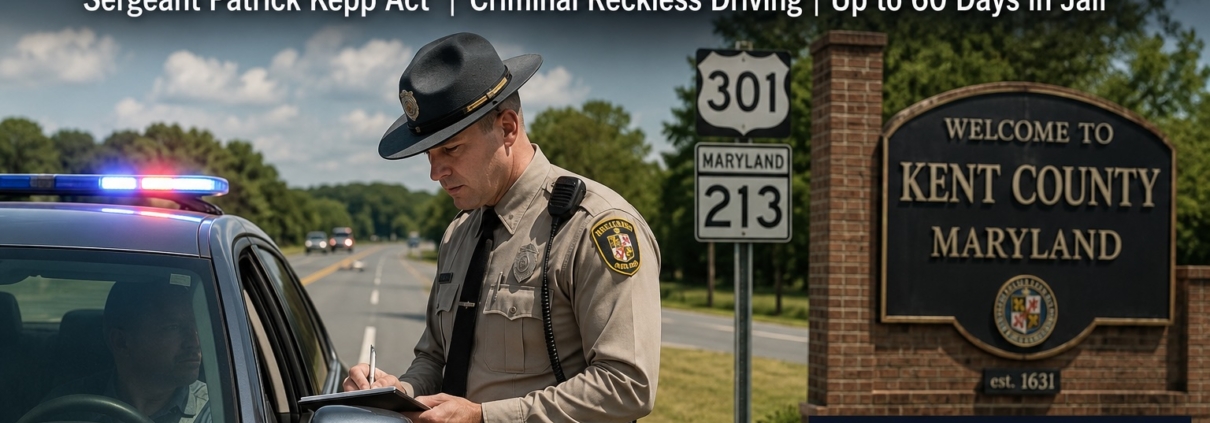
Maryland State Police officer issuing a speeding ticket on a rural highway in Kent County, highlighting Maryland's new criminal reckless driving law for speeds 30 mph or more over the limit.

Facing a “30 Over” Speeding Ticket in Kent County? Why You Could Realistically See Jail Time Under Maryland’s New Threshold

If you were pulled over on Route 301, Route 213, or any road in Kent County and the citation says you were going 30 miles per hour or more above the posted limit, you are not looking at a routine speeding ticket anymore. As of October 1, 2025, Maryland law reclassifies that conduct as criminal reckless driving — a charge that can carry up to 60 days in jail, a $1,000 fine, and six points on your license. This isn’t a scare tactic or an exaggeration of a minor statutory tweak. It’s a fundamental shift in how the State of Maryland treats extreme speeding, and it means the stakes for anyone cited in Kent County just went up dramatically.

This article breaks down exactly what changed, why it happened, what it means if you’re a Maryland resident or an out-of-state driver passing through Chestertown, and what the process looks like once your case lands at the Kent County District Court.

The Law That Changed Everything: The Sergeant Patrick Kepp Act

The new penalty structure comes from Senate Bill 590, Chapter 447, a piece of legislation known informally as the Sergeant Patrick Kepp Act. The law is named after Montgomery County Police Sergeant Patrick Kepp, who lost both of his legs after being struck while deploying stop sticks to try to stop a teenage driver who had a history of illegal street racing and who was reportedly clocked at roughly 160 mph on Interstate 270 (CBS News Baltimore). That incident became the catalyst for lawmakers to close what many viewed as a dangerous gap in Maryland’s traffic code — the fact that even extreme, life-threatening speeding was often treated as nothing more than a high-dollar traffic ticket.

The legislation took effect on October 1, 2025, and it did three things at once (SB 590 (2025), Sgt. Patrick Kepp Act):

  1. Redefined reckless driving to explicitly include driving 30 mph or more over the posted speed limit, with penalties increased to up to 60 days in jail and a $1,000 fine.
  2. Increased negligent driving penalties to a fine of up to $750.
  3. Broadened the definition of aggressive driving, making it easier for prosecutors to charge a driver who commits three or more qualifying violations — speeding, tailgating, unsafe lane changes, or failure to yield, among others — during a single continuous stretch of driving.

Before this law, the reckless driving statute relied on a somewhat subjective standard: driving in “wanton or willful disregard for the safety of persons or property.” Prosecutors had to argue that a driver’s behavior met that threshold, which left plenty of room for negotiation and dismissal. Now, hitting 30 mph over the limit is enough on its own to trigger a reckless driving charge under Md. Code, Transportation Article § 21-901.1, regardless of road conditions, traffic, or intent (Md. Code, Transp. § 21-901.1).

Old Penalty vs. New Penalty: The Numbers Tell the Story

To understand how significant this shift is, it helps to compare the “before” and “after” side by side. Under the old framework, a driver caught going 30 mph over the speed limit would typically face five points on their driving record and a fine in the range of $290 (HB 744 Fiscal and Policy Note (2025)). It was expensive and it hurt your insurance, but it was still, fundamentally, a civil traffic infraction. You paid the fine, you took the points, and you moved on with your life.

Under the current law, that same 30-over citation now carries:

  • Up to 60 days in jail
  • A fine of up to $1,000
  • Six points on your license — the maximum a speed-related offense can carry
  • Mandatory court appearance — this is no longer a “pay and forget it” ticket
  • A criminal record, since reckless driving is classified as a misdemeanor

That last point deserves emphasis. A misdemeanor conviction isn’t just a line on your driving abstract — it becomes part of your permanent criminal history. That can complicate background checks for employment, professional licensing, security clearances, and even loan applications. A speeding ticket that once cost you a few hundred dollars and a bump in your insurance premium can now follow you into job interviews and rental applications.

It’s also worth noting that Maryland didn’t stop at reckless driving. Negligent driving penalties increased to a $750 fine, and the aggressive driving statute was streamlined so that prosecutors have an easier time stacking multiple minor infractions — say, speeding plus following too closely plus an unsafe lane change — into a single, more serious charge (HB 744 Fiscal and Policy Note (2025)). The overall effect is that Maryland’s traffic code, across the board, now treats aggressive and excessive driving behavior far less forgivingly than it did a year ago.

Why Kent County Drivers Are Especially Exposed

Kent County sits along some of the most heavily traveled corridors on Maryland’s Eastern Shore, including Route 301, Route 213, and Route 20. These roads see a mix of local commuters, agricultural traffic, and — especially in the warmer months — heavy volumes of out-of-state travelers heading to and from the beaches, Delaware, and points north via the Bay Bridge corridor. That combination of long, relatively open stretches of highway and heavy seasonal traffic has historically made Kent County a common location for high-speed citations.

Under the old law, an officer clocking a driver at 95 mph in a 65 zone on Route 301 would write a serious speeding ticket, but it stayed within the civil infraction system. Today, that same stop can result in the driver being arrested, or at minimum issued a criminal summons, for reckless driving. Local law enforcement agencies have been explicit that the new law effectively makes driving 30 mph or more over the limit an arrestable offense.

If you’re cited in Kent County, your case begins at the District Court of Maryland for Kent County, located at 103 N. Cross Street in Chestertown (Maryland Courts). Because reckless driving is a criminal misdemeanor rather than a civil infraction, you are required to appear in person — this is not a charge you can resolve by mailing in a payment. Reckless driving carries a maximum of 60 days in jail, which is below the 90-day threshold for demanding a jury trial in Maryland, so a reckless driving charge on its own is generally decided by a judge in District Court. Md. Code, Cts. & Jud. Proc. § 4-302

Maryland’s point system compounds the risk. Under Maryland law, the Motor Vehicle Administration generally must suspend a driver’s license at 8 points and revoke it at 12 points (Md. Code, Transp. § 16-404). A single reckless driving conviction carrying six points puts most drivers uncomfortably close to that threshold — especially anyone who already has a violation or two on their record from the past two years.

What About Out-of-State Drivers Passing Through?

A significant share of the extreme-speeding citations written in Kent County involve drivers who don’t live in Maryland at all — commuters cutting through on their way to Delaware, vacationers heading to the shore, or truckers running the 301 corridor. For these drivers, a reckless driving charge is not something to shrug off and forget about once they cross back into their home state.

Maryland is a member of the Driver License Compact and Non-Resident Violator Compact with most states, meaning a Maryland conviction typically gets reported back to your home state’s licensing agency and can affect your driving record and insurance rates there as well. And because reckless driving in Maryland is a criminal charge requiring a court appearance, an out-of-state driver who simply skips the court date risks a bench warrant being issued — which can turn a traffic stop into a much bigger legal problem the next time that driver is anywhere near Maryland, or if they’re ever stopped in another state that shares warrant information.

For commercial drivers, the exposure is even greater. A reckless driving conviction can trigger a disqualification of a commercial driver’s license (CDL), since federal regulations treat certain traffic convictions as serious violations for CDL holders regardless of what vehicle they were driving at the time (49 C.F.R. § 383.51). A trucker who picks up a 30-over citation on Route 301 in Kent County could be looking at consequences that follow them well beyond Maryland’s borders and directly threaten their livelihood.

Why Local, Maryland-Based Counsel Matters More Than Ever

Because reckless driving is now a criminal charge rather than a civil infraction, the way it’s handled in court has changed too. Prosecutors in Kent County, like elsewhere in Maryland, often carry heavy caseloads, and a well-prepared defense that raises legitimate legal or factual challenges can open the door to a more favorable resolution — whether that’s a reduction to a non-point violation or a disposition like Probation Before Judgment (PBJ), which allows a driver to avoid formal points on their record upon successful completion of probation (Md. Code, Crim. Proc. § 6-220).

Getting to that kind of outcome requires more than a general understanding of traffic law — it requires familiarity with how a specific courthouse operates: which judges tend to be receptive to certain arguments, how the local State’s Attorney’s office typically approaches reckless driving cases under the new statute, and how to challenge the accuracy of speed measurement devices or the circumstances of the stop itself. An attorney who was born and raised in Maryland, who has spent years working in and around Eastern Shore courthouses, brings a level of local insight that out-of-town firms simply can’t replicate. Knowing the physical layout of the Kent County District Court, the clerk’s procedures, and the tendencies of the judges who sit on the bench there can make a meaningful difference in how a case unfolds.

What to Do If You’re Cited for Reckless Driving in Kent County

If you’ve received a citation for driving 30 mph or more over the posted limit, here’s what matters most in the days immediately after:

  • Don’t ignore the court date. Because this is now a criminal charge, failing to appear can result in a bench warrant for your arrest.
  • Preserve any evidence from the stop. Note the weather and road conditions, the type of speed detection device used (radar, lidar, or pacing), and anything unusual about how the stop was conducted.
  • Understand what’s actually on the table. A conviction carries up to 60 days in jail and $1,000 in fines, but that doesn’t mean every case results in the maximum penalty — prosecutors have discretion, and a defense attorney can negotiate (Md. Code, Transp. § 21-901.1).
  • Talk to an attorney before your court date, not the morning of. Early involvement gives your lawyer time to review the citation, request discovery, and identify weaknesses in the state’s case.

The Bottom Line

Maryland’s traffic laws changed in a way that catches a lot of people off guard. Plenty of drivers still assume that going well over the speed limit means nothing worse than a big fine and a few points — an assumption that was accurate for decades but simply isn’t true anymore. The Sergeant Patrick Kepp Act turned extreme speeding into a criminal offense with real jail exposure, and Kent County’s busy through-roads mean local drivers and out-of-state travelers alike are increasingly finding themselves on the wrong end of this new law.

If you or someone you know has been cited for reckless driving, negligent driving, or aggressive driving anywhere in Kent County or the surrounding Eastern Shore, the time to get ahead of the case is now — not the week of your court date.

Been cited for reckless driving, a 30-over speeding violation, or an aggressive driving offense in Kent County or the surrounding area? Don’t wait to find out what the new law means for your record, your license, or your freedom. Reach out today for a consultation.

👉🏼 Contact David N. Mabrey, Attorney at Law

Two convenient locations:

Chestertown
107 Court St, Chestertown, MD 21620
Office: 410-778-1630

Pasadena
8611 Fort Smallwood Rd C, Pasadena, MD 21122
Office: 443-702-7708
Fax: 443-702-7709
Cell: 443-848-2878 (Cell for Emergency/New Accident Only)

Frequently Asked Questions

Is driving 30 mph over the speed limit really a criminal charge in Maryland now?

Yes. As of October 1, 2025, under the Sergeant Patrick Kepp Act (Senate Bill 590, Chapter 447), driving 30 mph or more over the posted speed limit is automatically classified as reckless driving under Md. Code, Transportation Article § 21-901.1. Reckless driving is a criminal misdemeanor, not a civil traffic infraction, which means it carries the possibility of a criminal record, mandatory court appearance, and jail time (HB 744 Fiscal and Policy Note (2025)).

What’s the maximum penalty I could actually face?

The maximum penalty is up to 60 days in jail, a $1,000 fine, and six points on your driver’s license. A conviction doesn’t automatically mean the maximum sentence, but prosecutors have the discretion to request it, and judges have the authority to impose it (Md. Code, Transp. § 21-901.1).

Can I just pay a fine and skip my court date, like a regular speeding ticket?

No. Because reckless driving is now a criminal charge, you’re required to appear in court. Missing your court date can result in a bench warrant being issued for your arrest, which creates a much bigger problem than the original citation ever was.

What happens if I’m from out of state and got cited passing through Kent County?

You’re still required to appear in Maryland court, even if you live elsewhere. Because Maryland participates in interstate driver license compacts, a conviction can be reported back to your home state and affect your license and insurance there too. Skipping the court date can lead to a warrant that follows you well beyond Maryland’s borders — and for commercial drivers, a reckless driving conviction can also trigger CDL disqualification under federal regulations (49 C.F.R. § 383.51).

Where will my case be heard if I’m cited in Kent County?

Reckless driving cases in Kent County begin at the District Court of Maryland for Kent County, located at 103 N. Cross Street in Chestertown (Maryland Courts). Because the maximum penalty for reckless driving is 60 days in jail, below the 90-day threshold Maryland sets for demanding a jury trial, a reckless driving charge on its own generally stays in District Court and is decided by a judge. Md. Code, Cts. & Jud. Proc. § 4-302

Will a reckless driving conviction show up on background checks?

Yes. Because reckless driving is a criminal misdemeanor, a conviction becomes part of your criminal record, not just your driving record. That can surface during employment background checks, professional licensing applications, and even certain loan or rental applications.

Is there any way to avoid points or a conviction on my record?

In some cases, yes. Depending on the facts of the stop and your prior record, an attorney may be able to negotiate a reduction to a non-point violation or a disposition like Probation Before Judgment (PBJ), which lets you avoid formal points after successfully completing probation (Md. Code, Crim. Proc. § 6-220). These outcomes aren’t automatic — they typically depend on a prepared defense and early legal involvement.

How quickly should I contact an attorney after getting cited?

As soon as possible, ideally well before your scheduled court date. Early involvement gives your attorney time to review the citation, request discovery, examine the speed detection method used, and identify any weaknesses in the officer’s stop or report — all of which take time to build properly.

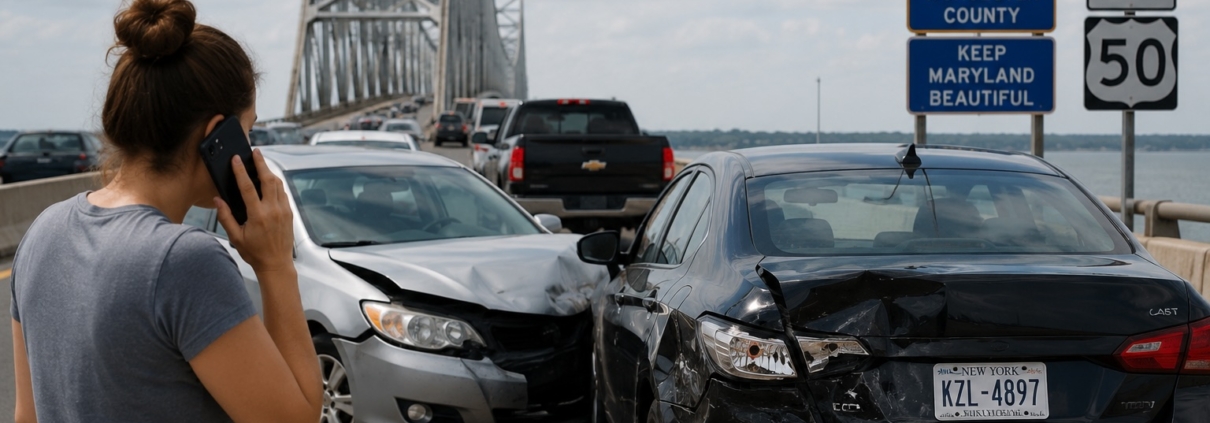
Traffic collision on Maryland’s Route 50 near the Chesapeake Bay Bridge involving an out-of-state vehicle, with damaged cars stopped on the roadway and a driver calling for assistance during heavy summer traffic.

Route 50 and Bay Bridge Accident Guide: What to Do If an Out-of-State Driver Hits You

If you’ve driven Route 50 toward the Bay Bridge on a Friday afternoon in June, you already know what it looks like. The left lane backed up past Parole. Rental cars weaving. Pennsylvania plates tailgating at sixty miles an hour. New York drivers who haven’t touched a two-lane highway since the last time they drove to the Shore. And somewhere in the middle of all of it, a bottleneck at the bridge itself where four lanes of impatient summer traffic compress into two — and where the conditions for a serious rear-end collision are essentially engineered into the road.

Every summer, the stretch of US Route 50 running through Anne Arundel and Queen Anne’s Counties becomes one of the most congested and accident-prone corridors in the state of Maryland. The William Preston Lane Jr. Memorial Bridge — universally called the Bay Bridge — is the single choke point between the Baltimore-Washington metropolitan area and the beaches of Ocean City, Delaware, and beyond. On peak summer Fridays, the Maryland Transportation Authority estimates that more than 75,000 vehicles cross the bridge in a single day.¹ That volume, combined with unfamiliar drivers, distracted vacation behavior, and the abrupt slowdowns that characterize bridge approaches, produces a predictable surge in collisions every season.

When one of those collisions involves you — and the driver who caused it has Pennsylvania, Virginia, New York, or New Jersey plates — you are not dealing with a simple insurance claim. You are dealing with an out-of-state driver, an out-of-state insurance company, an out-of-state policy, and a set of legal complications that most accident victims don’t fully understand until they’re already deep into the process. This guide explains what happens after that kind of crash, why it’s more complicated than a standard Maryland accident claim, and what you need to do to protect yourself from the moment the collision happens.

Why Route 50 and the Bay Bridge Are So Dangerous in Summer

Understanding why this corridor produces so many serious accidents isn’t just background — it shapes how liability is established, how severity is documented, and how your case is built.

The Bay Bridge approach on the westbound side has long been identified as a crash concentration point. The transition from the multi-lane Route 50 corridor down to the bridge’s two lanes creates a forced merge that drivers unfamiliar with the road handle poorly. Sudden braking, late lane changes, and drivers who misjudge the deceleration of traffic ahead generate rear-end collisions at speeds that cause serious injury.² The eastbound approach has its own hazards — traffic that moves freely on Route 50 east of Annapolis suddenly encounters congestion at the bridge approach, and the speed differential between moving traffic and stopped or slowing vehicles is substantial.

Beyond the bridge itself, the Route 50 corridor through Annapolis and into Queen Anne’s County has additional high-risk characteristics. The intersection at Route 50 and Route 301 near Bowie, the Parole interchange, and the stretch through Grasonville all generate significant accident volume. During summer months, these locations see a disproportionate share of out-of-state involvement — drivers who don’t know the road, don’t know the interchange patterns, and are navigating with GPS on a phone while managing children in the back seat.

Maryland State Police and the Anne Arundel County Police Department both have jurisdiction over portions of this corridor, and the agencies that respond to your accident, the reports they generate, and the courts that would hear your case all depend on exactly where the collision occurred. That local specificity matters enormously when building a claim.

The Immediate Aftermath: What to Do at the Scene

The steps you take in the minutes following a collision on Route 50 or at the Bay Bridge approach directly affect your ability to recover compensation later. Here is what matters most.

Call 911 and stay at the scene. Even if the collision seems minor, a police report is essential when the other driver is from out of state. Without a report, you have no official documentation of who was involved, what the other driver said at the scene, and what the responding officer observed. An out-of-state driver who seems cooperative at the scene has every incentive to tell a different story once they’re home in Pennsylvania and talking to their insurance company. The police report is your contemporaneous record.

Document everything before the vehicles move. Use your phone to photograph the positions of all vehicles before anything is moved, all points of impact on both vehicles, the other driver’s license plate, their license and insurance card, the road conditions, any skid marks or debris, and the surrounding area including road signs and traffic control devices. If there are witnesses — and on a busy summer Friday on Route 50 there usually are — get their names and phone numbers before they drive away. Witnesses who saw an out-of-state driver cause a collision are valuable, and they are under no obligation to stay.

Get medical attention, even if you feel fine. The adrenaline response following a collision can mask injury symptoms for hours or even days. Whiplash, soft tissue injuries, and traumatic brain injuries frequently present with delayed symptoms.³ If you decline medical attention at the scene and your injuries manifest later, the gap between the accident and your first medical visit becomes ammunition for the other driver’s insurance company to argue that your injuries were caused by something else. Go to the emergency room or urgent care the same day. Every time.

Be careful what you say. Do not apologize, do not speculate about what happened, and do not give a recorded statement to the other driver’s insurance company at the scene or in the immediate aftermath. Insurance adjusters are trained to use early statements — made when you are shaken, in pain, and not thinking clearly — to minimize your claim. Anything you say can and will be used against you in the claim process.

Request the police report number. Before the responding officer leaves the scene, get the report number and the officer’s name and badge number. In Anne Arundel County, reports are available through the Anne Arundel County Police Department or Maryland State Police, depending on where the accident occurred. In Queen Anne’s County, the Queen Anne’s County Sheriff’s Office or Maryland State Police handles most Route 50 corridor accidents. Knowing which agency filed the report saves significant time later.

Why Out-of-State Drivers Complicate Your Claim

A collision with a Maryland driver is complicated enough. A collision with an out-of-state driver introduces a layer of complexity at every stage of the process — from the initial insurance contact to litigation, if it comes to that.

Different state insurance requirements. Every state sets its own minimum auto insurance requirements, and those minimums vary significantly. A driver from a state with lower minimum liability coverage than Maryland may carry a policy that is inadequate to fully compensate you for your injuries and property damage. Maryland requires minimum liability coverage of $30,000 per person and $60,000 per accident for bodily injury, and $15,000 for property damage.⁴ Some neighboring states have lower minimums, and drivers carrying only the minimum in their home state may be underinsured relative to the severity of a serious injury claim.

Out-of-state insurance companies. When you file a claim against an out-of-state driver’s insurance, you are dealing with an insurer that has no particular interest in your jurisdiction, no local relationships to protect, and every financial incentive to minimize your payout. Large national carriers handle claims through centralized adjusting operations that process thousands of files. Local context — the specific conditions at the Bay Bridge, the particular characteristics of the Route 50 corridor, the standard of care expected of a driver approaching that merge — is not something their adjusters factor in unless it is put in front of them by someone who knows it.

Jurisdiction and where your case is heard. This is where local knowledge becomes particularly valuable. Even though the other driver is from out of state, the accident occurred in Maryland — which means Maryland law governs the substance of your claim, and Maryland courts have jurisdiction over the case.⁵ Specifically, the case can typically be filed in the circuit or district court for the county where the accident occurred, such as Anne Arundel County or Queen Anne’s County, although other venues, including federal court, may also be possible.

An attorney who practices regularly in those courts — who knows the local rules, the standard jury instructions used in that jurisdiction, and the typical resolution patterns for cases of similar severity — has a meaningful advantage over an out-of-state attorney or a large firm that treats your case as one of thousands. The Bay Bridge corridor is specific terrain, and familiarity with that terrain matters.

Locating and serving the out-of-state defendant. If your claim goes to litigation, the other driver must be properly served with the lawsuit. Maryland has a nonresident motorist statute that provides a mechanism for serving out-of-state drivers involved in accidents on Maryland roads — but the process requires knowing how to use it correctly.⁶ An attorney who handles Maryland accident litigation regularly knows this statute and how to invoke it efficiently.

Uninsured and underinsured motorist coverage. Maryland law requires auto insurance policies to include uninsured motorist coverage, and underinsured motorist coverage is available as well.⁷ If the out-of-state driver who hit you carries inadequate insurance — or if they flee the scene entirely, which happens more often than most people expect — your own policy’s UM/UIM coverage becomes your primary source of recovery. Understanding how to make that claim, and how to preserve your rights under your own policy while pursuing the at-fault driver, requires careful coordination that an experienced personal injury attorney manages as a matter of course.

Maryland’s Contributory Negligence Rule: Why It Matters Here

Maryland is one of only a handful of states that still follows the doctrine of pure contributory negligence.⁸ Under this rule, if you are found to be even one percent at fault for the accident — one percent — you are legally barred from recovering any compensation from the other driver. Not reduced compensation. Zero.

Most states have moved to comparative negligence systems that apportion fault and reduce recovery proportionally. Maryland has not. This makes the defense strategy employed by out-of-state insurance companies particularly aggressive: if their adjuster or their attorney can identify any arguable basis for claiming that you contributed to the collision — following too closely, failing to observe a traffic condition, an improper lane change — they will argue it, because in Maryland, any successful contributory negligence argument eliminates your recovery entirely.

This is not a theoretical risk on the Route 50 corridor. The nature of bridge approach traffic means that vehicles are often in close proximity, merging, and responding to sudden stops. An out-of-state insurer’s adjuster reviewing your claim from a desk in another state is not going to give you the benefit of the doubt on the sequence of events. They are going to look for any fact that supports a contributory negligence argument and deploy it.

Thorough documentation at the scene, prompt medical attention, a complete police report, and experienced legal representation are your best defenses against a contributory negligence argument that should not succeed but might, if the facts are not properly preserved and presented.

The Insurance Claim Process: What to Expect

After a collision with an out-of-state driver, the claims process typically unfolds in a predictable pattern — and knowing what to expect helps you avoid the mistakes that reduce recovery.

The other driver’s insurer will contact you quickly. Out-of-state insurers often reach out within days of an accident, sometimes within 24 hours. The adjuster will be friendly, sympathetic, and focused on getting a recorded statement and, eventually, a quick settlement. Early settlements — offered before the full extent of your injuries is known — are almost always inadequate. A soft tissue injury that seems manageable in the first week can require months of physical therapy. A concussion that isn’t immediately diagnosed can have lasting cognitive effects. Accepting a settlement before your medical treatment is complete means accepting compensation that does not account for future medical costs, lost wages, or long-term impact on your quality of life.

Maryland’s statute of limitations. In Maryland, the statute of limitations for personal injury claims arising from a motor vehicle accident is three years from the date of the accident.⁹ This does not mean you have three years to start thinking about it — evidence degrades, witnesses become unavailable, and the other driver’s insurer is not going to preserve evidence on your behalf. But it does mean that you have time to complete your medical treatment, understand the full scope of your injuries, and pursue a claim that reflects actual damages rather than a rushed estimate.

Property damage and diminished value. Your vehicle damage claim is separate from your personal injury claim and typically resolves faster. Maryland law allows recovery not only for the cost of repair but also for diminished value — the reduction in your vehicle’s market value that results from having been in a collision, even after repairs are completed.¹⁰ Many accident victims don’t know to claim diminished value, and insurance companies don’t volunteer to pay it.

Medical payment coverage. Unless you waived it, your Maryland auto policy includes Personal Injury Protection (PIP), which pays medical bills and some lost wages regardless of fault — immediately, without waiting for the liability claim to resolve.¹¹ PIP, and any medical payments (MedPay) coverage on your policy, can cover emergency room visits, specialist appointments, physical therapy, and other treatment costs while your injury claim against the at-fault driver is pending. Using it does not affect your right to pursue the full claim against the other driver.

Why Local Representation Matters on This Corridor

There is a meaningful difference between hiring an attorney who handles personal injury cases generally and hiring an attorney who is specifically familiar with the Route 50 and Bay Bridge corridor, the courts in Anne Arundel and Queen Anne’s Counties, and the dynamics of out-of-state defendant cases in Maryland.

The Anne Arundel County Circuit Court and District Court handle a substantial volume of motor vehicle litigation. Judges and court staff in those courts develop patterns and expectations around how cases are presented, what evidence matters, and how damages are argued. An attorney who appears in those courts regularly — who knows the local rules, the local discovery practices, and the local judicial temperament — operates with context that a distant or unfamiliar attorney simply doesn’t have.

The same is true for investigation. Accident reconstruction on the Route 50 corridor involves specific knowledge of the road geometry, the traffic control patterns at the Bay Bridge approach, and the MDTA’s own incident records for that stretch of highway. A local attorney has relationships with investigators, accident reconstruction experts, and medical providers who understand this corridor and can support your case with evidence that is specific, credible, and locally grounded.

And practically speaking, an attorney who is geographically accessible to you — who you can meet with in person in Chestertown or Pasadena, who can appear at local court hearings without traveling from a distant office, and who returns calls with the attentiveness of a firm that depends on its local reputation — provides a level of service that large, out-of-area firms handling high volumes of cases do not consistently deliver.

What Compensation You May Be Entitled To

A serious injury claim arising from a Route 50 or Bay Bridge collision can encompass multiple categories of damages, and understanding what you’re entitled to recover is essential to evaluating any settlement offer.

Medical expenses. All reasonable and necessary medical costs arising from the accident — emergency care, hospitalization, surgery, specialist visits, physical therapy, chiropractic care, prescription medications, and anticipated future medical costs — are recoverable.¹²

Lost wages and lost earning capacity. If your injuries caused you to miss work, your lost wages are recoverable. If your injuries have long-term effects on your ability to earn — a construction worker with a back injury, a surgeon with a hand injury — the reduction in future earning capacity is also a compensable element of damages.¹³

Pain and suffering. Maryland allows recovery for the physical pain and emotional suffering caused by the accident and the injuries it produced. This is a non-economic damage, and its value depends on the severity and duration of your injuries, the nature of the treatment required, and the impact on your daily life.¹⁴

Loss of consortium. Serious injuries that affect your relationship with your spouse — including the loss of companionship, affection, and the ability to maintain a normal marital relationship — can support a joint loss of consortium claim that you and your spouse bring together under Maryland law.¹⁵

Property damage and diminished value. As noted above, the cost of repairing or replacing your vehicle, plus the diminished value resulting from the collision history, are both recoverable.

Frequently Asked Questions

The other driver has out-of-state insurance. Do I file a claim in Maryland or their home state?

You file the claim in Maryland. The accident occurred in Maryland, Maryland law governs the claim, and Maryland courts have jurisdiction. The other driver’s insurer handles claims in every state — they will assign a Maryland adjuster or work with Maryland counsel if litigation is necessary. Your attorney files everything in the appropriate Maryland court for the county where the accident happened.

The out-of-state driver didn’t have enough insurance to cover my injuries. What are my options?

Your own underinsured motorist (UIM) coverage becomes relevant. Maryland requires insurers to offer UIM coverage, and if you have it, your own policy can cover the gap between what the at-fault driver’s policy pays and your actual damages, up to your UIM policy limit. An attorney can coordinate the pursuit of both the at-fault driver’s insurer and your own UIM claim simultaneously.

The other driver left the scene before the police arrived. Can I still recover?

Yes. Maryland’s uninsured motorist coverage — which your policy is required to include — covers hit-and-run accidents where the responsible driver cannot be identified.¹⁶ You must report the accident to the police and to your own insurer promptly, and there are procedural requirements for making a UM claim after a hit-and-run. An attorney familiar with these requirements can walk you through the process.

I felt fine at the scene but started having neck and back pain two days later. Is it too late to make a claim?

No — but the gap between the accident and your first medical visit is something the other driver’s insurer will use against you. Go to a doctor as soon as symptoms appear, and make sure you connect those symptoms to the accident clearly in your medical records. Delayed symptom presentation is medically well-documented and entirely consistent with whiplash and soft tissue injuries. An experienced personal injury attorney knows how to present delayed-onset injuries in a way that addresses the insurer’s skepticism.

How long will my claim take to resolve?

It depends on the severity of your injuries, how quickly your treatment concludes, and whether the case settles or goes to trial. Minor injury claims can resolve in a few months. Serious injury cases — involving surgery, extended rehabilitation, or permanent impairment — typically take longer, because you should not settle until the full extent of your damages is known. Maryland’s three-year statute of limitations gives you room to let the medical picture develop before resolving the claim.

Do I need an attorney, or can I handle this myself?

You can handle it yourself, and for very minor collisions with clear liability and minimal injury, some people do. For anything involving injury, out-of-state defendants, significant property damage, or disputed liability, handling it yourself puts you at a significant disadvantage. You are negotiating against an adjuster whose job is to pay as little as possible, who knows the process better than you do, and who is counting on you not knowing what your claim is actually worth. An experienced personal injury attorney can level that playing field.

You shouldn’t have to fight an out-of-state insurance company alone from a hospital bed.

If you were injured in a collision on Route 50, at the Bay Bridge, or anywhere in Anne Arundel or Queen Anne’s County involving an out-of-state driver, Mabrey Law is ready to help. We know this corridor, we know these courts, and we know how to go up against out-of-state insurers who are counting on you not having local representation.

Schedule a Consultation →

Chestertown — 107 Court St, Chestertown, MD 21620 · (410) 778-1630

Pasadena — 8611 Fort Smallwood Rd C, Pasadena, MD 21122 · (443) 702-7708

This article is for general informational purposes only and does not constitute legal advice. Consult an attorney regarding your specific situation.

Sources

  1. Maryland Transportation Authority, Bay Bridge Traffic Volume Statistics, mdta.maryland.gov (annual traffic data).
  2. Maryland State Highway Administration, Crash Data and Safety Reports, roads.maryland.gov.
  3. Cassidy, J.D. et al., Incidence, Risk Factors and Prevention of Mild Traumatic Brain Injury, Journal of Rehabilitation Medicine (2004).
  4. Md. Code Ann., Transportation Article § 17-103 (Maryland minimum liability insurance requirements).
  5. Restatement (Second) of Conflict of Laws § 145; Maryland courts apply the law of the state where the accident occurred for tort claims.
  6. Md. Code Ann., Courts and Judicial Proceedings Article § 6-103 (Maryland long-arm statute); Transportation Article § 17-106 (nonresident motorist service of process).
  7. Md. Code Ann., Insurance Article § 19-509 (uninsured motorist coverage requirements); § 19-509.1 (underinsured motorist coverage).
  8. Coleman v. Soccer Ass’n of Columbia, 432 Md. 679 (2013) (reaffirming Maryland’s contributory negligence doctrine).
  9. Md. Code Ann., Courts and Judicial Proceedings Article § 5-101 (three-year statute of limitations for personal injury).
  10. Diminished value: the loss in a vehicle’s market value after repairs may be recoverable as part of a property damage claim.
  11. Md. Code Ann., Insurance Article § 19-505.1 (medical payment coverage).
  12. Consolidated Eng’g Co. v. Martin, 176 Md. 269 (1939) (medical expenses as element of damages).
  13. Reifer v. Westport House, 250 Md. 375 (1968) (lost earning capacity as compensable damage).
  14. Md. Pattern Jury Instructions — Civil, MPJI-CV 10:2 (pain and suffering damages).
  15. Deems v. Western Maryland Railway Co., 247 Md. 95 (1967) (loss of consortium recognized under Maryland law).
  16. Md. Code Ann., Insurance Article § 19-509(c) (uninsured motorist coverage applicable to hit-and-run accidents).
Maryland police officer detains a distressed young man near a patrol car with flashing lights at sunset as teens gather in the background after a summer celebration, illustrating the consequences of underage DUI.

The Summer “Under 21” DUI Surge: Protecting Your Graduate’s Future

Graduation season on Maryland’s Eastern Shore looks a lot like it does everywhere else — backyard parties, bonfires near the water, families celebrating kids who worked hard to get to this moment. For most, the night ends with memories worth keeping. For some families, it ends with a phone call no parent is prepared for.

Maryland has some of the strictest underage DUI laws in the country. For drivers under 21, the legal limit isn’t .08 — it’s .02. That’s one drink for most young adults. A single lapse in judgment on the way home from a graduation party can trigger an arrest, a license suspension, and a criminal charge that follows a young person into college applications, job interviews, and professional licensing boards for years to come.

Every June and July, the volume of underage DUI arrests in Maryland rises sharply. Graduation parties, beach weekends, Fourth of July celebrations — the combination of newly minted freedom, social pressure, and access to alcohol creates conditions that law enforcement anticipates and prepares for. Checkpoints go up. Patrols increase. And families who had no reason to think about criminal defense attorneys suddenly find themselves searching for one on a Saturday night.

If your son or daughter was arrested this summer, the decisions made in the next few days matter enormously. This guide walks through what Maryland law actually says, what the consequences actually look like, and what an experienced attorney can do to protect your graduate’s future before permanent damage is done.

Maryland’s Zero-Tolerance Law: The Standard Most Families Don’t Know Until It’s Too Late

Most people know that the legal BAC limit for adult drivers in Maryland is .08. Far fewer realize that Maryland operates under a separate, far stricter standard for anyone under 21 — and that the gap between what feels like “barely anything” and what triggers a criminal charge is razor thin.

Under Maryland’s zero-tolerance law, a driver under 21 with a BAC of .02 or higher can be charged with violating their license’s under-21 alcohol restriction — even if they show no visible signs of impairment, even if they drove without incident, and even if the amount consumed seems trivial by any practical measure.¹ A BAC of .02 is achievable for many young adults after a single standard drink, depending on body weight, metabolism, and how recently they ate.

Maryland Transportation Article § 16-113 makes this explicit: every licensee under 21 carries an alcohol restriction that prohibits driving with alcohol in the blood, and a BAC of .02 or more is evidence of a violation, which can bring up to 2 months in jail, a $500 fine, or both, plus MVA action against the license.² There is no “impaired driving” threshold to clear, no visible swerving required, no slurred speech necessary. The number alone is sufficient.

This is a deliberate policy choice by the state. Maryland, like all states, adopted zero-tolerance laws under federal pressure in the 1990s, and Maryland’s implementation is among the most strictly enforced.³ The legislature’s intent was to remove any ambiguity for young drivers: if you are under 21 and you drink anything before driving, you are at legal risk. Period.

Understanding that framework is essential, because it shapes everything that follows. The standard your graduate is being held to is not the same standard applied to adults. It is stricter, it is enforced aggressively during summer months, and it carries consequences that extend far beyond the night of the arrest.

What’s Actually at Stake: The Full Picture

Parents sometimes assume an underage DUI is a minor infraction — something that gets expunged, paid off with a fine, and forgotten. That assumption is one of the most expensive mistakes a family can make. The consequences of an underage DUI in Maryland touch virtually every major life milestone a young adult is approaching.

A permanent criminal record. A DUI conviction in Maryland is a criminal matter, not a civil infraction. It is not automatically expunged. It appears on background checks run by colleges, employers, landlords, graduate school admissions offices, and professional licensing boards. For a seventeen or eighteen year old who just graduated high school, or a twenty year old about to finish college, this mark arrives at precisely the moment their record begins to matter most.

Driver’s license suspension. The Maryland Motor Vehicle Administration treats the administrative side of a DUI entirely separately from the criminal case. These are two parallel proceedings, and families are often blindsided when they realize they can do everything right on the criminal side and still lose the license on the administrative side — or vice versa. A driver under 21 who fails or refuses a breath test faces an MVA-imposed license suspension that begins before any criminal conviction.⁴ For a young adult who drives to work, to class, or to medical appointments, this can be immediately devastating.

College enrollment complications. Many colleges and universities require applicants and enrolled students to disclose criminal charges and convictions. A pending DUI charge — not even a conviction, just an open charge — can complicate fall enrollment for a student who was already accepted. Schools handle these disclosures differently, but few simply ignore them. Some require a conduct review. Some defer enrollment. And a conviction that occurs while a student is already enrolled can trigger disciplinary proceedings under the student code of conduct, separate from anything happening in the courts.⁵

Federal financial aid. Federal student aid is no longer suspended for drug convictions as of the 2023-24 award year, but private and institutional scholarships often include conduct clauses, so any conviction is worth discussing with the school’s financial aid office.

Scholarships. Merit-based scholarships, athletic scholarships, and private foundation awards frequently include conduct clauses in their terms. An arrest — even without a conviction — can trigger a review. A conviction can result in revocation. For a student whose college plan depends on scholarship funding, this is not a theoretical risk.

Professional licensing. This is where the long tail of an underage DUI becomes most serious. Maryland licensing boards for nursing, education, accounting, real estate, law, medicine, pharmacy, and dozens of other professions have broad authority to consider an applicant’s criminal history when evaluating fitness for licensure.⁷ A DUI conviction at age nineteen can surface fifteen years later on a nursing license application or a bar admission background check. The earlier in life the conviction occurs, the more professional checkpoints it has the potential to complicate.

Employment background checks. Even for graduates entering fields that don’t require professional licensure, a criminal conviction on a background check creates friction. Many employers — particularly in finance, government contracting, education, and healthcare — screen for criminal history as a standard part of hiring. A DUI doesn’t automatically disqualify a candidate in every situation, but it requires explanation, and it gives a hiring manager a reason to pass on a candidate when other options are available.

Military service and security clearances. For graduates considering military enlistment or careers that require federal security clearances, a DUI conviction is a material obstacle. Waiver processes exist, but they add complexity, delay, and uncertainty to a path that was previously straightforward.

The point is not to catastrophize. Many people with a DUI in their past have gone on to build successful careers and full lives. The point is that none of these consequences are inevitable — and the window to avoid them is open right now, in the days and weeks following an arrest.

The 10-Day Window You Cannot Afford to Miss

When a driver under 21 is arrested for DUI in Maryland and their license is confiscated, they receive a paper temporary license. Most families don’t realize that this document comes with one of the most important deadlines in the entire case printed on it — and that missing it forfeits a critical right.

To contest the MVA license suspension — entirely separate from fighting the criminal charge — the driver or their attorney must request a hearing within 10 days of the arrest.⁸ Miss that window, and the right to contest the suspension is waived entirely. The suspension proceeds automatically, on the MVA’s schedule, without any opportunity to present evidence or challenge the basis for the suspension.

This deadline catches families off guard constantly. The arrest happens on a Friday night. The family spends the weekend processing what happened, trying to get the graduate home, figuring out what to tell the other parent, maybe assuming things will settle down. By the time Monday comes and they start thinking about next steps, four days of the ten-day window are already gone.

By the time many families consult a lawyer — sometimes after the holiday weekend, sometimes after waiting to see if the charge “goes anywhere” — the deadline has passed. And unlike many legal deadlines, this one has no exception for excusable neglect, no motion for reconsideration, and no way to reopen the administrative case once the window closes.

If your graduate was arrested, the first call to an attorney should happen within 24 to 48 hours. Not after the long weekend. Not after you’ve figured out exactly what happened. Not after the court date. Now.

How the Criminal Case and the MVA Case Work Together

One of the most confusing aspects of an underage DUI arrest in Maryland is that it generates two entirely separate legal proceedings that run on different tracks, in different venues, under different rules — but whose outcomes are linked in important ways.

The criminal case is filed in the District Court of Maryland for the county where the arrest occurred. It is prosecuted by the State’s Attorney’s office. The potential outcomes range from a conviction (which produces a criminal record) to a probation before judgment disposition (which avoids a formal conviction) to a dismissal or acquittal. This case proceeds on the court’s schedule, which typically means an initial appearance followed by a trial date several months out.

The MVA administrative case is handled entirely separately by the Motor Vehicle Administration. Its concern is not guilt or innocence in the criminal sense — it is whether the driver’s license should be suspended based on the breath test result or refusal. The MVA operates under its own procedures, its own hearing officers, and its own timeline. A favorable outcome in the criminal case does not automatically restore a license suspended by the MVA. Conversely, a license suspension by the MVA does not constitute a criminal conviction.

An experienced DUI attorney manages both tracks simultaneously. They file the MVA hearing request within the 10-day window, appear at the MVA hearing to contest the suspension, and work the criminal case in parallel. Missing either track — or handling one without attention to the other — leaves a significant portion of the problem unaddressed.

What an Experienced DUI Attorney Actually Does

Hiring an attorney after an underage DUI arrest is not an admission that something wrong happened. It is a recognition that the legal system is complex, that the stakes are high, and that navigating it without guidance produces worse outcomes than navigating it with representation. Here is what experienced advocacy actually looks like in practice.

Preserving the MVA hearing right immediately. The first action is filing the hearing request before the 10-day deadline closes. This alone preserves the opportunity to contest the license suspension and potentially keep your graduate driving during the pendency of the case — which matters for work, school, and daily life.

Investigating the traffic stop. Every DUI case begins with a traffic stop, and that stop must be legally justified. Law enforcement must have reasonable articulable suspicion to stop a vehicle in the first place.⁹ If the stop was based on a pretextual reason, or if the officer lacked sufficient basis to initiate the encounter, the evidence obtained from that stop — including the breath test result — may be subject to suppression. An attorney reviews the police report, the dashcam and bodycam footage, and the officer’s notes to identify any deficiencies in the stop.

Reviewing field sobriety test administration. Standardized field sobriety tests — the walk-and-turn, the one-leg stand, the horizontal gaze nystagmus test — are governed by specific administration protocols developed by the National Highway Traffic Safety Administration.¹⁰ When officers deviate from those protocols, the reliability of the tests is compromised and their admissibility can be challenged. An attorney who handles DUI cases regularly knows what proper administration looks like and where shortcuts are commonly taken.

Challenging the breath test. Breathalyzer equipment requires regular calibration and maintenance. The test must be administered within specific timeframes and under specific conditions. The officer administering the test must be properly certified. The device’s maintenance records are discoverable. Any gap in the chain of proper procedure creates a challengeable issue. For blood draws, the chain of custody of the sample — from collection to lab analysis — must be documented and unbroken. These are not technicalities; they are the evidentiary foundations on which the case rests.

Pursuing probation before judgment. Maryland’s Criminal Procedure Article § 6-220 allows a court to grant probation before judgment (PBJ) to a qualifying defendant — most commonly a first-time offender.¹¹ Under PBJ, the defendant pleads guilty or is found guilty, but the court does not enter a formal judgment of conviction. The defendant completes a period of probation, and if successful, the charge does not result in a conviction on the criminal record. For a young adult with no prior history, PBJ can be the single most important outcome in the case. It is not automatic, it must be argued for with a credible presentation of the client’s character and circumstances, and it is not available in every case — but pursuing it aggressively is often the right strategy for a first-time offender.

Considering diversion programs. Some Maryland jurisdictions offer diversion or early disposition programs for young, first-time offenders that can resolve cases with treatment, community service, or education requirements rather than criminal proceedings. Availability varies by county and by the specific facts of the case, but an attorney familiar with the local court knows what programs exist and whether your graduate might qualify.

Planning for expungement from the start. Maryland law allows certain charges and dispositions to be expunged from the record after a waiting period, subject to eligibility rules that depend on the outcome of the case.¹² An attorney who is thinking about the long game structures the resolution of the case with expungement eligibility in mind from the beginning — not as an afterthought years later.

A Word to Parents

If you’re reading this in the hours after your child’s arrest, the mix of fear, frustration, and guilt is completely understandable. So is the instinct to minimize — to hope this goes away on its own, or that a judge will see a good kid who made one mistake and respond with leniency.

Judges do see good kids who made one mistake. What they see less frequently, without experienced advocacy, is a clear argument for why that good kid deserves the best possible outcome the law allows. Maryland’s courts process thousands of DUI cases every year. A young defendant without representation is navigating a system that is not designed to walk them through their options, explain what they’re agreeing to, or flag the long-term consequences of the plea they’re about to enter.

The families who navigate these situations best are the ones who called an attorney first — before the arraignment, before the initial appearance, and certainly before the 10-day MVA deadline expired. The families who struggle are those who waited, assumed the system would be fair on its own, or tried to handle it without guidance and then called after options had already closed.

David Mabrey has spent years representing minors and young adults in Maryland criminal proceedings, including underage DUI cases across Anne Arundel County, the Eastern Shore, and surrounding jurisdictions. He understands both the legal mechanics of these cases and the real-world stakes for young clients whose futures are just beginning. The goal in every case is the same: minimize the impact on the client’s life, protect their record wherever possible, and make sure one mistake at a graduation party doesn’t become the defining entry on a background check.

Frequently Asked Questions

My child blew a .03 — isn’t that basically nothing?

Under Maryland’s zero-tolerance law, .02 is the threshold for drivers under 21. A .03 is above the .02 level that shows a violation of the under-21 alcohol restriction, which carries its own penalties and an MVA suspension even though it is below the .08 DUI level. The question isn’t whether the number seems low in isolation — it’s whether the legal threshold was crossed. It was. What matters now is how the case is handled from this point forward.

Can we just pay the fine and move on?

A DUI in Maryland is a criminal charge, not a traffic ticket. There is no fine you can pay to make it go away. Entering a guilty plea — which is effectively what happens when someone resolves a case without contesting it — results in a criminal conviction on the record. The goal of representation is to pursue every available avenue to avoid that outcome, or to minimize its severity through PBJ or other dispositions.

What if my child refused the breath test?

Refusal triggers an automatic license suspension under Maryland’s implied consent law — and the suspension period for refusal is longer than the suspension for a failed test.¹³ Refusal also does not prevent a charge; police can seek a warrant for a blood draw in certain circumstances, and the refusal itself can be used as evidence in the criminal case. An attorney needs to be involved immediately, and the 10-day MVA hearing request is just as urgent after a refusal as after a failed test.

Will this affect my child’s college acceptance or fall enrollment?

It depends on the school, the timing, and how the case resolves. Many colleges require disclosure of criminal charges on applications and mid-year enrollment updates. A pending charge can complicate fall enrollment at schools that conduct ongoing background reviews. A conviction is more serious. Resolving the case favorably — through PBJ, dismissal, or acquittal — materially reduces the risk to enrollment and keeps expungement options open.

My child is 17 — does the juvenile system work differently?

Yes, significantly. Seventeen-year-olds in Maryland may be processed through the juvenile justice system depending on the circumstances of the arrest, and the juvenile system operates under different rules, with different confidentiality protections and different disposition options than adult criminal court.¹⁴ An attorney needs to assess immediately which system applies and what the strategy should be in either track.

How quickly do we really need to act?

The MVA hearing request must be filed within 10 days of the arrest. That deadline is absolute — there is no exception, no extension, and no way to recover it once it passes. Beyond that deadline, every additional day that passes without an attorney involved is a day during which evidence is not being gathered, footage is not being requested, and options are not being evaluated. The answer is: as quickly as possible, and ideally within the first 24 to 48 hours.

One mistake shouldn’t follow your graduate for the rest of their life.

If your son or daughter was arrested for an underage DUI in Maryland, time matters. Contact Mabrey Law today to discuss your options before the window closes.

Schedule a Consultation →

Chestertown — 107 Court St, Chestertown, MD 21620 · (410) 778-1630

Pasadena — 8611 Fort Smallwood Rd C, Pasadena, MD 21122 · (443) 702-7708

This article is for general informational purposes only and does not constitute legal advice. Consult an attorney regarding your specific situation.

Sources

  1. Md. Code Ann., Transportation Article § 16-113 (alcohol restriction for licensees under 21).
  2. Id.
  3. National Highway Traffic Safety Administration, Zero Tolerance Laws, nhtsa.gov; 23 U.S.C. § 161 (federal incentive for zero tolerance laws).
  4. Md. Code Ann., Transportation Article § 16-205.1 (administrative per se suspension for drivers under 21).
  5. See generally National Association of Student Personnel Administrators, Crime Reporting and Disciplinary Policies (2022).
  6. Higher Education Act of 1965, 20 U.S.C. § 1091(r) (former drug-conviction rule, repealed effective the 2023-24 award year by the FAFSA Simplification Act).
  7. See, e.g., Md. Code Ann., Health Occupations Article § 8-316 (nursing board character review); Business Occupations and Professions Article § 10-214 (real estate licensing); Md. Rules 19-201 et seq. (admission to the bar, character and fitness).
  8. Md. Code Ann., Transportation Article § 16-205.1(b)(2) (10-day hearing request requirement).
  9. Terry v. Ohio, 392 U.S. 1 (1968); State v. Williams, 401 Md. 676 (2007).
  10. NHTSA, Standardized Field Sobriety Testing Student Manual, HS 178 R2/06 (2006 ed.).
  11. Md. Code Ann., Criminal Procedure Article § 6-220 (probation before judgment).
  12. Md. Code Ann., Criminal Procedure Article §§ 10-101 et seq. (expungement of records).
  13. Md. Code Ann., Transportation Article § 16-205.1(h) (refusal suspension periods exceed test-failure suspension periods).
  14. Md. Code Ann., Courts and Judicial Proceedings Article § 3-8A-03 (juvenile court jurisdiction); § 3-8A-06 (transfer to adult court).
Maryland police officer conducting a traffic stop with flashing patrol lights while checking a driver’s license beside a “License Suspended MD” sign and blog headline about jail time for driving on a suspended license.

Can You Go to Jail for Driving on a Suspended License in Maryland?

The short answer is yes — and it happens more often than most people expect.

Driving on a suspended license in Maryland is not a payable traffic fine. It is a criminal misdemeanor that carries the potential for jail time, significant fines, and points that can permanently complicate your driving record. It is also a must-appear offense, which means you cannot pay it online, send someone else to court, or simply ignore it and hope it goes away.

What most people do not know — and what makes a real difference in how these cases resolve — is that not all suspended license charges are the same under Maryland law. The charge you face depends entirely on why your license was suspended, and that distinction can mean the difference between no jail time at all and a year behind bars.

The Two-Tier Charge System Most Drivers Don’t Know About

Most people are unaware that there are two types of driving on a suspended license in Maryland. One violation carries 12 points, a year in jail, and a $1,000 fine as a maximum sentence. The other does not result in jail time at all and only carries a maximum penalty of a $500 fine with three points attached to it. Both kinds are must-appear offenses. Md. Code, Transp. § 16-303

Here is how the distinction works:

The Less Serious Charge: § 16-303(h)

If your driver’s license is suspended for failure to pay a traffic fine, failure to appear in court for a traffic citation, unpaid child support, a lapse in required auto insurance, or failure to attend a required driver improvement program, then the proper charge is under Section 16-303(h). These offenses do not carry jail time. Md. Code, Transp. § 16-303

The maximum penalty under this section is a $500 fine and 3 points on your driving record. It is still a criminal traffic charge and still a must-appear offense — but there is no risk of incarceration.

The More Serious Charge: § 16-303(c)

If your suspension was for any other reason — accumulation of points, a DUI or DWI conviction, failure to submit to a breath test, or a suspension ordered by the Medical Advisory Board — the penalties jump to up to 1 year in jail, a fine of up to $1,000, and 12 points on your driving record. A second offense committed within 3 years can mean up to 2 years in jail. Davidnmabreylaw

The Critical Problem: Officers Usually Charge the More Serious Version

Unfortunately, police officers almost always charge the more serious violation under a different section, even when the facts of the case actually warrant the lesser charge.

This means that someone whose license was suspended for nothing more than an unpaid parking ticket can find themselves facing a charge that carries up to a year in jail — simply because the officer at the scene charged the wrong section. An experienced Maryland traffic attorney will identify this immediately and move to have the charge corrected or reduced. Most people who represent themselves never realize this distinction exists.

So Will You Actually Go to Jail?

It depends on several factors — and the answer is not automatic for a first offense.

It is possible, but unlikely, that a first-time offender will be sent to jail in Maryland. However, a lengthy jail sentence is a possibility for someone who is a repeat offender, especially if this person continues to drive while their license is suspended or revoked. Md. Code, Transp. § 16-303

The factors Maryland courts look at when deciding on jail time include:

Your prior record. A first offense with no prior criminal history is treated very differently from a third or fourth offense by a habitual offender. Judges take repeat driving while suspended charges seriously — they reflect ongoing disregard for the law, not a one-time mistake.

Whether you knew your license was suspended. In order to be convicted of driving on a suspended or revoked license, you must have knowledge that your driver’s license has been suspended or revoked. This is not just actual knowledge but inferred knowledge as well. The judge can infer from the circumstances that you either knew or should have known. The most common way the prosecution establishes this is by showing that the MVA mailed a suspension notice to your address. If you never received it because you moved, that may be a viable defense.

Whether you have other charges from the same stop. A driving while suspended charge stacked on top of a DUI, reckless driving, or an accident significantly increases the likelihood of jail time and heightens the seriousness of the overall case.

Whether you were on probation at the time. Driving on a suspended license while on probation for another offense is a serious probation violation that courts treat very harshly, independent of the suspended license charge itself.

Whether your license was suspended or revoked. If you are caught driving while revoked, the penalties can increase to 2 years in jail for subsequent offenses. A revocation is a full termination of driving privileges requiring reapplication through the MVA — it is treated more seriously than a temporary suspension. Maryland MVA: Revoked or Suspended Licenses

The 12-Point Problem Nobody Talks About

Beyond the immediate question of jail time, there is a secondary consequence of the more serious suspended license charge that causes enormous long-term problems: the points.

In Maryland, accumulating 12 or more points within a two-year period requires the MVA to revoke your license, though the MVA first sends a notice of revocation and you have a short window to request a hearing. If you’re already carrying points from prior violations, a § 16-303(c) conviction that adds 12 points in one shot can put you in a far worse position than where you started — and make reinstating your license dramatically more complicated. Davidnmabreylaw

In other words, a conviction under the more serious version of this charge does not just result in a fine and possible jail time. It can trigger a full revocation of your license — meaning you then need to reapply entirely to drive again — on top of whatever suspension you were already dealing with. For people trying to get their driving privileges back, this is a trap that can set them back by years.

Common Reasons Licenses Get Suspended — And Why People Often Don’t Know

One of the most consistent themes in suspended license cases is genuine surprise. A significant number of people pulled over for driving while suspended did not know their license was suspended when they got behind the wheel.

Common reasons Maryland licenses get suspended include:

  • Failure to pay a traffic fine
  • Failure to appear for a traffic court date
  • Accumulation of points on your driving record
  • A DUI or DWI conviction
  • Failure to submit to a breathalyzer test
  • Failure to maintain required auto insurance
  • Unpaid child support
  • An order from the Medical Advisory Board
  • Out-of-state violations reported to Maryland’s MVA through the Driver License Compact

The MVA sends suspension notices by mail to the address on your license. If you have moved and not updated your address, or if the notice got lost or was overlooked, you may have been driving on a suspended license without knowing it. The Maryland Motor Vehicle Administration provides online services where you can request your driving record so you can check your status at any time. If you have any doubt about whether your license is currently valid, check before you drive. Maryland MVA: Driving Records

What Happens If You Are Stopped While Suspended

The moment an officer runs your license and sees the suspension, the stop changes character. What began as a traffic stop for speeding or a broken taillight is now a criminal investigation. You will likely be issued a must-appear citation — and in some cases arrested on the spot, depending on the nature of the suspension and whether there are outstanding warrants.

You are required to appear in court on the date specified. Missing your court date on a criminal traffic offense might result in a warrant being issued for your arrest. A bench warrant compounds your situation significantly — now you have both the suspended license charge and a failure to appear warrant, and every subsequent traffic stop carries the risk of arrest.

The Single Most Effective Thing You Can Do Before Your Court Date

The most effective defense in these cases is often compliance. If you can walk into court with a valid, reinstated plastic license in your hand, a traffic lawyer can often negotiate with the prosecutor to have the criminal charges reduced to a minor non-incarcerable offense that carries no jail time and fewer points.

This is not a guarantee — but it changes the conversation in court dramatically. A judge and prosecutor looking at a defendant who has taken the steps to fix the underlying problem are far more likely to show leniency than one looking at someone who still cannot legally drive.

Steps to take between your citation and your court date:

  1. Find out exactly why your license is suspended. Request a driving record from the MVA online or at any branch office. Understanding the specific reason determines what you need to do to reinstate.
  2. Address the underlying cause. Pay outstanding fines. Satisfy the insurance requirement. Address the child support arrears. Complete whatever the MVA requires for reinstatement based on your specific suspension reason.
  3. Apply for reinstatement through the MVA. Depending on the reason for suspension, there may be a waiting period, a reinstatement fee, or additional requirements such as completing a driver improvement program or providing proof of insurance.
  4. Bring documentation to court. Bring your reinstated license, your driving record showing the suspension has lifted, and any documentation of the steps you took to resolve the underlying issue.
  5. Hire an attorney. A Maryland traffic attorney familiar with the local courts can present your reinstatement to the prosecutor, argue for the charge to be reduced to the less serious version if it was incorrectly charged, and negotiate a disposition that protects your record and keeps you out of jail.

Defenses Available in a Maryland Suspended License Case

A suspended license charge is not automatically a conviction. Several defenses are available depending on the facts of your case.

Lack of knowledge. The prosecution must prove you knew — or should have known — that your license was suspended. The most common way to show you knew your license had been revoked or suspended is to show that the MVA mailed a letter to you informing you of that fact. If the notice was sent to a wrong address, never received, or the suspension was triggered by an error, lack of knowledge can be a viable defense.

Incorrect charge section. As discussed above, if your suspension was for an administrative reason like an unpaid fine but you were charged under the more serious § 16-303(c), an attorney can challenge the section of the charge and seek reduction to the lesser offense.

Unlawful stop. Every piece of evidence in a traffic case flows from the validity of the initial stop. If the officer did not have reasonable suspicion to pull you over in the first place, any evidence obtained — including the discovery of your suspension — may be suppressible.

MVA error. Suspension notices are occasionally sent based on administrative errors. If your license was suspended due to a mistake by the MVA, that can be a complete defense.

Reinstatement before the date of the stop. In some cases, a person believed their license had been reinstated but the MVA’s records had not yet updated. Documentation showing reinstatement can be critical.

Frequently Asked Questions

Is driving on a suspended license a felony or a misdemeanor in Maryland?

Driving suspended or on a revoked license is a misdemeanor crime in Maryland. It is not a felony. However, being a misdemeanor does not make it minor — it still creates a criminal record, carries potential jail time, and adds significant points to your driving record. Md. Code, Transp. § 16-303

Can I get a Probation Before Judgment (PBJ) for driving while suspended?

Potentially yes. A lawyer can help you get Probation Before Judgment, allowing you to avoid jail time and keep a conviction off your permanent record. PBJ is not guaranteed and depends on your record, the court, and the specific circumstances of your case — but it is a realistic outcome in many first-offense situations where the defendant has taken steps to reinstate their license. Md. Code, Crim. Proc. § 6-220

What if I didn’t know my license was suspended?

Lack of knowledge is a legitimate defense. However, the prosecution can attempt to establish knowledge through circumstantial evidence — including showing that the MVA mailed a notice to the address on your license. If you genuinely did not know, gather any evidence that supports that: evidence of an address change that was not reflected in MVA records, evidence of a mail delivery problem, or documentation showing an MVA error.

Will this appear on my criminal record?

Yes, if convicted. Driving while suspended under the more serious charge is a misdemeanor conviction that appears on your criminal record and in Maryland Case Search. This can affect employment background checks, professional licensing, and other areas where a criminal record matters. Pursuing a PBJ or a reduction to a non-conviction disposition specifically avoids this.

What if I have been charged multiple times for driving while suspended?

Repeat offenses are where the potential consequences become most serious. A pattern of driving on a suspended license signals to judges that ordinary penalties are not deterring the behavior, and sentencing tends to escalate accordingly. If you have multiple prior charges, legal representation is not optional — it is essential.

Can I get a hardship or restricted license while suspended?

In some cases yes. In some cases, the MVA may grant a restricted or provisional license that allows for limited driving, such as commuting to work or school, during a suspension period. However, this is not guaranteed and often requires a persuasive argument at a hearing after a timely request. An attorney can advise you on whether you are eligible and help prepare the strongest possible case for a restricted license.

Charged With Driving on a Suspended License in Maryland? Talk to Us First.

At the Law Offices of David N. Mabrey, we handle driving while suspended cases across Maryland — including in Queen Anne’s County, Kent County, Anne Arundel County, and throughout the Eastern Shore. Whether this is your first offense or you have prior charges on your record, we can review the specific reason for your suspension, identify whether the charge was correctly filed, help you pursue reinstatement before your court date, and fight for the best possible outcome.

Do not walk into a Maryland courtroom on a criminal traffic charge without representation.

Chestertown Office 107 Court St, Chestertown, MD 21620 📞 410-778-1630

Pasadena Office 8611 Fort Smallwood Rd C, Pasadena, MD 21122 📞 443-702-7708 🚨 Emergency/New Accident: 443-848-2878

Contact us online here — we are ready to help.

Maryland state trooper conducting a summer traffic stop on Route 50 near Route 301 with police lights flashing and Ocean City highway signs visible.

Summer Traffic Stops on Route 50 and Route 301: When a Simple Citation Turns Into a Criminal Charge

Every summer, millions of drivers pour onto Route 50 and Route 301 heading to the Eastern Shore — DC and Baltimore commuters escaping to the beach, families heading to Ocean City, boaters making for Kent Island and the Chesapeake Bay. And every summer, Maryland law enforcement floods those same corridors with heightened enforcement operations that catch far more than just speeders.

What most drivers do not realize is how quickly a routine traffic stop on the Eastern Shore can escalate into something much more serious than a citation. A speeding ticket becomes a suspended license charge. An open container becomes a DUI investigation. A warrant from another county turns a minor infraction into an arrest on the side of Route 50.

Here is what is actually happening on these roads in summer — and what to do if a traffic stop takes a turn you did not expect.

Why Route 50 and Route 301 Are Active Enforcement Corridors Every Summer

This is not coincidence or random patrol activity. Maryland law enforcement specifically targets these routes during summer travel season as part of coordinated high-visibility enforcement operations.

Maryland Transportation Authority Police Officers conducted high visibility traffic enforcement along US-50 near the Bay Bridge ahead of Memorial Day weekend and the busy summer travel season, joined by troopers from the Maryland State Police, officers from the Anne Arundel County Police Department, and deputies from the Queen Anne’s County Office of the Sheriff. Officers conducted 189 traffic stops and issued 277 citations, warnings, and repair orders during a single initiative. One driver was charged with driving under the influence, and two drivers were charged with drug offenses. maryland

Maryland State Police increase enforcement efforts on impaired, aggressive, and distracted driving through every major holiday weekend, with troopers from all barracks conducting high-visibility enforcement along Route 50 and state roads throughout their respective counties. Maryland State Police

The result is a corridor where enforcement density during summer weekends is among the highest in the state — and where a stop for a minor violation is far more likely to lead to additional scrutiny than it would be on a typical weekday in a less-trafficked area.

How a Simple Traffic Stop Escalates: The Most Common Scenarios

Speeding + Suspended License = Criminal Charge

This combination happens constantly on Route 50 and 301. A driver gets pulled over for speeding — a routine stop. The officer runs the license. It comes back suspended. What was a payable traffic citation is now a criminal charge.

Driving on a suspended license in Maryland is not a traffic infraction. It is a criminal offense that can result in arrest, jail time, additional fines, and a charge that goes on your criminal record. Many people driving with suspended licenses do not know their license is suspended — they missed a court date, failed to pay a fine, or were never properly notified. The suspension happened anyway.

The summer traffic volume on Route 50 means that officers are running license checks at high frequency. If your license has any issue — a suspension, a revocation, an outstanding failure to comply — the odds of it being discovered are significantly higher than they would be during a slow Tuesday in February.

Speeding and Maryland’s New Reckless Driving Threshold

Maryland toughened its speeding laws effective October 1, 2025. Aggressive driving is still charged only when a driver commits three or more listed violations (such as speeding, following too closely and unsafe lane changes) during a single, continuous period of driving, and it carries a fine of up to $1,000 and 5 points. Additionally, driving 30 mph or more over the posted limit will now be classified as reckless driving, carrying a fine of up to $1,000 or jail time, with six points added to the driver’s record. CBS News

On a highway like Route 50, speeding combined with tailgating and unsafe lane changes in heavy beach traffic can add up to an aggressive driving charge, and driving 30 mph or more over the limit is now reckless driving, which can carry jail time.

For drivers approaching the Eastern Shore from the Bay Bridge, where traffic moves fast and lane discipline deteriorates during congestion, this is a genuine trap that many summer drivers are unaware of.

Open Container in the Car

An open container violation in Maryland might seem minor, but it can quickly lead to more serious legal trouble. When police find alcohol near the driver or in the passenger area, it often triggers more questions and a closer look at the driver’s behavior and level of impairment. What might have started as a routine traffic stop for a broken taillight or speeding can turn into a full DUI or DWI investigation if an officer smells alcohol, sees an open bottle, or suspects recent use.

Maryland prohibits open alcoholic beverage containers anywhere in the passenger compartment of a vehicle — by any occupant. The open container law may not apply if the alcohol is not in the passenger area. This includes alcohol kept in the trunk, behind the rearmost upright seat in vehicles without a trunk, or in a locked glove compartment. Md. Code, Transp. § 21-903

The exception applies to hired vehicles — taxis, rideshares, limousines — but not to personal vehicles. A car full of passengers heading home from a crab feast on Kent Island, with a half-consumed bottle of wine in the back seat, is an open container violation that can open the door to a full DUI investigation.

Cannabis in the Vehicle

Maryland legalized recreational cannabis in 2023, which created genuine confusion about what is and is not permissible in a vehicle. The rules are more nuanced than most people realize.

Officers cannot conduct a traffic stop or search your vehicle based solely on the smell of cannabis or observation of a personal use amount of cannabis in the vehicle. However, the smell of cannabis can still be used as one factor if an officer suspects that a driver is impaired. Howard County

Possession limits matter enormously. Under Maryland law, possession of less than 1.5 ounces is no crime or civil penalty. Possession of between 1.5 and 2.5 ounces is a civil offense subject to a fine of up to $250. Possession of more than 2.5 ounces is a criminal misdemeanor, and conviction can lead to up to 6 months in jail, a fine of up to $1,000, or both. Md. Code, Crim. Law § 5-601

Smoking or consuming cannabis in a vehicle on a public road is a separate violation regardless of the amount possessed. A driver of a motor vehicle may not consume an alcoholic beverage, or smoke or consume cannabis, in a passenger area of a motor vehicle on a highway. Justia

The practical problem: people returning from legal dispensary purchases, or bringing cannabis to the beach from home, frequently have quantities that cross from “legal personal use” into criminal territory without realizing it. And a stop for speeding on Route 50, combined with visible cannabis in the vehicle or the smell of recent use, can quickly become a drug charge layered on top of the original traffic violation.

The Warrant Discovery

During a single large-scale traffic enforcement initiative, four drivers were arrested on open warrants. This happens routinely at every major enforcement push on Route 50 and Route 301. Warrants from missed court dates, unpaid fines, or unresolved criminal matters in any Maryland county show up the moment an officer runs your name. A driver pulled over for following too closely near the Bay Bridge who has an outstanding warrant in Queen Anne’s County — or from a prior year in Baltimore City — is going to leave in handcuffs, not with a citation. maryland

If you have any reason to believe there might be an outstanding warrant in your name in any Maryland jurisdiction, do not wait to find out at a traffic stop on the way to the beach. Contact an attorney now and address it proactively — before it surfaces at the worst possible time.

What to Do During a Traffic Stop on Route 50 or 301

Stay calm and be cooperative

Pull over promptly, turn off the engine, place your hands on the steering wheel, and wait for the officer to approach. Do not reach for anything until asked.

Provide what is required — nothing more

You are required to provide your driver’s license, vehicle registration, and proof of insurance. You are not required to answer questions about where you are going, where you have been, whether you have been drinking, or whether there is anything in the car. You can decline to answer politely: “I’d prefer not to answer questions without an attorney.”

Do not consent to a search

If an officer asks whether they can search your vehicle, you have the right to decline. Saying “I do not consent to a search” does not give the officer permission to search — it preserves your rights if the search later becomes a legal issue. An officer with probable cause can search without consent. But many searches happen because drivers give permission when they did not have to.

Do not argue about the stop at the scene

If you believe the stop was unlawful, the roadside is not the place to make that argument. Comply, be polite, document what you can remember afterward, and raise the legal challenge with an attorney in court. Arguing at the scene rarely helps and sometimes hurts.

Call an attorney before your court date

A traffic citation with a must-appear designation is a court date — not an optional fine. A criminal charge of any kind — driving on a suspended license, aggressive driving, drug possession — requires legal representation. The courts in Queen Anne’s County, Kent County, and Talbot County handle these cases with their own judges and local prosecutors, and having an attorney who knows those courtrooms makes a real difference.

Queen Anne’s County and Kent County Traffic Court: What to Expect

The District Court in Centreville handles the bulk of traffic and criminal matters arising from stops on Route 50, Route 213, and the surrounding Eastern Shore corridors. The District Court in Chestertown handles Kent County matters.

These are smaller, tighter-knit courts than what DC or Baltimore drivers are accustomed to. Prosecutors and judges are familiar with the patterns of summer enforcement, and the cases are handled with seriousness. An out-of-state driver who assumes a Maryland traffic charge will simply go away, or who misses a court date because they have gone home, will quickly discover that a missed Maryland court date can lead to a warrant and, through the Non-Resident Violator Compact, a suspension of their home-state license.

Local representation matters. An attorney who regularly appears in Centreville District Court or Chestertown District Court knows the local practices, the prosecutors’ typical positions, and what arguments are likely to be effective in front of specific judges.

Frequently Asked Questions

I got a speeding ticket on Route 50. Do I need a lawyer?

It depends on the speed and your record. A minor speeding citation can often be handled without an attorney. But if the speed was significant, if you have prior points on your license, or if the citation is a must-appear offense, legal representation is worth the investment. Points accumulate quickly, and enough of them in a short period triggers a license suspension hearing.

The officer asked if they could search my car and I said yes. Can I undo that?

Not easily — but the search may still be challengeable on other grounds. Whether the initial stop was lawful, whether the consent was truly voluntary, and what was actually found all affect how the evidence can be used. Talk to an attorney before concluding that the consent makes your situation hopeless.

I was stopped on Route 50 and found out I have a warrant. What happens now?

You may have been arrested on the spot or released with a notice to appear depending on the nature of the warrant. Either way, the warrant needs to be resolved — a motion to recall it filed, a new court date obtained, and the underlying matter addressed. Do not wait. An active warrant means every future traffic stop carries the same risk.

Cannabis is legal in Maryland now. Why was I charged?

Recreational cannabis is legal in limited quantities and in limited circumstances. Smoking it in a vehicle is illegal regardless of quantity. Possessing more than 2.5 ounces is a criminal misdemeanor. And driving while impaired by cannabis is a DUI charge, just like alcohol. The legalization of cannabis did not make it legal in all contexts — and many people are charged because they assumed it did.

I live in DC or Virginia. Does a Maryland traffic charge affect my home license?

Yes. Maryland participates in the Driver License Compact and the Non-Resident Violator Compact. Convictions in Maryland result in points that your home state can act on. Failure to appear on a Maryland citation can trigger suspension of your home state license. Treat a Maryland charge with the same seriousness you would give a charge in your home state.

The stop was on Route 50 near the Bay Bridge. Which court handles my case?

The Bay Bridge and the immediate approaches fall in Anne Arundel and Queen Anne’s County depending on which side you were stopped. The District Court of Maryland for Queen Anne’s County sits in Centreville. If you were stopped further east — on Route 50 past Grasonville toward Easton, or on Route 213 toward Chestertown — the case may be in Talbot or Kent County. Your citation will indicate the court location.

Charged After a Traffic Stop on the Eastern Shore? We Can Help.

At the Law Offices of David N. Mabrey, we represent clients across Maryland’s Eastern Shore in traffic and criminal matters — including charges arising from stops on Route 50, Route 301, Route 213, and throughout Queen Anne’s, Kent, and Talbot Counties. Whether you are facing a speeding charge, an aggressive driving allegation, a suspended license charge, or something more serious that developed from a routine stop, we provide the local representation that makes a difference in these courts.

Chestertown Office 107 Court St, Chestertown, MD 21620 📞 410-778-1630

Pasadena Office 8611 Fort Smallwood Rd C, Pasadena, MD 21122 📞 443-702-7708 🚨 Emergency/New Accident: 443-848-2878

Contact us online here — we handle urgent matters and are here when you need us.

Welcome sign for Maryland’s Eastern Shore beside a coastal highway at sunset, symbolizing relocation and new resident legal considerations.

Moving to Maryland’s Eastern Shore? Common Legal Mistakes New Residents Make in Centreville, Stevensville, and Chestertown

People are moving to Maryland’s Eastern Shore in growing numbers — drawn by lower housing costs, waterfront living, a slower pace, and the ability to work remotely from places like Stevensville, Centreville, and Chestertown that were once considered too far from the metro corridor to be practical.

What most newcomers do not realize is that Maryland has some genuinely unusual laws — and the Eastern Shore has its own local character when it comes to enforcement, courts, and community expectations. The legal mistakes new residents make here are rarely intentional. They are almost always the result of assuming Maryland works the way their home state did.

Here are the most common — and most costly — legal mistakes new residents make when they arrive on the Eastern Shore.

Mistake 1: Assuming Your Out-of-State Gun Laws Still Apply

This is the single most dangerous assumption new residents make, and it creates real criminal exposure for people who have done nothing wrong in their home state.

Maryland has some of the most restrictive firearm laws in the country — and they apply the moment you cross the state line. Your Virginia concealed carry permit, your Pennsylvania license to carry, your Florida permit — none of them are recognized in Maryland. A traveler without a Maryland permit may not carry a handgun on foot or in a vehicle in a loaded or readily accessible manner. Md. Code, Crim. Law § 4-203

The rules for transporting a handgun in a vehicle are specific and strict. The firearm must be stored separately, must not be loaded, and cannot be readily accessible to the driver. Transporting a firearm is illegal anytime it is not stored properly in the vehicle and is readily accessible to the driver. To transport a handgun legally under one of these exceptions, Maryland law requires it to be unloaded and carried in an enclosed case or enclosed holster. Storing ammunition separately and locking the case are sensible extra precautions. Md. Code, Crim. Law § 4-203

The legal exceptions for transporting a handgun are narrow. Legal transport is permitted for a person transporting a handgun used in connection with a target shoot, formal or informal target practice, sport shooting event, hunting, or similar activity, while the person is on the way to or returning from that activity, if the handgun is unloaded and carried in an enclosed case or holster. Transport between bona fide residences is also permitted — but only if done directly, without stops. Justia

We have seen numerous cases where out-of-state residents from places with more reasonable firearm laws have been arrested for simply driving through Maryland with a gun in their car. In almost all of these cases the gun was unloaded and in the trunk, and in many cases the defendants were driving to or from a residence, which under the statute is legal. But cops on the scene rarely ask the right questions, and few defendants know the law. The result of these stops is usually an arrest for a serious criminal offense that carries, for a first offense, 30 days to 5 years in jail, a fine of $250 to $2,500, or both. Md. Code, Crim. Law § 4-203

What new residents should do: Before you move your firearms into Maryland, consult with a Maryland attorney who handles gun law matters. The rules here are genuinely different from most other states and the consequences of getting it wrong are severe.

Mistake 2: Not Updating Your License and Registration Within 60 Days

This one catches people constantly — especially those who moved to the Eastern Shore while still working remotely or maintaining ties to their previous state.

You must obtain your Maryland driver’s license and Maryland vehicle title and registration within 60 days of becoming a Maryland resident. Maryland Motor Vehicle Administration

An out-of-state driver’s license must be updated to a Maryland driver’s license within 60 days of moving to Maryland. An out-of-state commercial driver’s license must be transferred within 30 days of moving to Maryland. Failure to meet the deadline may result in penalties. Maryland Motor Vehicle Administration

The vehicle registration deadline is equally strict. If you delay beyond 60 days, you will not be eligible for a tax credit for any titling tax paid in another state, and you may be subject to a citation for an out of state registration. Maryland MVA: Out-of-State Vehicle Titling

People who are renting temporarily, spending time between two properties, or still in the process of fully relocating often convince themselves they are not yet “really” Maryland residents. Maryland law defines residency more broadly than most people assume — if you are living in the state for other than a temporary or transitory purpose, the clock is running.

A traffic stop with an out-of-state plate and a year-old out-of-state license, on a car you have been driving around Queen Anne’s County for four months, is a problem you did not need to create.

What new residents should do: Schedule your MVA appointment before your 60-day window closes. You can handle your driver’s license and vehicle registration in a single visit. Do not put it off.

Mistake 3: Moving Here With a Custody Order Without Telling the Other Parent

This is perhaps the most emotionally charged mistake on this list — and also the one with the most severe legal consequences.

People move to the Eastern Shore for good reasons all the time: a new job, a parent who needs care, lower cost of living, a relationship, a fresh start. If you have children and a custody order, moving to Kent County or Queen Anne’s County is not just a personal decision — it is a legal event.

Under Maryland law, a custodial parent wishing to relocate must provide written notice of their intention to move at least 90 days prior to the intended relocation. This rule applies to both in-state and out-of-state moves. The purpose of this requirement is to give the non-relocating parent sufficient time to object to the relocation if they believe it will negatively impact the child or their relationship with the child. Md. Code, Fam. Law § 9-106

That notice must be formal — not a text message, not an email. The notice should be sent by certified mail with return receipt requested to the other parent’s last known address. Md. Code, Fam. Law § 9-106

What happens if you move without giving notice? Some parents mistakenly believe it is better to ask for forgiveness than permission. This is a catastrophic error in judgment in Maryland family court. Violating that order by unilaterally relocating the child is seen as a direct affront to the court’s authority and a willful disregard for the other parent’s rights. The non-moving parent can file an emergency petition with the court. A judge will view the parent’s unilateral action as evidence that they are not willing to foster a relationship between the child and the other parent — a critical factor in any custody determination. The judge may be heavily inclined to strip the moving parent of primary physical custody.

If your custody or visitation order requires at least 90 days’ written notice before you relocate, failing to give it can be held against you in later custody or visitation proceedings. Md. Code, Fam. Law § 9-106

This applies even if you are the custodial parent. Even if the move is across state lines — from Virginia or Delaware into Maryland. Even if you have sole custody. The notice requirement exists to protect both parents’ rights and the child’s relationship with the non-moving parent.

What new residents should do: If you have an existing custody or visitation order and you are planning to move to the Eastern Shore, speak with a family law attorney before you move — not after. The 90-day timeline needs to be planned for, not reacted to.

Mistake 4: Starting a Business Without Understanding Local Licensing Requirements

The Eastern Shore is attracting a wave of entrepreneurs — people opening shops in Chestertown’s historic downtown, starting marine services businesses on Kent Island, launching farm-to-table operations in Talbot County, or setting up home-based businesses after relocating from suburban areas where zoning was more permissive.

What works in one county or one state may not work here. Maryland has state-level business licensing requirements, but Queen Anne’s County, Kent County, and Talbot County each have their own local zoning rules, occupancy requirements, and permit processes that can vary significantly — sometimes even at the municipality level.

Common pitfalls include:

Operating without a trade name registration. If you are doing business under any name other than your own full legal name, Maryland requires you to register a trade name with the State Department of Assessments and Taxation. Operating without one exposes you to fines and can create problems with banking and contracts.

Assuming rural zoning allows home-based businesses. Agricultural and rural zones on the Eastern Shore have specific restrictions on commercial activity, signage, customer traffic, and employee numbers. What is permitted in a suburban neighborhood in Northern Virginia may not be permitted on a farm parcel in Caroline County.

Missing the requirement for a Trader’s License. Maryland requires a Trader’s License for most businesses that sell goods. It is issued by the county clerk’s office — not the state — and the requirements vary by county and by sales volume.

Not registering for Maryland sales tax. If you are selling taxable goods or services in Maryland, you need a sales and use tax license from the Comptroller’s office before you begin — not after your first transaction.

What new residents should do: Before you open your doors, consult with a Maryland business attorney familiar with the county you are operating in. A short consultation can prevent months of compliance problems down the road.

Mistake 5: Ignoring How Maryland Traffic Laws Differ From Your Home State

Traffic laws vary more than most drivers realize across state lines, and the Eastern Shore has its own enforcement patterns that new residents are frequently surprised by.

A few specific differences that catch newcomers:

Speed enforcement on rural roads. Route 50 through the Eastern Shore, Route 213 through Kent County, and the approach roads to Chestertown all have speed limits that are actively enforced — and Maryland courts treat speeding as a point offense with real consequences. Enough points on your record within a short period can trigger a license suspension hearing. Maryland’s point system counts violations from all U.S. states, so if you moved here with points already on your record, you may be closer to a suspension threshold than you realize.

Aggressive driving statutes. Maryland has a specific aggressive driving law: committing three or more listed violations together, such as tailgating, unsafe lane changes and speeding, can be charged as aggressive driving, which carries a fine of up to $1,000 and 5 points.

Open container laws. Maryland strictly prohibits open alcoholic beverage containers anywhere in the passenger compartment of a vehicle, by any occupant — including passengers. This surprises visitors from states with more permissive open container rules, particularly on the way home from Eastern Shore events, crab feasts, or waterfront venues.

Cell phone and hands-free requirements. Maryland prohibits the use of a handheld cell phone while driving entirely. The fine for a first violation is modest, and the fines increase for repeat violations; points are added if the phone use contributes to a crash.

What new residents should do: Treat your first few months on Eastern Shore roads as an adjustment period. A traffic attorney can help if a citation creates a point problem — and acting early, before a suspension is triggered, leaves far more options available.

Mistake 6: Not Understanding That Maryland Is a Contributory Negligence State

This one is less visible day-to-day but enormously consequential if you are ever in an accident.

Most states follow a comparative negligence standard — meaning that even if you were partially at fault for an accident, you can still recover some compensation proportional to the other party’s fault. Maryland does not. Maryland is one of only five jurisdictions in the country that still follows pure contributory negligence.

Under Maryland’s rule, if you are found even 1% at fault for an accident, you may be completely barred from recovering any compensation — regardless of how responsible the other driver was. Insurance companies know this and use it aggressively.

For new residents who have never lived under contributory negligence before, this creates a specific behavioral warning: anything you say at an accident scene — any apology, any admission, any casual statement about what happened — can be used to assign partial fault to you and eliminate your right to compensation entirely.

What new residents should do: After any accident in Maryland, say only what is necessary to exchange information and cooperate with law enforcement. Do not apologize, speculate, or estimate fault. Consult a personal injury attorney before speaking with any insurance adjuster.

Frequently Asked Questions

Do I need a Maryland attorney if I already have one in my home state?

For most Maryland-specific legal matters — traffic violations, criminal charges, business licensing, custody modifications, and real estate — yes. Your home state attorney is not licensed to practice in Maryland and is unlikely to be familiar with local court practices in Queen Anne’s, Kent, or Talbot County. For matters that cross state lines, such as a custody order that was issued in another state, a Maryland attorney can work alongside your prior counsel.

I have a concealed carry permit from another state. Can I bring my handgun when I move?

Your out-of-state permit is not recognized in Maryland. You may transport an unloaded handgun in a locked case directly between residences, but you cannot carry it on your person or in an accessible location in your vehicle without a Maryland wear and carry permit — which is a separate application process. Get legal advice before transporting any firearms into the state.

What if my custody order was issued in another state?

Out-of-state custody orders are generally enforceable in Maryland under the Uniform Child Custody Jurisdiction and Enforcement Act (UCCJEA). However, once you become a Maryland resident, Maryland courts can and will assert jurisdiction over custody matters involving children living here. The 90-day relocation notice requirement may still apply depending on the terms of your order. Review your order with a Maryland family law attorney before you move.

Can I operate a small home-based business without registering in Maryland?

Almost certainly no. Even home-based businesses typically require trade name registration, local zoning compliance, and in many cases a Trader’s License or sales tax registration. The Eastern Shore’s county governments are smaller and more hands-on than large suburban jurisdictions — operating without proper licensing tends to come to light faster than it might elsewhere.

My traffic ticket from back home just followed me here. Does Maryland care about it?

Yes. Maryland participates in the Driver License Compact and the Non-Resident Violator Compact, which means out-of-state convictions can result in points on your Maryland record and out-of-state failures to appear can trigger suspension of your Maryland license. If you have unresolved traffic matters from another state, address them promptly.

New to the Eastern Shore and Have Legal Questions? We Are Here.

At the Law Offices of David N. Mabrey, we serve clients across Maryland’s Eastern Shore from our Chestertown office — including residents of Kent County, Queen Anne’s County, Talbot County, and beyond. Whether you are navigating a firearms question, a custody relocation issue, a business licensing matter, or anything else that comes with starting a new chapter in a new state, we provide the straightforward local legal guidance you need.

Chestertown Office 107 Court St, Chestertown, MD 21620 📞 410-778-1630

Pasadena Office 8611 Fort Smallwood Rd C, Pasadena, MD 21122 📞 443-702-7708 🚨 Emergency/New Accident: 443-848-2878

Contact us online here to schedule a consultation.